

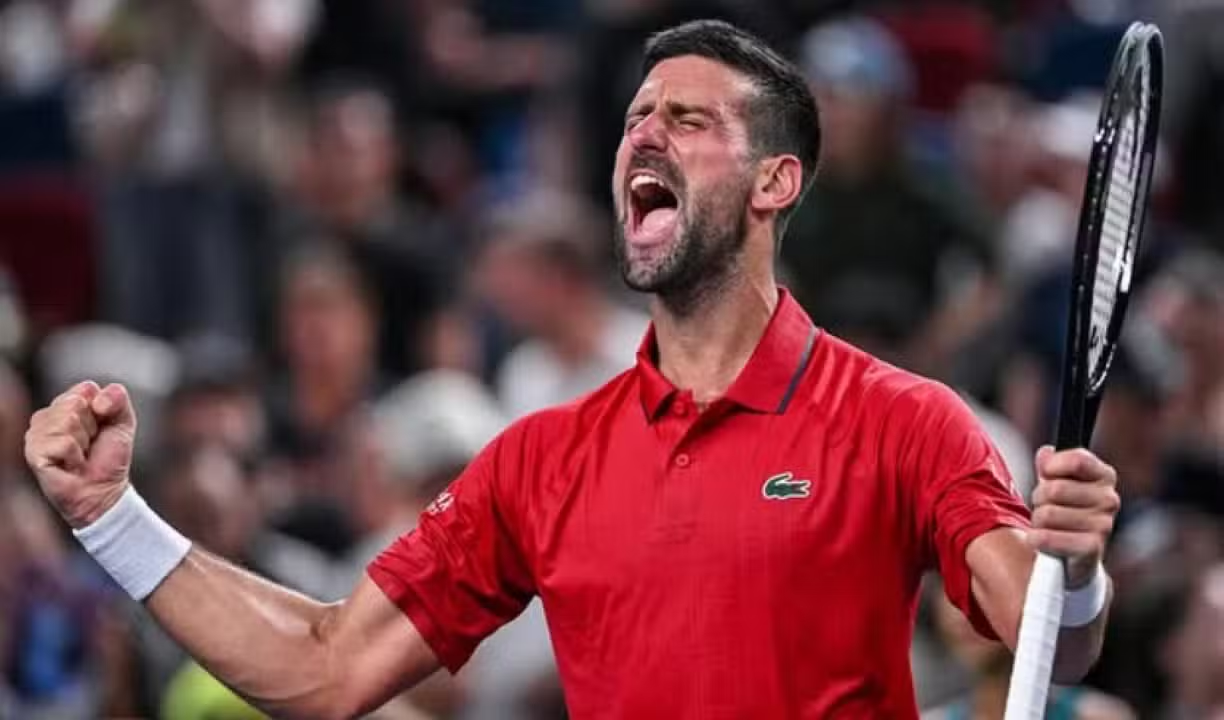
Novak The Serbian tennis player justified the decision with persistent concerns about transparency, governance and the use of his voice and image in the organization.
The statement was made through a post on social media, where Djokovic highlighted that his personal values no longer align with the current direction of the PTPA. Ele expressed pride in the association’s initial vision, but stated that the chapter is closed for him.
Djokovic will focus his efforts on the professional circuit, his family and contributions to tennis that reflect his principles. The decision comes on the eve of Australian Open, the first Grand Slam of the year, scheduled to begin in 12 days on Melbourne.
History of the founding of PTPA
The PTPA emerged in 2020, during the US Open, at a time of player dissatisfaction with representation on the professional circuit. Djokovic and Pospisil led the initiative to create an independent entity, focused on giving a stronger voice to athletes, especially lower-ranked ones.
The association sought greater participation by tennis players in ATP and WTA decisions, as well as better distribution of tournament revenue. At the time, the proposal gained support from several players, but also faced resistance from the sport’s governing bodies.
Since then, the PTPA has positioned itself as an alternative to the ATP’s Conselho, which Djokovic presided over for years before resigning to launch the new group. The entity grew with executive committees made up of active athletes.
Detailed reasons for leaving
Djokovic explicitly mentioned concerns about transparency in PTPA’s internal operations. Ele pointed out that the way his image was used did not correspond to his prior approval on several occasions.
Another central issue involves the organization’s governance, with the Serb indicating misalignment in recent strategic decisions. Ele reinforced that the original vision of independence and empowerment of players remains valid, but the current execution diverges from its principles.

The decision does not directly affect Djokovic’s participation in the ATP circuit, where he continues to compete normally. The tennis player wished the PTPA and the players involved success from now on.
Context of the ongoing legal action
In March 2025, the PTPA initiated proceedings against the ATP, WTA, ITF, ITIA and, later, the four Grand Slams. The central accusation refers to anti-competitive practices and failures to protect the well-being of athletes.
Players argue that only 15% to 20% of tournament revenue goes to prizes, a lower percentage than leagues like the NBA and NFL. Djokovic, at the time, declared that he did not agree with all the points of the action and chose not to appear as a plaintiff.
Recently, the association reported being close to agreement with Tennis Australia for Australian Open. The understanding would avoid conflicts during the tournament that opens the Grand Slams season.
Official PTPA response
The entity released a statement stating that it has always operated with player-led governance. The note highlighted open communication and collaborative decisions as pillars of the organization.
The PTPA reinforced its availability to discuss any issue raised by athletes. The text emphasized that the association was created to guarantee a transparent and independent voice in professional tennis.
Despite the departure of one of the founders, the entity maintains normal operations and focuses on the demands of tennis players. The executive committee continues to be made up of active players on the circuit.
PTPA’s main initial objectives
From the beginning, the association listed clear goals to improve conditions on the circuit:
- Increased prize distribution for lower rankings
- Greater protection for the mental and physical health of athletes
- Direct participation in decisions about tournament calendars and formats
- Independence in relation to traditional bodies such as ATP and WTA
These points gained relevance during the pandemic, when many players faced financial difficulties. The PTPA positioned itself as a defender especially of tennis players outside the top 100.
Over the years, the entity has promoted regular meetings and engagement with members. The model seeks inspiration from unions in other team sports.
Impact on the current tennis scenario
The departure of Djokovic represents a significant change for the PTPA, which loses its most prominent figure. The Serb, holder of 24 Grand Slam titles, was a symbol of the fight for reforms in the sport.
Analysts point out that the association may face challenges in maintaining momentum in the ongoing legal action. On the other hand, the entity reinforces that it continues to represent the collective interests of the players.
The episode highlights persistent tensions in the governance of professional tennis, divided between men’s tours, women’s tours and Grand Slams organizers. Reformas in the calendar and revenue distribution remain under debate.
Future Focus of Djokovic
The Serbian tennis player stated that he will prioritize competitions and preparation for the 2026 season.
Djokovic also highlighted the importance of family in his current routine. The player balances a long career with personal commitments off the court.
Contributions to tennis continue through the academy and individual initiatives. The Serb plans to participate in Australian Open normally, without any impact from the announced decision.
Initial repercussion on the circuit
Players consulted preferred not to comment publicly on the removal. Fontes nearby indicate that the topic is circulating behind the scenes before the start of the Australian season.
Tournament organizers monitor developments, especially with the recent agreement involving Australian Open. The ATP and WTA have not issued official scores to date.
The tennis community awaits possible positions from other PTPA members. The episode reinforces debates about representation and unity in individual sport.