The Japanese company Disco participated in SEMICON Japan 2025, held between December 17 and 19, 2025 at Tokyo Big Sight, in Tóquio. The company displayed around 20 semiconductor manufacturing equipment, attracting a large number of visitors to its stand.
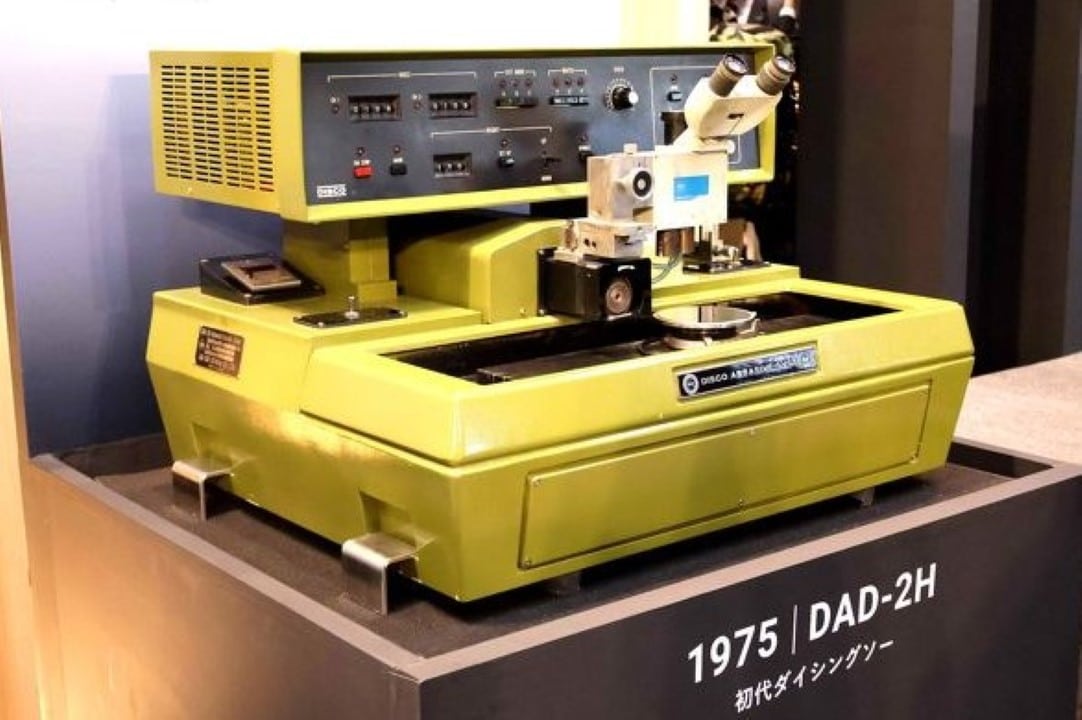
The event highlighted the milestone of 50 years since the launch of the first Disco dicing saw in 1975. The pioneering model DAD-2H was presented to the public, contrasting with today’s high automation machines.
Disco specializes in “Kiru, Kezuru, Migaku” technologies, which means cutting, sharpening and polishing. Essas competencies form the basis of its products, such as dicing saws and grinders used in the production of semiconductor wafers.
Origins of innovation in wafer cutting
Disco started as a manufacturer of abrasive wheels. In 1968, he developed the ultra-thin wheel Micron Cut, with a thickness of 40 micrometers, but faced problems as there was no equipment capable of using it without breakages.
To solve this, the company decided to create its own cutting device. The result was the DAD-2H, launched in 1975, which allowed full use of the thin wheel and received great reception on the international market.
The initial model mainly processed discrete devices and chips for calculators and watches. Ele worked with 4-inch wafers and required manual operations for alignment, wafer supply, and blade changing.
Comparative display at the event
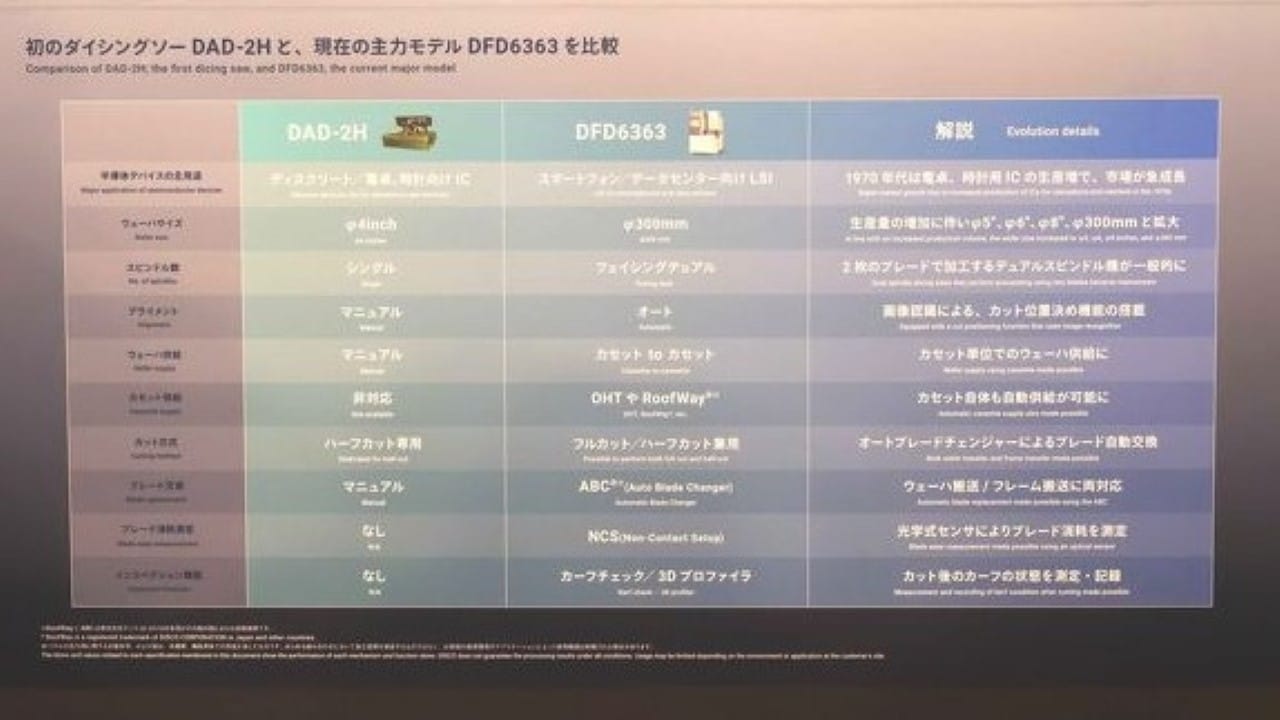
At the SEMICON Japan 2025 booth, Disco positioned the DAD-2H alongside current models. Essa comparison highlighted advancements such as full automation and support for larger wafers, up to 300mm or larger.
Visitors were able to observe differences in accuracy and productivity. Modern machines incorporate lasers and advanced control systems, reducing processing time and material waste.
- Wafer size: 4 inches on DAD-2H versus 300 mm on recent models
- Operations: mostly manual versus fully automatic
- Early applications: ICs for simple electronics versus advanced chips for AI and mobile devices
- Cutting precision: limited by technology at the time versus submicrometer today
Technological evolution over five decades
The trajectory of Disco reflects the growth of the semiconductor industry. Do Manual processing of small wafers for calculators in the 1970s moved to mass production of complex chips used in smartphones and high-performance computing.
The company maintained leadership by continually investing in research. Novos models incorporate technologies such as laser cutting and dry polishing, meeting demands for thinner and more efficient wafers.
This evolution allowed Disco to gain a significant share in the global market. Seus equipment is adopted by device manufacturers and foundries in several countries.
Recent advances presented at the fair
Disco announced the DFD6080, automatic dicing saw for packages up to 400 x 400 mm. Esse equipment supports panel level packaging, a growing trend towards greater productivity in fan-out wafer level packaging.
Other products on display included cutting blades optimized for difficult materials. Essas innovations aim to improve yield and reduce costs in the production of advanced semiconductors.
Participation in SEMICON Japan reinforced the company’s commitment to solutions for current challenges. The focus remains on precision and efficiency to support increased demand for chips.
Legacy and perspectives of the pioneer
The DAD-2H represented the beginning of a line that transformed semiconductor manufacturing. Sua exhibition in 2025 celebrated not only the history of Disco, but Japanese industry’s collective progress in the sector.
The company continues to develop tools that keep up with the miniaturization and complexity of chips. Isso includes support for materials such as silicon carbide for high power applications.
Industry professionals recognized the importance of this milestone during the event. The combination of tradition and innovation positions Disco for future advancements in cutting and polishing technologies.
Technical comparison between generations
The DAD-2H’s specifications contrast sharply with current equipment. Modern Modelos offer higher speeds, lower kerf loss and integration with computer vision systems.
This progression reduced defects and increased throughput on production lines. Automation has eliminated human variation, improving consistency across large volumes.
- Alignment: manual with microscope versus automatic with high-resolution cameras
- Blade change: manual operation versus integrated robotics
- Maximum wafer size: 4-5 inches versus 12 inches or larger panels
- Productivity: limited to a few wafers per hour versus hundreds in full auto systems
The exhibition attracted engineers and executives interested in technological history. Muitos highlighted how Disco’s pioneering spirit has influenced global accuracy standards.
