

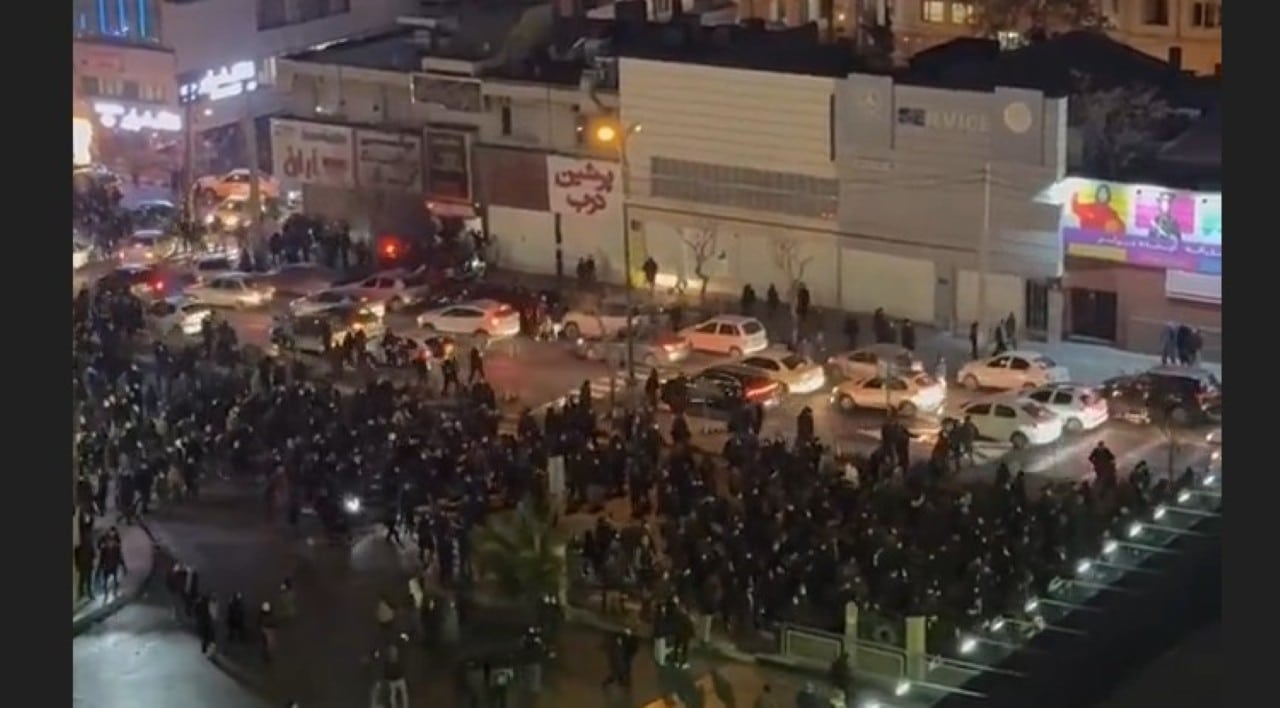
The Irã is facing one of its biggest waves of social instability in recent years, with popular demonstrations spreading to more than 100 cities in all 31 provinces of the country. In response to the escalation of acts, which have completed 12 consecutive days, the government implemented an almost total internet blackout, isolating the population and making internal and external communication difficult. The protests, which began with economic issues, evolved into a movement with strong political criticism of the regime, resulting in violent clashes with security forces.
The crisis began on December 28, 2025, caused by the severe devaluation of the local currency, the rial, and galloping inflation that affects the population’s purchasing power. The trigger was a strike by traders in Grande Bazar of Teerã, which quickly gained support in other parts of the country. The situation has attracted international attention, with the former president of the Estados Unidos, Donald Trump, threatening a forceful response if the repression against civilians intensifies.
The interruption of internet access was confirmed by digital monitoring organizations, which recorded a drop of more than 90% in data traffic from 8pm local time. The measure affected both mobile and fixed networks, in a clear attempt to disrupt the organization of new demonstrations and control the flow of information about the repression, which has already left dozens dead and thousands detained.

The economic crisis as a trigger for demonstrations
The Iranian economy has been severely impacted by the reimposition of international sanctions related to its nuclear program, which has accelerated the devaluation of the rial to record levels. Essa situation led to an inflationary spiral, making basic consumer goods, such as food and fuel, inaccessible to a large part of the population. The loss of purchasing power and economic uncertainty were the main catalysts for the start of the protests, which began on a sectoral basis and quickly became widespread. The closure of bazaars in strategic cities such as Teerã, Tabriz,
The dissatisfaction, initially concentrated among traders and self-employed workers, found an echo in other layers of society. Greves in traditional markets spread to other sectors, such as transport and services, partially paralyzing economic activity in several regions. Protesters began to express frustration not only with the situation, but with the government’s management of the economy, which is facing a predicted recession. The agendas, previously restricted to financial issues, expanded to include direct criticism of the country’s political leadership, reflecting a deeper and more structural discontent that was latent.
National expansion of acts and repression
What began as a series of localized acts quickly turned into a nationwide movement, reaching at least 111 cities, from large metropolises to rural areas, demonstrating the widespread nature of dissatisfaction. Em Mashhad, the hometown of supreme leader Ali Khamenei, thousands of people took to the central streets, a gesture of significant defiance. Em Teerã, the protests spread across several neighborhoods, with a strong turnout from drivers who continuously honked their horns in support of the protesters. The mobilization also reached the academic environment, with students from 36 universities organizing actions and chanting slogans against the political system. The authorities’ response was tough and coordinated. Forças security forces were mobilized on a large scale to disperse the crowds, using tear gas and, in several documented cases, live ammunition. Organizações human rights bodies monitoring the situation report a death toll of at least 45 since the start of the protests, including eight minors, with January 7th being the deadliest, with 13 fatalities. Além In addition, more than two thousand people were arrested in different provinces, and there are reports of hospitals being invaded by agents to detain injured protesters, a serious violation of international norms.
Digital blackout as a control tool
The decision to cut internet access across the country is a strategy already used by the Iranian government in times of crisis to silence dissent. The measure mainly aims to prevent protesters from coordinating through messaging applications and social networks, in addition to blocking the dissemination of images and videos of the repression to the rest of the world.
The shutdown was abrupt and comprehensive, affecting the main telephone operators and internet providers. Essa digital isolation tactic turns the country into a “black box”, where verifying information on human rights violations becomes extremely difficult for the press and international organizations, increasing the vulnerability of the civilian population.
Reactions from the government and the international community
Faced with the escalation of violence, President Masoud Pezeshkian made a public appeal for security forces to act with “maximum moderation”. In his statements, he recognized the economic difficulties faced by the population and promised to open channels of dialogue to hear their demands.
This stance, however, contrasts with the containment operations that continue to be active in the field. Autoridades of the regime have sought to differentiate what they consider “legitimate protests” from “actions that threaten public order”, a rhetoric that justifies repression against groups considered more radical.
In the external scenario, the declaration of Donald Trump had strong repercussions. The former American president stated that the Estados Unidos would respond with force if the Iranian government moved forward in the “lethal suppression of civilians”, raising geopolitical tension. Autoridades Iranian women classified the speech as unacceptable interference in internal affairs.
Diverse profile of protesters
The current wave of protests stands out for the diversity of its participants. Comerciantes, who started the movement, kept their stores closed in around 50 cities, demonstrating continued economic resilience.
University students brought a more politicized dimension to the acts, organizing demonstrations on campuses and raising issues linked to freedom of expression and civil rights.
Drivers and informal workers also gathered in large numbers, expressing the difficulties they face on a daily basis in ensuring the livelihood of their families.
Female participation has been notable in several cities, continuing the leading role that Iranian women have taken on in recent mobilizations for greater rights and freedom.
Balance of victims and arrests
Independent organizations, such as the Norwegian Iran Human Rights, closely monitor the number of victims. The updated balance points to 45 civilian deaths, but the number could be higher due to communication difficulties imposed by the internet blackout.
Hundreds of people were injured in the clashes, overwhelming local health systems. The more than two thousand arrests include activists, journalists and ordinary citizens, generating great concern among human rights groups about the treatment of prisoners.
Uncertainty scenario
Despite the strong repression apparatus and digital isolation, calls for new acts continue to circulate through alternative means. The situation remains tense and unpredictable, with security forces maintaining an overt presence in strategic points in the main cities, while the population resists in the midst of an unprecedented economic and political crisis.