

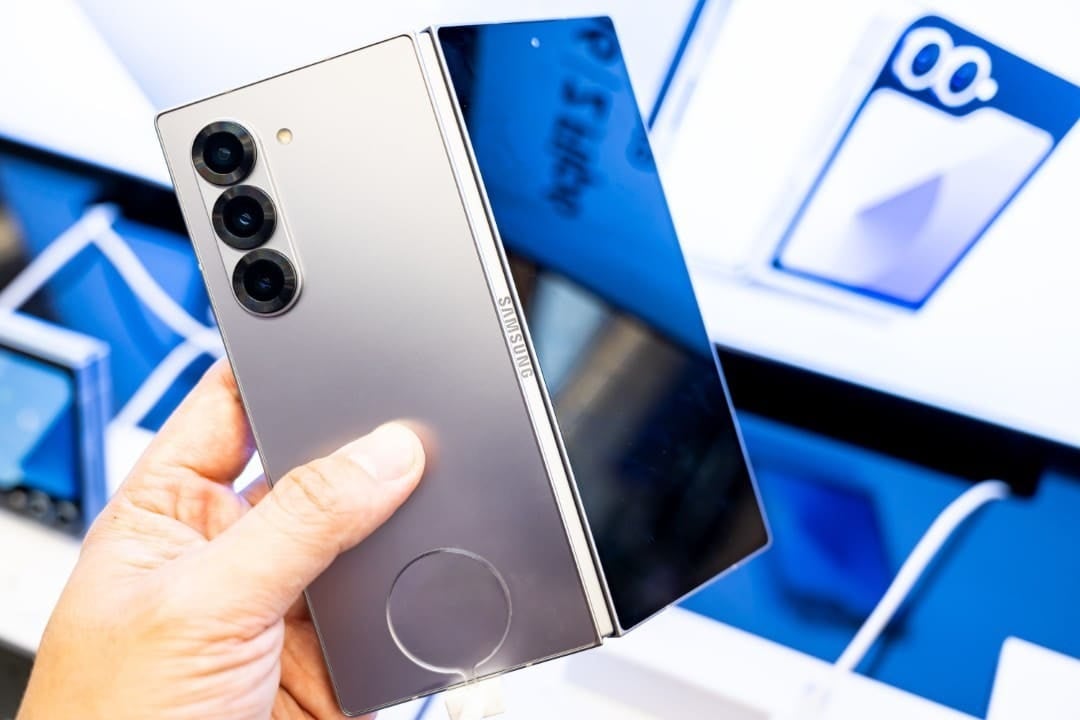
Global technology leader Samsung is signaling new directions for the design of its foldable smartphones, as revealed by a patent disclosed by Organização Mundial of Propriedade Intelectual (WIPO). The document details an innovative flip cell phone concept, which is distinguished by a reversible mechanism and the integration of screens on the front and back when the device is unfolded, promising an unprecedented user experience. The Este concept differs significantly from the current Galaxy Z Flip, which typically have a main screen and a rear panel with a smaller secondary display, indicating a quest for greater functionality and versatility in future releases.
The patented design eliminates the rigid distinction between “back” and “front” when unfolding the device, as the hinge is designed to allow bending in both directions. Esta core feature opens doors to more dynamic interactions and an expanded range of functionalities.
The technical drawings presented in the patent also illustrate a circular cut on one of the surfaces, which may indicate a photographic sensor or other functional component. The sides of the device have a uniform thickness, with contours that suggest the presence of buttons integrated into the body.
- Samsung patent at WIPO exposes innovative foldable design.
- Flip phone with dual screens and reversible folding mechanism.
- Search for greater versatility and new interactions for users.
Rethinking the visual experience with two screens

The main innovation incorporated in this recent patent from Samsung lies in the bold implementation of screens on both surfaces of a foldable device in flip format, an approach that subverts the predominant architecture in the current market. Enquanto existing models prioritize an expansive internal screen, this new concept explores the integrated use of both panels, with a small external display for quick information. Tal configuration has the potential to optimize usability in a multitude of scenarios, allowing for dual interactions or the fluid extension of content.
The reversible hinge mechanism
A distinctive technical element of the new design is the hinge’s ability to operate bidirectionally, giving the device a level of flexibility previously unseen in flip smartphones. Essa functionality expands usage configuration possibilities.
The engineering behind this hinge not only adds versatility, but also poses significant challenges related to component durability and protection of flexible displays. Advancements in materials and bending mechanisms are crucial to the success of innovation.
The versatility of the single camera
The patent also contemplates a possible singular camera system, strategically positioned in a circular cut visible on one of the device’s surfaces. Esta Potential integration would simplify the hardware and provide an exceptionally adaptable photography experience.
Given the double-sided folding functionality, the same camera unit could be used with equal effectiveness for both capturing high-quality selfies and conventional photographs, taking advantage of the full extent of the screen for viewing. Esta solution would optimize internal space.
Innovation challenges in the market
Although the Samsung patent reveals a visionary design with disruptive potential, its materialization into a commercial product faces obstacles. Ensuring the durability of flexible displays and the robustness of the folding mechanism remain primary concerns for consumer acceptance.
Additionally, the inherent manufacturing complexity and costs associated with mass producing a device with dual screens and reversible folding capabilities could increase the final price. Samsung will need to balance cutting-edge technology with the economic sustainability of the project.
The scenario of foldable smartphones is still in a maturing stage, and the assimilation of such bold designs will fundamentally depend on users’ perception of functionality and practicality. The patent, for now, represents an investigation of possibilities.
The constant evolution of devices
Samsung has solidified its position as a pioneer in foldable display technology by consistently introducing new generations of its acclaimed Galaxy Z Fold and Galaxy Z Flip. Cada iteration demonstrates notable progress in terms of durability, performance and software optimization.
This dedication to innovation is a pillar of the company’s strategy, which continually invests in research and development to refine the user experience. Patentes like the one being analyzed are testaments to this unwavering commitment to exploring new smartphone formats.
Industry moves are already pointing to the future, with internal testing of the Android 17 underway for the Exynos 2600 platform.
Recent certifications have already confirmed the existence and development of the models Galaxy Z Fold 8 and Z Flip 8, suggesting a constant expansion of the line of flexible devices. Enquanto this, more experimental designs, like the one in the patent, can serve as inspiration for future innovations.
Design protection and experimentation
The practice of registering patents is a standard procedure for large technology corporations, aiming to protect their inventions and research projects. It is common that many of the concepts detailed in these documents never materialize into commercially launched products, acting mainly as a legal protection against copying ideas.
Thus, the patent in question can be interpreted as a window into the Samsung innovation laboratory, revealing the creative thinking and advanced engineering that guide its development. Ela sinaliza um esforço contínuo para antecipar o próximo grande avanço tecnológico, mesmo que o design específico não chegue ao mercado em sua forma atual.
Projections for future smartphones
The existence of a patent like this, detailing a Galaxy Z Flip with screens on both sides and a fully reversible hinge, projects a future where flexible smartphones offer greater versatility and functionality, integrating design and usability in ways that today are still just conceptual ideas in development.