

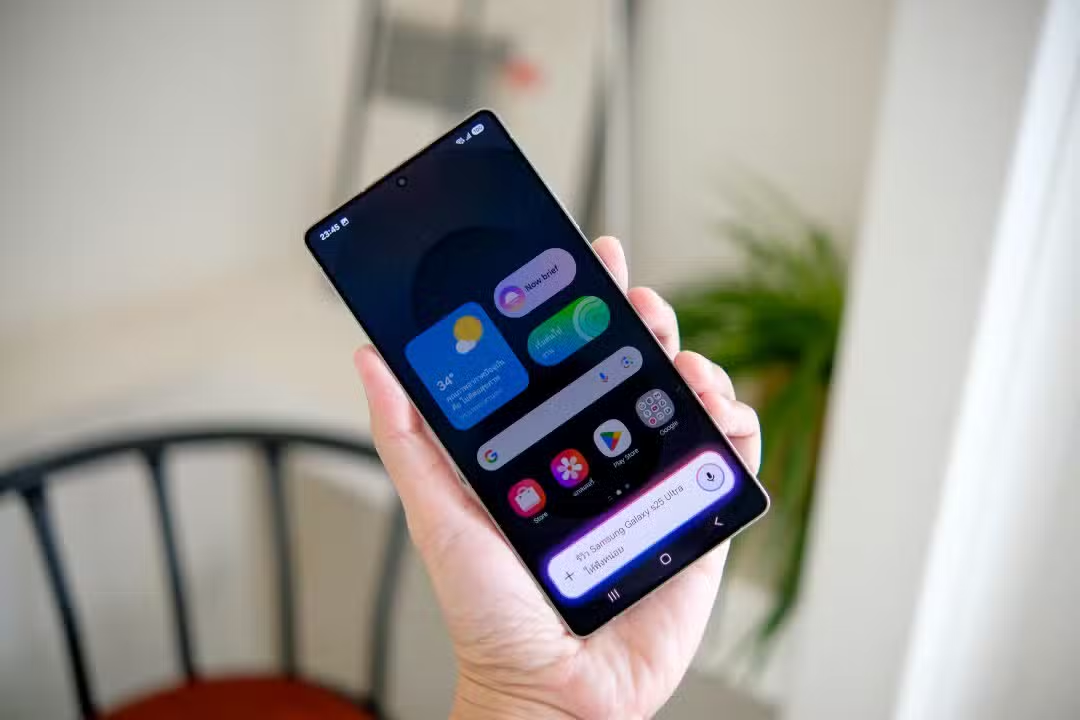
Samsung reinforced its approach to privacy in artificial intelligence during CES 2026, at Las Vegas, by highlighting options that allow Android users to decide where their personal data is processed. The company has positioned the concept of “trust-by-design” as central to its AI systems, emphasizing the need for predictable, transparent and easy-to-control platforms. Essa statement comes in the context of a recent controversy surrounding Gmail, when initial reports suggested misuse of email data to train AI models, generating confusion among millions of Android users. Samsung argues that consumers need to know whether processing occurs locally on the device or in the cloud.
The company remained focused on offering flexibility without compromising data protection. Executivos reinforced that trust in AI must be built with concrete actions, such as proven security and clear visibility for the user.
Hybrid approach gains prominence
Samsung has been promoting the hybrid AI model for years, which combines on-device processing with cloud resources. Esse method allows personal data to remain local whenever possible.
Cloud intelligence is only used selectively, when greater speed or scale is necessary. Usuários gain options to balance performance and privacy.
This strategy initially differentiates Samsung from more cloud-dependent approaches, although Google has also recently adopted hybrid elements. Combining Gemini with Google on Galaxy devices maintains integration but prioritizes user control.
Knox reinforces security at multiple levels
The Knox platform, from Samsung, serves as a layered security foundation from the chipset down. Ela protects sensitive data across the entire device ecosystem.
Devices authenticate each other through Knox Matrix, creating a resilient environment. Essa protection extends beyond your phone to connected TVs and appliances.
The approach ensures that trust does not depend solely on promises, but on mechanisms proven over more than a decade.
Users seek transparency in data processing
Consumers are showing increasing interest in understanding where and how their data is processed by AI systems. Samsung highlights that users want to lead their own personalized experiences.
They want to identify whether a model runs locally or in the cloud, as well as verify data security. Essa visibility directly contributes to building trust.
Panels of global experts at CES 2026 discussed how predictability and easy control power the adoption of AI technologies.
Expansion of Galaxy AI advances with focus on privacy
Samsung plans to significantly expand the reach of Galaxy AI. The target involves devices equipped with features powered by Gemini.
The number of devices with Galaxy AI is expected to double by 2026, reaching around 800 million units. Essa expansion occurs with an emphasis on maintaining privacy as a priority.
The company applies AI to all products, functions and services in an accelerated manner, always respecting the user’s choices.
Reaction to controversy drives message of control
The recent discussion about Gmail accelerated the positioning of Samsung. Initial Relatos data collection for AI training raised concerns, but clarifications indicated that the content of Gmail is not used to train Gemini.
The confusion highlighted the importance of transparency and clear options. Samsung takes advantage of the moment to reinforce that the user must decide the fate of their data.
The hybrid approach offers practical alternatives against a backdrop of increasing scrutiny over privacy in AI services.