

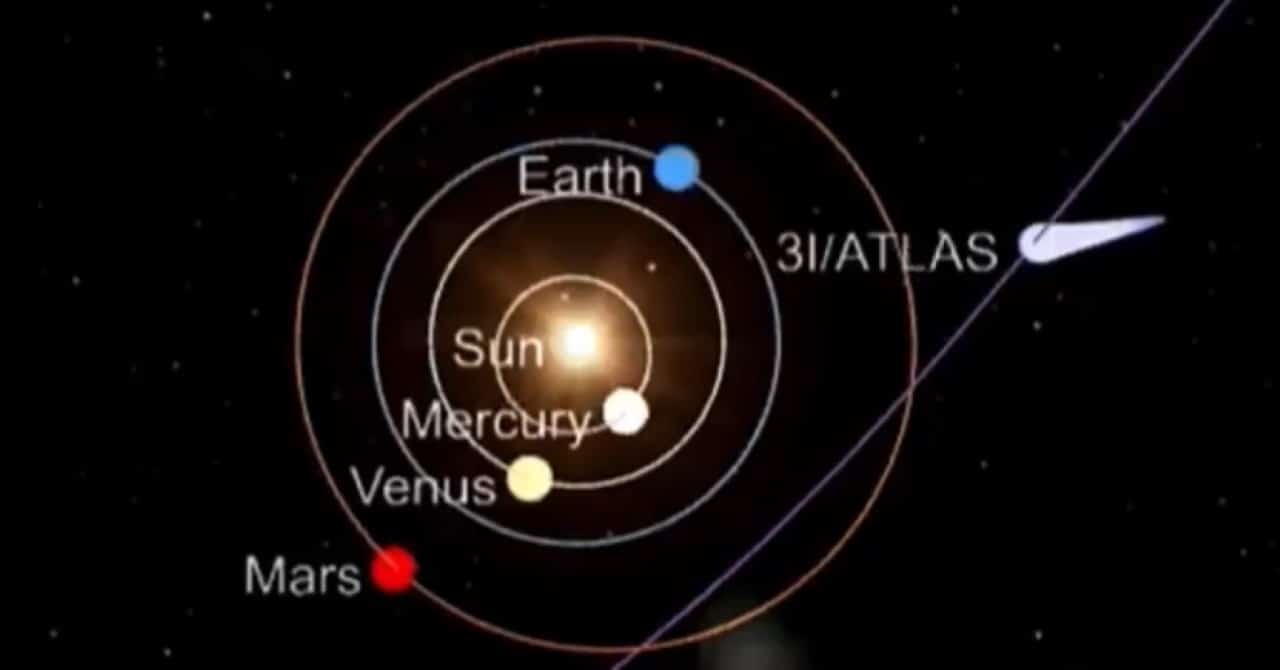
The interstellar comet 3I/Atlas reached its closest approach to Terra this Friday (19), at around 270 million kilometers, allowing detailed observations by advanced telescopes without posing any risk of collision. Descoberto on July 1, 2025 by the ATLAS system in Chile, the object confirms its origin outside of Sistema Solar due to the hyperbolic trajectory and high speed, exceeding 220 thousand km/h at the beginning of the passage. Astrônomos have been following the comet since July, with images from the Hubble telescope revealing a coma and tail formed by ice sublimation as it approaches Sol. Esse third known interstellar visitor offers valuable data on the formation of distant planetary systems.

Unique characteristics of the interstellar comet
3I/Atlas has a different chemical composition, with an excess of nickel compared to local comets and a possible age of up to three billion years older than our Sistema Solar. Observações indicate a core with an estimated diameter of between 600 and 800 meters, although initial measurements indicated a greater variation due to the gas and dust cloud. Activity increased close to perihelion, which occurred on October 29, 2025, approximately 210 million kilometers from Sol, generating an extensive coma and visible tail.
Recent observations and scientific advances
Ground- and space-based telescopes, including Hubble and instruments on Chile, captured details during closest approach, facilitating spectroscopic analysis. Astrônomos Spaniards detected periodic jet on the comet from Observatório of Teide, revealing information about its rotation and unusual behavior. Esses data helps understand planetary formation processes in other stellar systems, preserved in icy materials that have not undergone intense heating.
Tail behavior and refutation of speculation
The comet exhibited release of gases and dust in different directions, including a plume facing Sol in the early stages, a phenomenon also observed in comets from Sistema Solar. Representantes of Nasa stated in November 2025 that all evidence points to a natural comet, ruling out hypotheses of artificial origin. The hyperbolic trajectory guarantees that the object will never return to Sistema Solar, being ejected after passing close to Júpiter in 2026.
Importance for the study of interstellar objects
Comets like 3I/Atlas preserve primordial material from peripheral regions of planetary systems, allowing comparisons with the formation of our own system. The presence of organic material and ice suggests a possible contribution to the origins of water and prebiotic compounds on planets. The discovery reinforces expectations of more interstellar objects detected with modern telescopes and efficient data processing.
Current ticket details
The distance of 270 million kilometers is equivalent to almost twice the Terra-Sun separation, which makes observation with the naked eye impossible and requires professional or medium-sized amateur equipment. Recent Registros show the brightest and most active post-perihelion comet, with a developed tail and broad coma. The event marks a unique opportunity for precise measurements before definitive removal.
Future research perspectives
Analysis of data collected during the approach can take months or years to fully interpret. Próximos studies will focus on detailed chemical composition and comparison with previous interstellar visitors, ‘Oumuamua and Borisov. The passage of 3I/Atlas highlights advances in the detection and monitoring of cosmic objects coming from other stars.



