

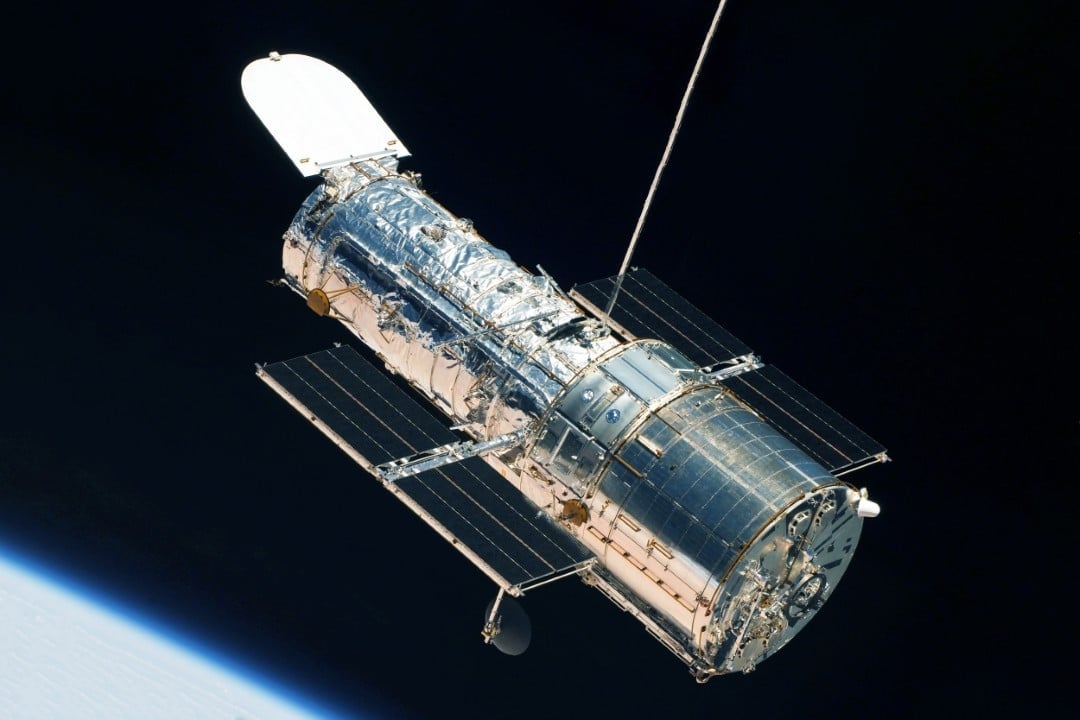
An international team of astronomers used the Hubble space telescope to confirm the existence of a new astronomical object, named Cloud-9. Trata is a cloud rich in neutral hydrogen gas, without any stars, dominated by dark matter and located approximately 14 million light years from Terra.
The discovery initially occurred through radio wave observations and was definitively confirmed with optical images of Hubble. Esse object represents a relic of the early stages of galaxy formation in the early universe.
Cloud-9 is in the vicinity of the spiral galaxy Messier 94, also known as M94. The researchers identified the cloud as part of a theoretical class predicted for years but never directly observed until now.
Main features of the Cloud-9
Cloud-9 has a diffuse structure composed mainly of neutral hydrogen. Radio Dados indicates the presence of a mass equivalent to millions of solar masses in gas, with no evidence of star formation.
Combined observations reveal that the cloud maintains its integrity thanks to a halo of dark matter that prevents complete gravitational collapse. Essa configuration explains the total absence of stars in its interior.
- Complete absence of stars confirmed by Hubble
- Estimated hydrogen mass exceeding one million solar masses
- Dark matter dominance as a stabilizing factor
- Emission detected mainly in radio waves
Initial detection process
Researchers first detected Cloud-9 with the Chinese FAST telescope, the world’s largest single-dish radio telescope. Complementary Observações occurred with Green Bank Telescope and Very Large Array, both in Estados Unidos.
These instruments identified a diffuse radio emission, marked in images as a magenta region around the signal peak. The dashed circle in the composites highlights the area of greatest intensity, where the subsequent search for stars was concentrated.
Combining radio data made it possible to map the extent of the cloud before optical intervention. The initial Essa step provided precise coordinates to direct the Hubble to the exact region.
Optical confirmation by Hubble
The Hubble telescope employed its Advanced Camera for Surveys to examine the central region of Cloud-9. The images revealed only background galaxies within the cloud’s boundaries, without any bright spots indicative of stars.
This definitive absence eliminated previous hypotheses that the object could be a distant dwarf galaxy with faint stars. The sensitivity of Hubble overcame limitations of ground-based telescopes and confirmed the starless nature of the structure.
Researchers processed the images using specific filters, assigning colors such as cyan and orange to highlight optical details. Overlay with radio data produced composites that highlight the cloud’s exact location in the sky.
Classification as RELHIC
Astronomers classify Cloud-9 as an Reionization-Limited HI Cloud, or RELHIC. Esse type of object consists of clouds of neutral hydrogen bound by the reionization of the early universe.
Reionization marked the period when the first stars ionized ambient neutral hydrogen. Nuvens like Cloud-9 survived without collapsing sufficiently to form stars due to the critical mass of their dark matter halos.
The discovery validates theoretical models that predict the existence of small structures dominated by dark matter. Esses models suggest that such objects represent primitive building blocks that did not evolve into full galaxies.
Association with Messier 94
Cloud-9 is positioned in the outer vicinity of the galaxy Messier 94, a spiral located in the Canes Venatici cluster. Essa proximity suggests that the cloud may be a remnant ejected or unincorporated during the formation of the host galaxy.
Messier 94 has its own characteristics, such as an intense star formation ring. The presence of Cloud-9 reinforces the idea that galaxy halos harbor invisible substructures composed mainly of dark matter and primordial gas.
The distance of 14 million light years places both objects in a region observable with current instruments. Essa accessibility has facilitated the combination of data from multiple telescopes to study the potential interaction between the cloud and the galaxy.
Cloud composition and stability
The stability of Cloud-9 depends on the balance between the gravity of dark matter and the pressure of the internal gas. Sem stars, there is no energetic feedback that significantly disperses or heats the material.
Neutral hydrogen emits at 21 centimeters, a characteristic line captured by radio telescopes. Essa emission made it possible to estimate the density and average temperature of the cloud, compatible with conditions in the early universe.
The absence of heavy metals suggests minimal contamination from previous generations of stars. Essa chemical purity makes Cloud-9 a natural laboratory for studying primordial compositions.
Instruments involved in the research
Several telescopes contributed to the complete study of Cloud-9. FAST has begun systematic survey detection of extragalactic neutral hydrogen.
- Five-hundred-meter Aperture Spherical Telescope (FAST) – initial radio detection
- Green Bank Telescope – additional issuance confirmation
- Very Large Array (VLA) – detailed mapping of the diffuse structure
- Hubble Space Telescope – optical verification and star exclusion
This multinational collaboration demonstrates the need for multiwavelength approaches in modern astronomy. Cada instrument provided essential parts to assemble the complete profile of the object.
Composite image details
Released images combine optical data from the Hubble with radio from the VLA. The magenta color represents radio emission, highlighting the diffuse extent of the cloud.
The dashed circle marks the emission peak, an area prioritized in the Hubble observations. Pontos apparent within the region correspond exclusively to distant background galaxies.
The composition includes a compass and scale to guide observers. Esses elements make it easier to understand the relative position of Cloud-9 in the broader celestial context.
Cloud-9 occupies a unique position at the upper limit of the allowable mass for haloes that trap gas without forming stars. Essa characteristic makes it visible in radio, unlike smaller halos that lose their hydrogen.
Researchers estimate that similar objects exist in greater numbers, but remain undetected due to low luminosity. Surveys futures with more sensitive telescopes should reveal additional populations.
The confirmation of Cloud-9 paves the way for detailed studies of the intrinsic properties of dark matter halos. Medições accurate mass and distribution provide valuable observational constraints for cosmological models.
Observations at different wavelengths
The multiwavelength approach revealed complementary aspects of Cloud-9. Radio Ondas mapped the cold gas, while visible light excluded light sources.
The absence of infrared emission reinforces the lack of recent stellar activity. Dados in ultraviolet also does not indicate significant ionization within the cloud.
This consistency between bands confirms the relict character of the object. The integration of information from varied spectra solidifies the interpretation as a preserved primordial structure.