
Comet 3I/ATLAS, the third confirmed visitor from another star system, continues to fascinate scientists with its peculiar behavior. Após reaches its closest approach to Sol in October 2025, data collected by Nasa and partner observatories revealed that the object is experiencing non-gravitational acceleration. The Este phenomenon, although common in comets in our own system, offers a rare window into the composition of celestial bodies formed around other stars.
Discovered in July 2025, the comet follows a hyperbolic trajectory, a clear signature of its interstellar origin, which will take it far from our Sol, back into the vast space between the stars. The speed of 3I/ATLAS already exceeds 200,000 kilometers per hour, and the additional acceleration, driven by the ejection of gases and dust from its surface, is being meticulously measured to decipher the secrets of its composition.
Continued observations are crucial as the comet serves as a natural probe of its home star system. Detailed analysis of its behavior and the materials it releases provides valuable clues about the chemical and physical conditions of distant regions of Via Láctea, helping astronomers piece together the puzzle of planet formation on a galactic scale.
Discovery and confirmation of origin
The identification of 3I/ATLAS occurred on July 1, 2025, through the ATLAS astronomical survey system (Asteroid Terrestrial-impact Last Alert System), a project financed by The object’s trajectory, calculated shortly after discovery, turned out to be unambiguously hyperbolic, indicating that it was not gravitationally bound to our Sol and was therefore an interstellar visitor.
Since the first observations, the comet has exhibited a diffuse coma and signs of activity, even when it was still a considerable distance from Sol. Sua’s approach to the planet
Analysis of cometary activity
Since the start of its monitoring, 3I/ATLAS has demonstrated robust cometary activity, with a clearly visible coma and tail. Spectroscopic analysis revealed a complex chemical composition, including the presence of carbon dioxide, carbon monoxide and water vapor, volatile elements that sublime as the comet heats up by solar radiation.
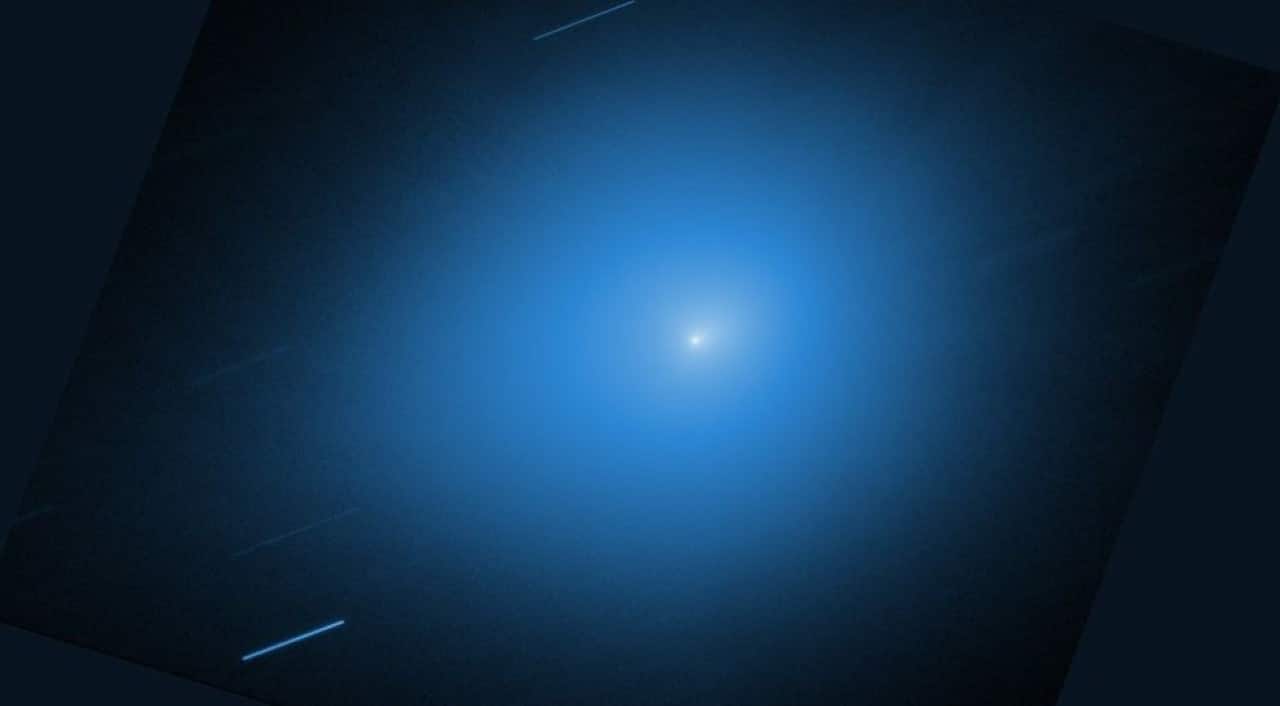
Telescópio Espacial Hubble was instrumental in recording the object’s morphology, capturing images of a teardrop-shaped dust envelope surrounding the nucleus. The comet’s activity notably intensified near its perihelion, the closest passage of Sol, which occurred on October 30, 2025, at a distance of approximately 1.4 astronomical units.
Other important discoveries came from specialized observatories. Análises spectroscopic tests confirmed the presence of cyanide and even atomic nickel in its coma, elements that help to trace a detailed chemical profile. Observatórios ultraviolet light, in turn, was able to detect the presence of water vapor and hydroxyl, while the coma displayed a distinct reddish color, a strong indication of the presence of dust rich in organic compounds.
Although many of these elements are found in native Sistema Solar comets, the relative proportions observed in 3I/ATLAS are unique. Essas subtle differences suggest that the comet formed in a stellar environment with conditions and composition different from those that prevailed during the formation of our own planetary system, making it an invaluable natural laboratory.
The phenomenon of non-gravitational acceleration
Precise analysis of 3I/ATLAS’s trajectory revealed a subtle but significant deviation from the path that would be expected if only the gravitational forces of Sol and the planets were acting on it. Essa additional acceleration is attributed to a recoil effect, generated by the asymmetric sublimation of ices on the surface of its core. As the side of the comet facing Sol heats, jets of gas and dust are expelled, functioning as tiny thrusters that gently change its speed and direction. Este phenomenon is direct proof that the comet is an active and dynamic body. Quantifying this effect was possible thanks to the combination of data from multiple instruments, including the Telescópio Espacial Hubble, the Psyche probe and several Mars orbiters, which provided high-precision astrometric measurements. The values obtained are consistent with outgassing models applied to active comets, contrasting sharply with the case of the first interstellar visitor, ‘Oumuamua, which also exhibited non-gravitational acceleration but without any visible coma or tail, generating intense debate about its nature. In the case of 3I/ATLAS, the unequivocal presence of cometary activity confirms the natural origin of the impulse.
An unprecedented observation campaign
The passage of 3I/ATLAS mobilized an international collaboration coordinated by Nasa, involving a fleet of space missions and ground-based observatories. Telescópio Espacial Hubble played a central role, carrying out observations in July, November and December 2025, whose high-resolution images allowed us to refine estimates of the size of the nucleus, which is believed to be between 440 meters and 5.6 kilometers in diameter.
Missions that traveled through different parts of Sistema Solar, such as Psyche (en route to the asteroid belt) and Lucy (exploring the Trojan asteroids of Júpiter), also pointed their instruments at the comet. Essa multi-viewpoint approach allowed capturing the object from unique angles, providing a more three-dimensional view of its structure and behavior.
Furthermore, solar observatories such as SOHO and STEREO recorded the comet as it crossed different heliocentric regions. The combined data made it possible to map an extensive ionic tail, visibly deflected by the influence of the solar wind, and to detect a vast hydrogen halo around the coma using ultraviolet spectroscopy, maximizing the collection of information before its definitive departure.
Clues about other star systems
The chemical composition of 3I/ATLAS offers a glimpse into the conditions of its birthplace. Analysis of his coma revealed a notable enrichment in highly volatile elements, such as carbon dioxide (CO2) and carbon monoxide (CO), in relation to the amount of water. The Essa feature suggests that the comet formed in a very cold region of its original star system, possibly further from its parent star than comets from our Cinturão and Kuiper formed from Sol. The presence of nickel and iron, in turn, points to long exposure to cosmic radiation during its millennial journey through interstellar space.
Each interstellar visitor functions as a time capsule, carrying direct information about the “recipe” for planet formation in other corners of the galaxy. By comparing data from 3I/ATLAS with that from the previous interstellar comet, 2I/Borisov, scientists noticed both similarities and striking differences in gaseous proportions. Essa diversity indicates that the composition of planetary building blocks can vary significantly from one star system to another, a crucial factor in understanding the prevalence of habitable worlds in Via Láctea.
Visibility and ground tracking
After a period in which it was very close to Sol in the sky, making its observation difficult, 3I/ATLAS once again became the target of ground-based telescopes at the end of 2025. Imagens captured in December revealed a well-developed conventional tail, with some estimates pointing to an extension exceeding 50 thousand kilometers.
For amateur astronomers, the comet has become a visible object in the pre-dawn sky with the aid of medium-sized telescopes, located in the constellation Leão. Seu moderate brightness allowed it to be followed by a wide network of observers, whose data contributes to astrometric campaigns that continually refine the calculation of its orbit.
Final journey into deep space
After its closest approach to Terra on December 19, 2025, at a safe distance of 270 million kilometers, 3I/ATLAS continued its outbound journey. Sua trajectory will take it to a distant encounter with Júpiter in March 2026, where the gas giant’s immense gravity will alter its course slightly, but not enough to capture it in a solar orbit. The object is destined to return to interstellar space, where it will travel for millions of years until, perhaps, it encounters another star system. Monitoring will continue as long as its most sensitive instruments can detect it, extracting every last bit of information possible from this rare cosmic visitor.
