
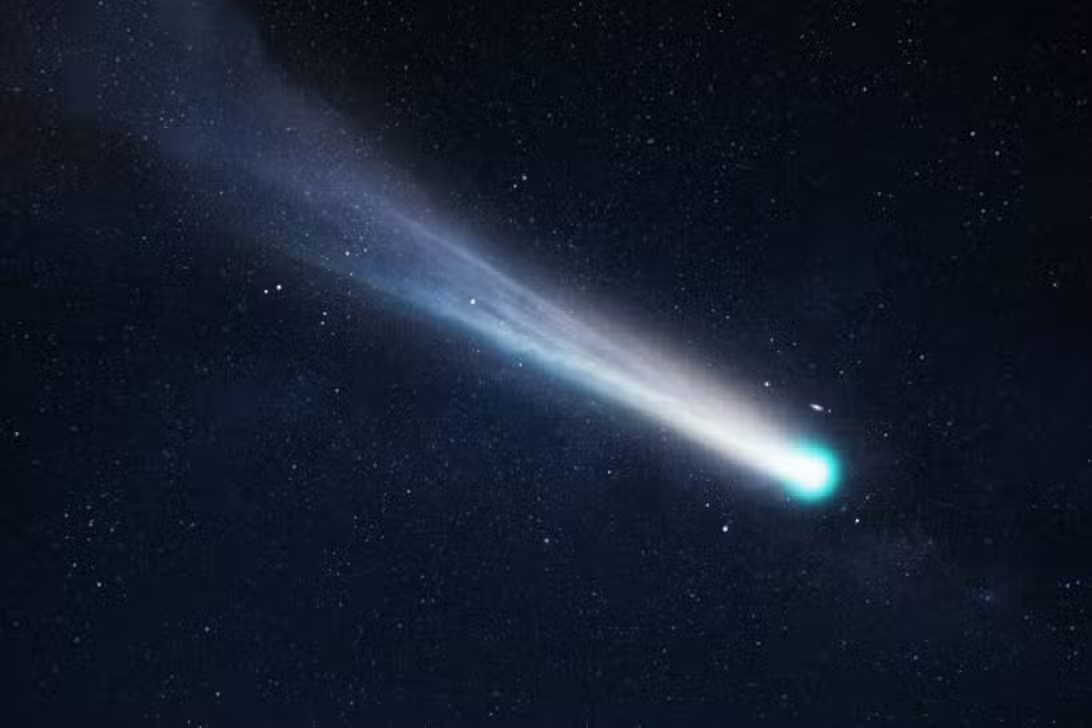
The global astronomical community continues to analyze data from C/2025 V1, a celestial object discovered in late 2025 that defies conventional classifications. Identificado by the amateur astronomer
Since its detection on November 2, 2025, at Observatório MARGO, at Crimeia, the object has been the subject of intense monitoring. Sua’s closest passage to Terra occurred on November 11 of that year, at a safe distance of 103 million kilometers, followed by perihelion, its closest point to Sol, on November 16, at 68 million kilometers.
The main question that mobilizes scientists is to determine whether C/2025 V1 is in fact the fourth interstellar object ever detected or an unusual comet originating from the distant Nuvem of Oort. The answer lies in detailed analysis of its composition and refinement of its orbit, a task that involves cutting-edge telescopes around the world.

A trajectory that defies conventions
The most notable feature of C/2025 V1 is its hyperbolic orbit, an open path that indicates the object has enough speed to escape the gravitational pull of Sol and never return. With an orbital eccentricity initially calculated at 1.0095 — where any value above 1.0 defines a hyperbola — its trajectory does not resemble the closed ellipses of the planets, asteroids and most comets belonging to our Sistema Solar. Essa excessive speed, estimated at 210 km/h in relation to Sol, is the main evidence supporting the hypothesis that it is a visitor from another star system, a true cosmic messenger that crossed the vast interstellar space for millions or billions of years before crossing our path.
The mystery of the missing tail
Comets are often described as “dirty snowballs” made up of ice, rock and dust. As they approach Sol, the heat causes the ice to sublimate, releasing gas and dust that form a temporary atmosphere called a coma and, subsequently, the iconic tails that can extend for millions of kilometers. C/2025 V1, despite having come considerably closer to Sol, exhibited only a diffuse coma, without developing an ion or dust tail, an atypical behavior that intrigues researchers.
Several hypotheses try to explain this anomaly. One possibility is that the composition of its surface is different, with volatile materials less abundant or buried beneath a protective crust. Outra theory suggests that the object may have exhausted most of its surface ice during its long journey through space, or even that it could be a hybrid body between a comet and an asteroid. Spectroscopic analysis, which studies reflected light to identify its chemical components, is fundamental to unraveling this issue.
The global race for observation
Soon after the discovery of Borisov, observatories around the world turned their instruments to C/2025 V1. The rapid confirmation of its existence and orbit was made possible by a collaborative network of professional and amateur astronomers.
Teams from NASA and Agência Espacial Europeia (ESA) mobilized resources to collect as much data as possible during its brief passage. Telescópios in Chile, Áustria and Japão were essential for continuous monitoring.
Instruments such as spectrometers were used to decompose the comet’s light and analyze its chemical signature, looking for the presence of molecules such as water, carbon monoxide and cyanogen, common in comets in our system.
Observation was challenging due to the object’s faint brightness, which reached an apparent magnitude of 14.2, making it visible only through large telescopes.
The profile of the enigmatic visitor
Initial observations allowed us to draw a preliminary profile of C/2025 V1. Seu nucleus has an estimated diameter of between 1.4 and 16 kilometers, a wide range that reflects the difficulty of accurately measuring such a distant and dimly luminous object.
Data from satellites such as NEOSSat, specialized in detecting objects close to Terra, suggested a rotation period of 13.2 days. Sua “ghostly” appearance, with a diffuse coma of about 25 arcseconds but without a defined tail, has led to speculation about possible gradual disintegration, although there is no conclusive evidence.
The combination of a high speed and low cometary activity makes C/2025 V1 a valuable object of study, as it may represent a class of celestial bodies that is still little understood by scientists.
Oort cloud or interstellar traveler?
Although the hyperbolic orbit is a strong indication of interstellar origin, scientists remain cautious. Existe the possibility that C/2025 V1 is an object of Nuvem of Oort, a vast and theoretical sphere of icy bodies believed to surround Sistema Solar at immense distances.
Occasionally, gravitational perturbation from a nearby star can launch one of these bodies on a highly eccentric trajectory toward Sol, which can be difficult to distinguish from a truly interstellar orbit. Continuous Observações, even as the object moves away, are crucial for refining orbital calculations and confirming that its trajectory is indeed unlimited.
The legacy of Gennady Borisov
The discovery of C/2025 V1 reinforces the importance of Gennady Borisov in modern astronomy. Após finding 2I/Borisov in 2019, its name has become synonymous with interstellar comet hunting, highlighting the vital role that dedicated amateur astronomers play.
Equipped with increasingly accessible and sophisticated technology, independent observers around the world tirelessly monitor the sky, acting as a first line of defense and discovery, complementing the work of major scientific institutions.
Comparison with ‘Oumuamua and 2I/Borisov
C/2025 V1 joins an exclusive club of interstellar visitors, including 1I/’Oumuamua and 2I/Borisov. Cada one of these objects turned out to be unique: ‘Oumuamua was an elongated, rocky body with no cometary activity, while 2I/Borisov behaved like a classic comet. C/2025 V1 presents an intermediate puzzle, with a comet’s coma but no tail, expanding our understanding of the diversity of small bodies roaming the galaxy.