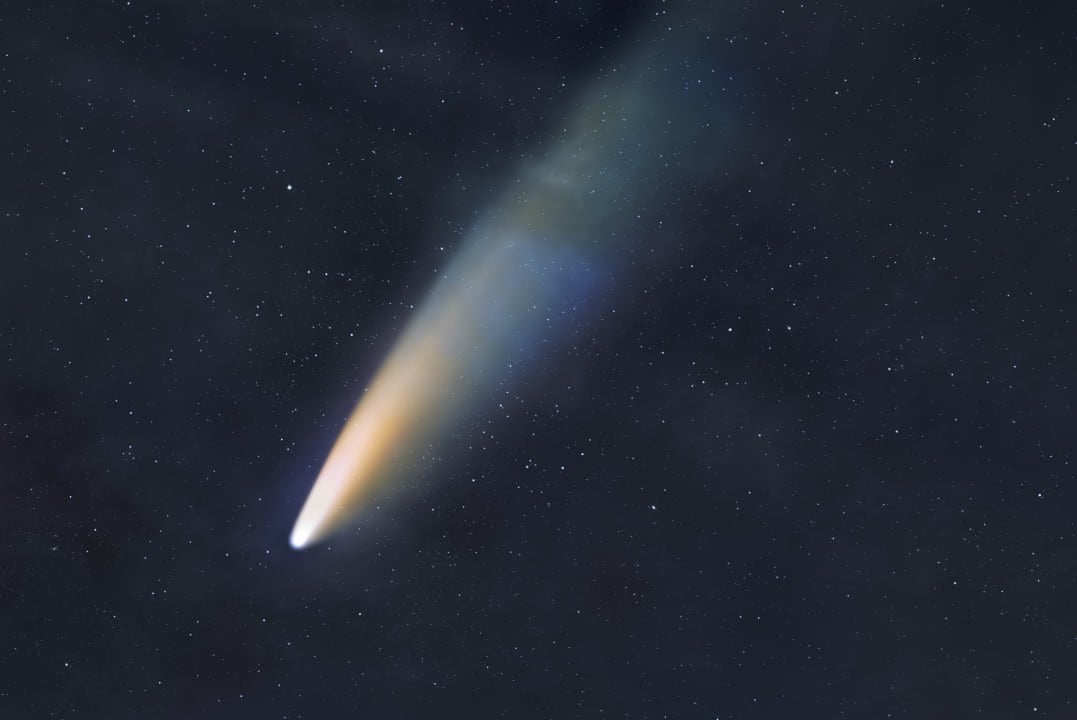
The interstellar comet 3I/ATLAS, the third confirmed object of origin external to Sistema Solar, continues to be monitored by astronomers in January 2026. The observations combine data from ground-based telescopes and space probes, providing valuable information about their composition and behavior.
3I/ATLAS has an icy core with continuous release of gas and dust, forming an extensive coma. Sua origin dates back to a distant star system, with primordial material estimated to be billions of years old. The current passage represents a rare opportunity for comparative studies with local comets.
- External origin confirmed by hyperbolic trajectory
- Intense activity with sublimation of surface ices
- Global monitoring involving multiple observatories
- Data contributes to understanding planetary formation in other systems
These characteristics highlight the scientific importance of the object. Equipes international teams coordinate efforts to maximize intelligence collection during the visibility window.
Recent Earth Observations
Telescopes located at high-altitude observatories recorded the comet under favorable conditions during December 2025 and January 2026. Instrumentos like Gemini North, in Havaí, captured details of the coma and brightness variations. Long exposures compensated for the object’s rapid movement relative to the stellar background.
The Atacama Large Millimeter Array (ALMA) detected specific emissions that indicate the presence of complex molecules. Esses records complement spectral analyzes carried out in real time. The privileged location of the observatories minimized atmospheric interference.
The processed data reveals non-gravitational deviation in the trajectory. Esse effect results from forces generated by the asymmetric release of materials. Astrônomos adjust orbital models based on these ongoing observations.
Europa Clipper spatial records
The Europa Clipper probe, en route to Júpiter since its launch in 2024, carried out extended observations of 3I/ATLAS in November 2025. The instruments captured the comet from a long distance, revealing gas and dust distribution at different wavelengths. The probe’s unique perspective complements terrestrial views limited by the atmosphere.
The combination of ultraviolet and infrared filters highlighted specific regions of the coma. NASA’s Cientistas processed the data to identify characteristic tones of released elements. Essa opportunity arose during the initial phase of the mission, before arrival in the Jovian system in 2030.
The Europa Clipper records contribute to the refinement of compositional calculations. The operational distance allowed monitoring for consecutive hours. Esses data enriches the global database of interstellar visitor information.

Compositional features detected
Spectral analyzes indicate the presence of compounds typical of active comets, including cyanide and carbon. 3I/ATLAS displays distinct chemical ratios of outer Sistema Solar objects. Essas differences suggest formation in a stellar environment different from ours.
The core has a diameter estimated at a few kilometers, surrounded by an expanding gaseous envelope. Activity remains intense even after perihelion, with continuous release of volatile materials. Observações compare the behavior with that of comet 2I/Borisov, recorded in 2019.
Studies identify temporal variations in dust production. Esses patterns reflect surface heterogeneity of the nucleus. The chemical composition offers clues about processes in distant star systems.
Complementary research looks for signs of complex organic molecules. The preliminary results expand knowledge about interstellar diversity. Equipes continues analyzing data accumulated across multiple campaigns.
Current trajectory and future projections
The comet passed its closest approach to Terra in December 2025, reaching visible magnitude in amateur telescopes. Atualmente, in January 2026, is heading for a gravitational encounter with Júpiter in March. Essa interaction will accelerate your definitive ejection from Sistema Solar.
Orbital calculations predict an escape speed of more than 30 km/s after the Jovian maneuver. The object will return to deep interstellar space, traveling for billions of years. The Earth observation window progressively decreases with increasing distance.
Space telescopes like Hubble maintain tracking despite reduced brightness. Missões in operation captures final data before loss of visibility. The confirmed trajectory reinforces the classification as the third authenticated interstellar visitor.
Comparisons with previous objects
3I/ATLAS differs from the first interstellar ‘Oumuamua in that it has a coma and clear cometary activity. Enquanto ‘Oumuamua was rocky and inactive, it exhibits intense release of materials. The comparison highlights variety among objects ejected from other systems.
The second visitor, 2I/Borisov, showed more similar characteristics, with an extended tail and a composition rich in carbon monoxide. The 3I/ATLAS has different proportions in some elements. Esses parallels and differences enrich models of cometary formation and evolution.
- ‘Oumuamua: elongated shape, no detectable coma
- 2I/Borisov: prominent tail, high activity
- 3I/ATLAS: vibrant coma, non-gravitational shifts observed
These distinctions reveal diversity of processes in distant planetary systems. Estudos integration of the three objects advances understanding of interstellar populations.
International monitoring coordination
Observatories on different continents coordinate campaigns for continuous coverage of the comet. Redes and International Astronomical Union facilitate rapid data exchange. The collaboration involves institutions from América to Norte, Europa and América to Sul.
Optical and radio instruments operate together for multi-frequency analysis. Resultados are shared on open scientific platforms. Essa approach maximizes scientific return during limited passage.
Space agencies contribute to active missions in deep space. The integration of terrestrial and space data generates a robust set of information. Equipes publish regular updates on object developments.
Contributions to interstellar astronomy
The passage of 3I/ATLAS reinforces the need for surveys dedicated to detecting distant objects. Programas such as ATLAS demonstrate effectiveness in early identification. Descobertas future ones will depend on new generation telescopes.
Comet studies expand the catalog of directly observable primordial materials. Comparações chemistries inform about conditions in outer protoplanetary disks. The data collected will serve as a reference for subsequent visitors.
Derived research explores implications for the distribution of organic compounds in the universe. The rarity of such events mobilizes global resources. Continuous monitoring up to detection limits ends an intensive cycle of observations.
