

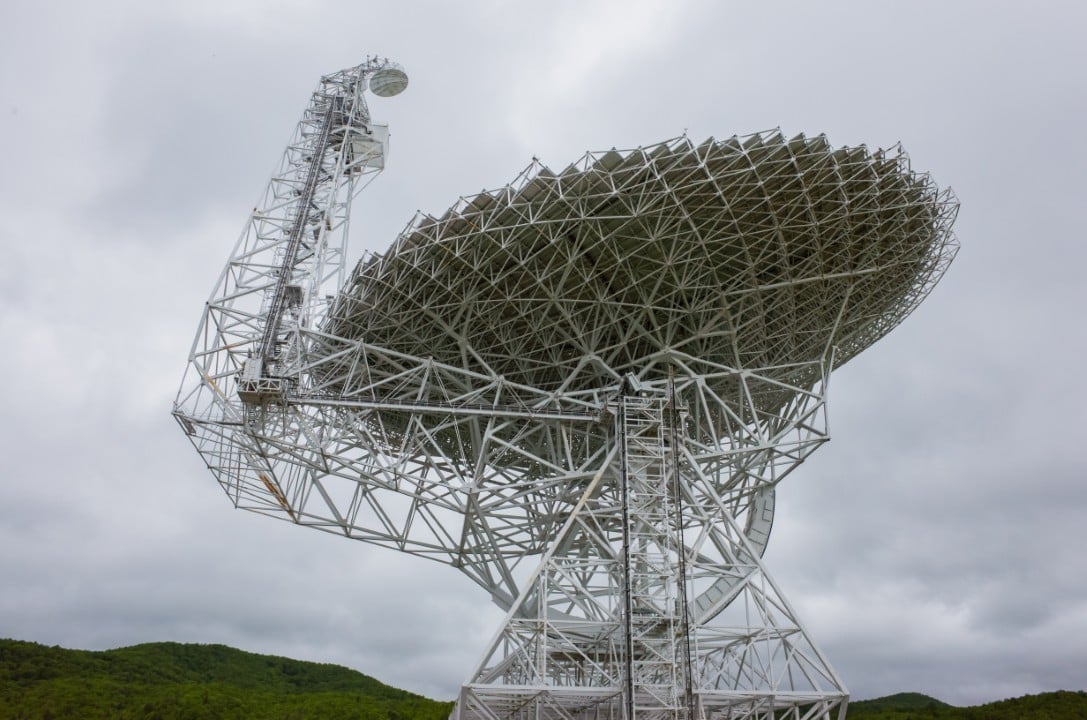
Astronomers from the Breakthrough Listen project conducted detailed observations of the interstellar comet 3I/ATLAS with Telescópio Green Bank, located at West Virginia, in the Estados Unidos. The analyzes took place on December 18, 2025, when the object was closest to Terra.
The study focused on the search for technosignatures that could indicate extraterrestrial technology. Nenhum artificial radio signal was detected, reinforcing the classification of 3I/ATLAS as a celestial body of natural composition.
The comet, the third confirmed interstellar object in our solar system, generated great scientific interest during its passage. Especialistas highlight that negative results contribute to the understanding of extrasolar visitors.
The research used the world’s largest steerable radio telescope to scan multiple frequency bands. The absence of localized emissions from the object eliminates candidates for technological signals.
- 3I/ATLAS was discovered in July 2025 by the ATLAS system.
- Its hyperbolic trajectory confirms origins outside the solar system.
- The object exhibited a coma and tail, typical characteristics of active comets.
- The minimum distance to Terra was about 1.7 astronomical units.
This initial data allowed planning of coordinated international observations. The comet remained visible for months in professional telescopes.
Initial discovery of the object
The ATLAS search system identified 3I/ATLAS in images obtained at Chile. Pre-discovery Observações were recovered to precisely calculate its orbit.
The comet reached perihelion in October 2025, positioning itself within the orbit of Marte. Sua high speed prevents gravitational capture by Sol.
Detailed orbital characteristics
The trajectory of 3I/ATLAS has an eccentricity greater than 1, characteristic of interstellar objects. The object crossed the ecliptic plane at an inclined angle.
Its passage through the inner solar system occurred without risk of planetary impact. Astrônomos monitored non-gravitational accelerations caused by material ejection.

Observed cometary activity
3I/ATLAS developed an extensive coma and dust tail as it approached Sol. Imagens revealed release of gases and particles from the nucleus.
Unlike the first interstellar object ‘Oumuamua, this comet showed typical activity. The sublimation of ice explained recorded brightness variations.
Signal search methods
The Telescópio Green Bank operated in bands from 1 to 12 GHz for continuous hours. The alternating observation pattern eliminated known terrestrial interference.
Specialized software processed data looking for narrow emissions. The sensitivity achieved would detect transmitters of moderate power at the comet’s distance.
Initially, signal candidates were identified in the raw data. Subsequent Análises classified all as originating from human sources in Terra.
Radio scan results
No signal remained exclusively associated with 3I/ATLAS movement. Outras teams carried out complementary searches on different frequencies.
The results converged on the absence of detectable technosignatures. The study establishes an upper limit for possible artificial emissions from the object.
Composition and estimated size
Spectroscopic observations indicate the presence of volatile compounds typical of comets. The core has dimensions between hundreds of meters and a few kilometers.
The mass loss during the passage reached millions of tons. Essa ejection influenced the observed trajectory of the comet.
International data coordination
Space telescopes such as Hubble and James Webb contributed images and spectra. Missões in progress recorded the object from different perspectives.
Space agencies exchanged data in real time to maximize coverage. Essa collaboration has enriched the set of scientific information available.
Contributions to interstellar astronomy
Objects like 3I/ATLAS provide direct samples of materials from other star systems. Sua chemical composition reveals conditions in distant regions of the galaxy.
The passage of 2025 increased the catalog of known visitors to three. Estudos comparisons with ‘Oumuamua and Borisov advance models of extrasolar comet formation.
Systematic searches for artificial signals accumulate valuable negative data. Esses limits restrict scenarios of nearby technological civilizations.
Future projects plan interception missions for in situ analysis. New generation Telescópios will improve early detection of similar objects.
The rigorous approach maintains scientific standards when evaluating extraordinary hypotheses. 3I/ATLAS reinforces the importance of concrete observational evidence in astronomy.