
The first solar eclipse of 2026 will be of the annular type and will occur on February 17th. Esse astronomical phenomenon creates the well-known ring of fire effect when Lua is positioned in front of Sol without completely covering it. The annular phase is mainly concentrated in Antártida, while partial visibility reaches parts of the southern hemisphere.
The event begins at 9:56 am Coordinated Universal Time (UTC), with the annular phase beginning at 11:42 am UTC. The peak occurs at 12:13 UTC and ends at 2:27 UTC. The maximum duration of annularity reaches around two minutes in specific points on the Antarctic continent.
Researchers highlight that annular eclipses occur when Lua is furthest from Terra in its elliptical orbit. Essa distance prevents total coverage of the solar disk and leaves a luminous ring visible around the lunar silhouette.
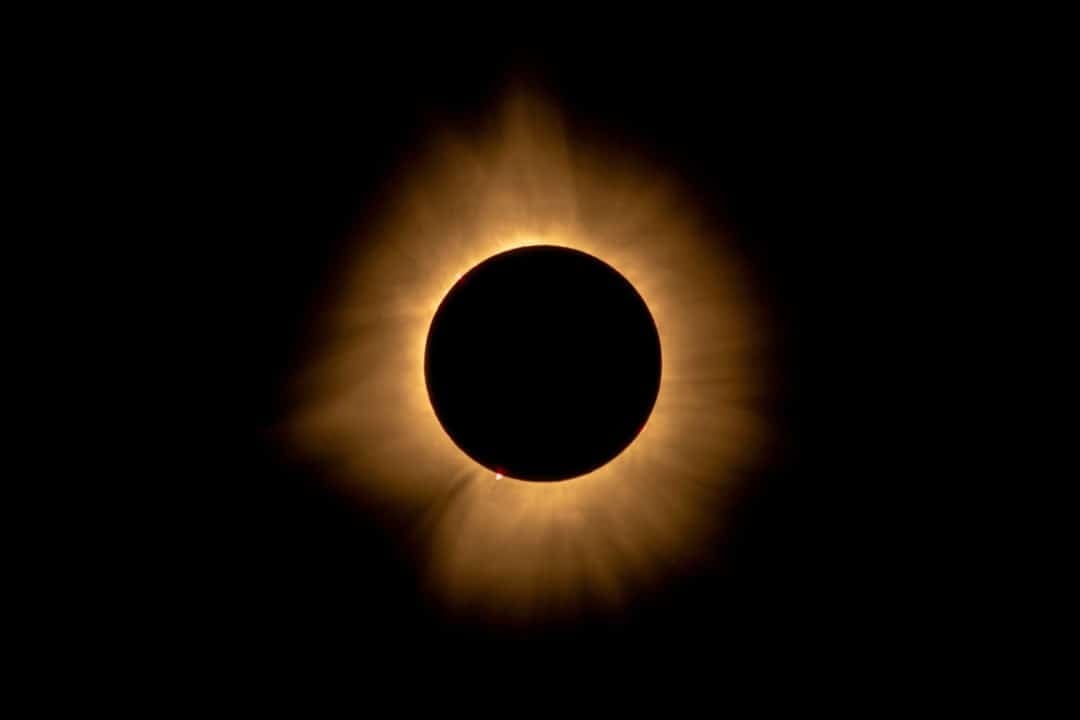
Ring of fire phenomenon
Annular solar eclipses differ from total ones because Lua does not block all sunlight. The alignment results in a bright circle that remains visible around the dark lunar disk.
The magnitude of the February eclipse reaches 0.963, a value that confirms its annular nature. Observadores in ideal locations perceive the Sol transformed into a thin, luminous ring for up to two minutes and twenty seconds.
Regions with annular visibility
The annularity range is almost exclusively restricted to Antártida. Scientific Estações such as Concordia and Mirny record the best observation conditions for the central phenomenon.
The path of annularity extends approximately 4,282 kilometers over the icy continent. Equipes researchers are already planning expeditions to record data during the event.
Partial eclipse areas
The partial eclipse covers southern portions of África, including countries such as África of Sul, Namíbia and Madagascar. Partes south of América of Sul, like Argentina and Chile, also experience partial coverage of Sol.
Oceanic regions in Atlântico, Pacífico, and Índico record varying degrees of bias. The magnitude decreases with distance from the center of the annular band.
At Brasil, partial visibility is limited to extreme southern areas, with minimal coverage of the solar disk. Condições meteorological conditions directly influence the perception of the phenomenon in these locations.
Local event times
Observers must convert UTC times to their local time zones. Na Antártida, stations operate in different time zones depending on their geographic location.
In the south of América of Sul, the event occurs during the local morning or early afternoon. Na África austral, the times coincide with the daytime period favorable for observation.
- Partial start: 9:56 am UTC
- Annular start: 11:42 UTC
- Maximum: 12:13 UTC
- Annular end: 14:27 UTC
- Maximum annular duration: up to 2 minutes and 20 seconds
Observation safety measures
Observing solar eclipses requires adequate eye protection. Filtros certified to ISO 12312-2 block harmful ultraviolet and infrared radiation.
Indirect methods include pinhole projection or use of telescopes with appropriate solar filters. Óculos Ordinary or exposed films do not provide sufficient protection.
Experts warn that looking directly at the Sol, even during bias, causes irreversible damage to the retina. Crianças require constant supervision during any observation attempts.
Astronomical organizations recommend equipment verified by trusted manufacturers. Telescópios without an adequate filter, they become dangerous when concentrating sunlight.
Eclipse online broadcasts
NASA and other observatories plan live broadcasts of the event from Antártida. Canais officials make real-time images available to a global audience.
Scientific streaming platforms complement coverage with comments from experts. Essas transmissions allow secure tracking regardless of geographic location.
Astronomical context of the event
Solar eclipses occur on average two to five times a year in different types. The saros cycle organizes these events in series that repeat approximately every 18 years.
The February eclipse belongs to a specific series that includes past and future events. Astrônomos use these patterns for accurate predictions of celestial phenomena.
The position of Lua at apogee during alignment explains the annularity. Larger Distância reduces the lunar apparent diameter and prevents totality.
Second solar eclipse of the year
The year 2026 holds another solar eclipse on August 12, this time total. The band of totality passes through Groenlândia, Islândia and north of Espanha.
Partial visibility extends over much of Europa and nearby regions. Duração of totality reaches up to two minutes at optimal points along the route.
Scientific preparation for observations
Antarctic stations mobilize teams to collect data during the February eclipse. Instrumentos measure variations in the ionosphere and atmospheric temperature.
International projects coordinate simultaneous observations at different points. Resultados contribute to studies on the interaction between Sol, Lua and the Earth’s atmosphere.
Research takes advantage of the remote location to minimize light interference. Condições polars offer clear skies in favorable periods.
Importance of eclipses in astronomy
Solar eclipses allow direct studies of the solar corona under natural conditions. Observações historical eclipses have confirmed theories such as general relativity.
Current phenomena provide data on solar composition and magnetic activity. Satélites complement information obtained on the ground during alignments.
Systematic records of eclipses date back to ancient civilizations. Modern Catálogos organize thousands of past and future events with millimeter precision.
Complementary astronomical calendar
The year 2026 also includes lunar eclipses visible in different regions. Chuvas of meteors and supermoons complete the calendar of celestial events.
Amateur observers can plan activities according to dates published by reliable institutions. Aplicativos and specialized websites make it easier to monitor phenomena.
Tips for recording the phenomenon
Eclipse photography requires equipment with suitable solar filters. Exposições vary depending on the phase of the event and local conditions.
Time-lapse videos capture the progression of the alignment. Edição later highlights details of the ring of fire in accelerated sequences.
Evolution of eclipse predictions
Current computer models predict eclipses to the nearest second. Atualizações consider variations in Earth rotation and lunar orbit.
Interactive maps provide detailed trajectories for planning. Ferramentas online simulate visibility from any geographic coordinate.
The annular eclipse of February 17, 2026 represents a unique opportunity for observation in polar regions. Transmissões live guarantees global access to the astronomical phenomenon.
