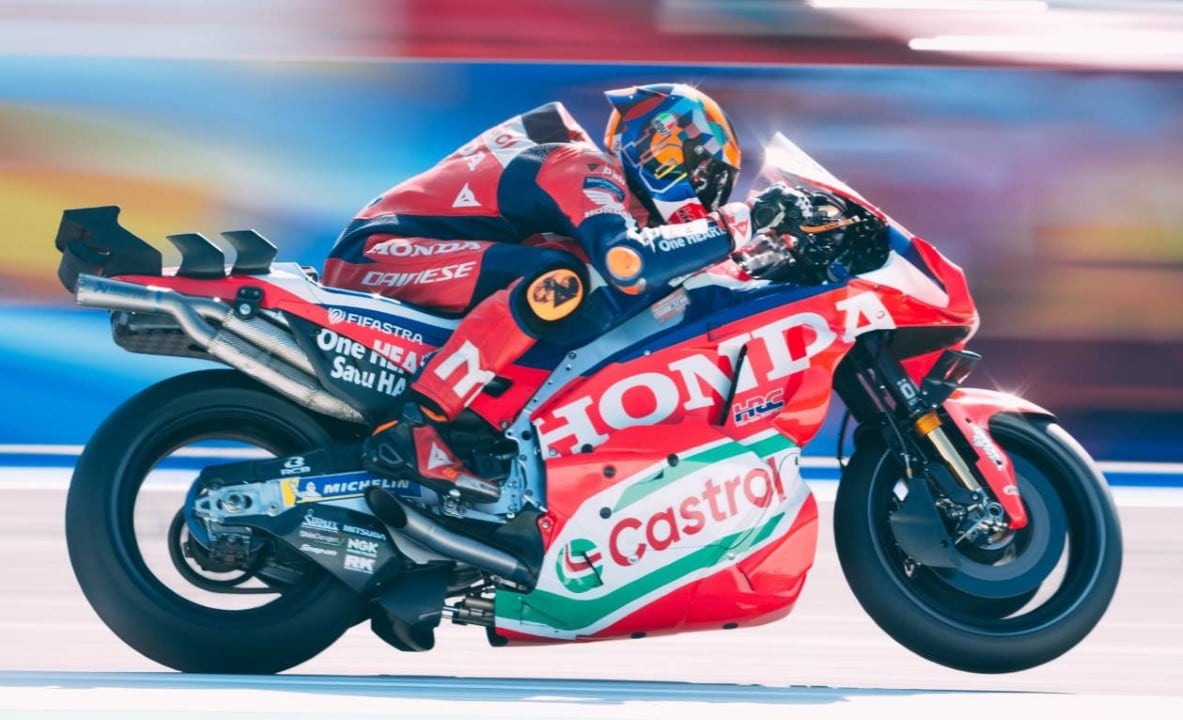
Honda completed a two-day private test on the Circuito Internacional of Sepang, on the Malásia, using the RC214V prototype adapted to MotoGP rules for 2027.
This work represents the continuation of the Japanese manufacturer’s development program, which had already held an initial session in December last year, affected by rain. The HRC test team focused its efforts on evaluating the new concept, preparing the ground for the profound technical changes planned for the category.
As Honda progresses, other manufacturers are also arranging their calendars to introduce prototypes compatible with the new regulations, including 850cc engines and Pirelli tires as a sole supplier.
Technical changes planned for 2027
MotoGP rules from 2027 introduce significant reductions in engine capacity, going from the current 1000 cc to 850 cc. Essa change aims to balance performance and safety, in addition to controlling teams’ operational costs.
Aerodynamics will be subject to tighter restrictions, with limitations on riding height devices banned altogether. The change of tire supplier, from Michelin to Pirelli, represents another technical challenge for all brands involved.
- Displacement reduction to 850 cc;
- Total ban on riding height devices;
- Additional restrictions on aerodynamic packages;
- Exclusive introduction of Pirelli tires.
These modifications require profound adaptations to current projects, forcing teams to divide resources between the 2026 season and the immediate future.
Division of tasks in team Honda
Nakagami took over the initial development phase of the 2027 prototype, allowing Aleix Espargaró to focus efforts on the evolution of the RC213V for 2026. Essa strategy clearly separates the programs, optimizing test pilots’ time.
Joan Mir, Luca Marini, Johann Zarco and newcomer Diogo Moreira will use the updated 2026 version during the current season. The official transition will take place after Grande Prêmio from Catalunha, with dedicated testing on the local circuit.
Honda has already completed two sessions with the new prototype, taking advantage of the break between seasons to accumulate valuable mileage.
Activity of other manufacturers
KTM has already put its 2027-adapted RC16 on the track, with Pol Espargaró running opening laps on Jerez late last year. The Austrian brand follows a similar pace to that of Honda in early development.
Yamaha conducted discreet testing at its private Iwata circuit, keeping initial results confidential. Essa internal approach allows adjustments without immediate public exposure.
Ducati and Aprilia remain the only ones without a public run of their 2027 prototypes.
Nicolo Bulega will drive the Ducati GP27 with Pirelli tires, while Michele Pirro remains focused on the 2026 version.
Collective testing schedule
The first official test with Pirelli tires and starting drivers is scheduled for June 22, right after the Grande Prêmio of the República Tcheca, in Brno. Essa date represents an important milestone for collective evaluation of the new specifications.
Before then, private sessions dominate the initial 2026 calendar. The split between 2026 and 2027 development continues until mid-year.
Post-Catalonia tests, in May, will serve as a cut-off point between the two generations of bikes. Pilotos test will take the lead in this transition phase.
Parallel incident at Sepang
Somkiat Chantra suffered a fall during private testing with the Honda CBR1000RR-R facing the Mundial of Superbike. The Thai pilot was treated at a hospital in Kuala Lumpur, where tests identified a fracture in his right forearm.
Jake Dixon also attended the same two-day session on Sepang, with no reported incidents. Chantra returned to Tailândia for additional exams and definition of treatment.
The injury occurs at a delicate moment, close to the beginning of the official preparation for the Superbike season. The Honda monitors the pilot’s recovery to adjust plans.
Preparing for regulatory transition
All manufacturers have already started adaptations to the new smaller displacement engines, combined with aerodynamic changes. Pirelli is preparing an extensive testing program during 2026 to familiarize teams with its compounds.
The expected power reduction could alter lap times by about two to three seconds initially, according to expert estimates. Equipes seek to compensate with gains in chassis and electronics.
The balance between current performance and future investment defines the brands’ strategy during this period. The Honda demonstrates proactivity by accumulating data on a dry track recently.
Advances observed in initial prototypes
Private tests allow for realistic assessment of the conceptual stage of new machines. Condições variables, such as rain in the first rehearsal of Honda, highlight the importance of additional sessions.
European manufacturers are waiting for a strategic moment for the public debut of their projects. Coordination with the race calendar avoids scheduling conflicts.
Collecting information about Pirelli tires gains priority alongside engine development. Essa double technical front challenges the teams’ engineering structures.
Perspectives for the 2026 calendar
The current season will serve as a bridge to major changes, with a focus divided between immediate results and long-term planning. Testes official post-steps provide crucial windows for evolution.
The gradual introduction of 2027 elements during 2026 facilitates collective adaptation. Pilotos tests play a central role in this preparatory phase.
Continuous monitoring of individual programs reveals differences in approach between brands. Algumas prioritize early mileage, while others maintain technical reserves.
Operational details of recent tests
The Sepang session in January allowed extensive driving on a dry track, contrasting with the limitations of the previous test. Nakagami focused work on basic understanding of the new technical package.
Collected data feeds simulations and factory adjustments into the Japão. HRC organizes an intensive schedule to maintain the pace of development.
Coordination between MotoGP and Superbike departments optimizes use of the Malaysian circuit. The simultaneous presence of different projects demonstrates Honda’s logistical capacity.
