

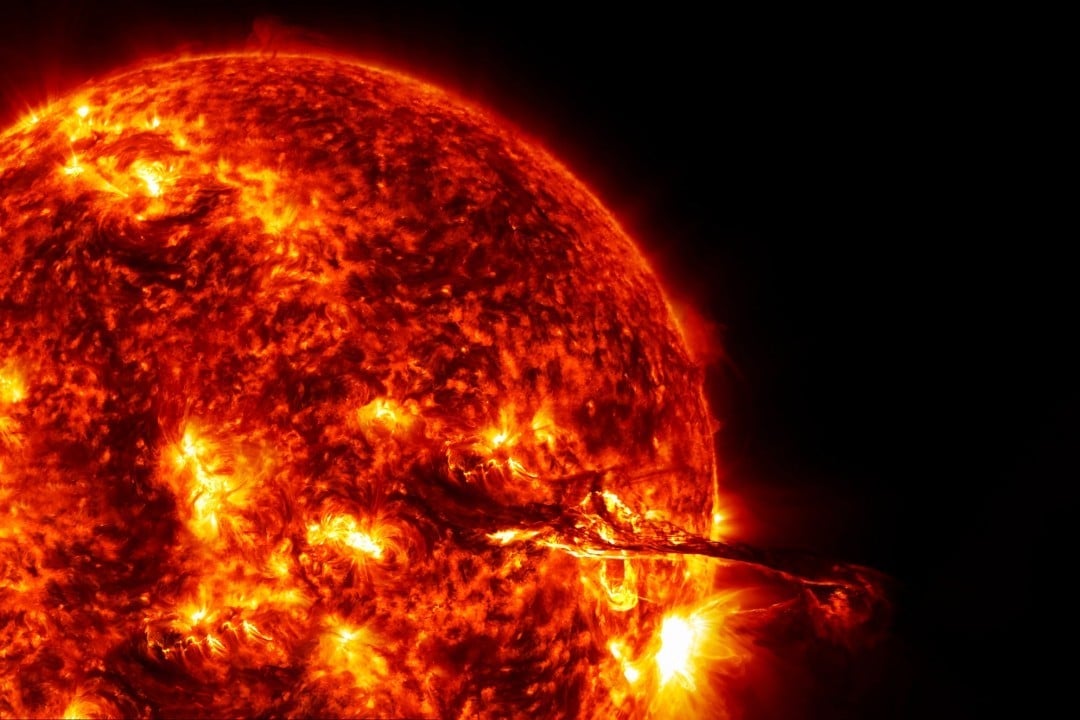
Groundbreaking research led by scientists from Universidade of St. Andrews, in Escócia, revealed that temperatures reached during solar flares are drastically higher than previously assumed. Publicado in the scientific journal The Astrophysical Journal Letters, the study demonstrates that ion particles in solar plasma can reach an impressive 60 million degrees Esta fundamental discovery solves a puzzle that has intrigued the astrophysics community for more than five decades, related to the energetic behavior of Sol, and redefines understanding of the process of magnetic reconnection, the engine behind these violent bursts of energy. The work, led by Professor Alexander Russell, offers a new perspective on the mechanisms that govern the release of radiation, such as X-rays, that can directly affect technology in orbit and the safety of astronauts.
The main conclusion of the research is that, during an eruption, ions (positively charged particles) are heated much more intensely and efficiently than electrons (negatively charged particles). The Essa heating difference was the missing piece to explain certain anomalies observed in the Sol spectral data.
The implications of this discovery go beyond solar physics, as it provides crucial data to improve space weather prediction models. Entender the true magnitude of the energy released is essential to protect communications satellites, electrical power grids and GPS navigation systems against the effects of future solar storms.

The mechanism behind extreme heat
The research deepens knowledge about magnetic reconnection, the central phenomenon that fuels solar flares. Esse process occurs in the atmosphere of Sol, known as the solar corona, where magnetic fields with opposite polarities approach, break and reconnect abruptly. Essa reconfiguration releases a colossal amount of stored magnetic energy, converting it into thermal and kinetic energy that accelerates plasma particles to extreme speeds. The Scottish study demonstrated, through advanced computer simulations and analysis of observational data, that this energy transfer is not uniform. Ions, because they are much more massive than electrons, absorb a disproportionately greater portion of this energy, resulting in their overheating to tens of millions of degrees in a matter of milliseconds. Essa explanation finally justifies why the spectral lines, which function as a “thermometer” of the plasma, appeared much wider than theoretical models predicted, a mystery that has persisted for half a century.
Future applications of the discovery
With new understanding about the heating of solar particles, scientists can improve models that predict the behavior of Sol. Esses models are crucial for anticipating solar storms, which can impact everything from space missions to energy grids in Terra. The discovery also paves the way for more detailed studies on plasma physics, with possible applications in technologies based on nuclear fusion, which seek to replicate the energetic processes of stars in the Terra.
The Universidade team from St. Andrews plans to expand the research by investigating how uneven warming affects other regions of the solar atmosphere. Além Furthermore, the data can help design satellites that are more resistant to radiation, ensuring greater security for global communications infrastructures and positioning systems.
Implications for technological security at Terra
Solar flares are not just distant astronomical phenomena; its effects can be devastating for modern technological infrastructure. The intense emission of X-rays and energized particles can damage electronic components of satellites, interrupting communication, data transmission and GPS services. Tempestades severe geomagnetic waves, triggered by these eruptions, can induce electrical currents in power grids, overloading transformers and causing widespread blackouts, such as the one that left millions of people without electricity in Quebec, in Canadá, in 1989.
More accurate understanding of extreme temperatures and particle energy allows engineers and scientists to develop more effective warning systems. By predicting the intensity of an impending solar storm with greater accuracy, satellite operators can put their equipment into safe mode, and energy companies can take steps to protect their grids, minimizing potential damage. The safety of astronauts on space missions also directly depends on this predictive ability, as exposure to high levels of solar radiation outside the protective magnetosphere of Terra can be fatal.
The methodology that combined observation and simulation
The significant progress achieved by the St team. Andrews was made possible by an interdisciplinary approach that combined direct observation data with cutting-edge computational modeling. Researchers analyzed information collected by state-of-the-art solar telescopes, which capture details of the solar atmosphere with unprecedented resolution.
Esses observational data was then used to feed supercomputer simulations. These numerical models are capable of recreating the extreme physical conditions of plasma in the solar corona, an environment impossible to replicate in laboratories on Terra.
By comparing the results of the simulations with real observations, the scientists were able to confirm that the preferential heating of ions during magnetic reconnection is the mechanism that explains the extreme temperatures. Essa cross-validation strengthens the robustness of the conclusions and consolidates a new basis for solar physics.
Revisiting an ancient solar mystery
For more than fifty years, the scientific community has been faced with a puzzle in measurements of the solar corona. Observations showed that the temperature in Sol’s outer atmosphere was hundreds of times higher than that of its surface, a counterintuitive phenomenon that is not yet fully explained, known as the coronal heating problem.
Within this greater mystery, there was a specific issue: the instruments detected spectral lines much wider than expected. The width of these lines is directly related to the temperature and movement of the particles that emit them.
Existing theories could not justify this excessive width based on a uniform temperature for all plasma particles. The discovery that ions become much hotter than electrons offers a straightforward and elegant solution to this discrepancy.
This new understanding requires a revision of the models that describe the flow of energy in the solar atmosphere, impacting not only the study of eruptions, but also the fundamental understanding of how the solar corona maintains its million-degree temperatures.
What changes for space exploration
The research has direct and critical implications for the future of human space exploration. Astronautas in low orbit from Terra are relatively protected by the planet’s magnetosphere, but on missions to Lua or Marte, they are exposed to the hostile environment of interplanetary space. A solar flare of great magnitude could release a stream of high-energy particles that would represent a lethal dose of radiation for an unprotected crew.
More accurate space weather prediction models, fueled by discoveries like this, are essential for planning long-duration missions. Eles allow space agencies to identify time windows with lower solar activity to conduct extravehicular activities (spacewalks) and ensure that radiation shelters on spacecraft and habitats are designed to withstand the now better understood worst-case energy scenarios.
Fun facts about solar flares
In addition to their technological impact, solar eruptions are responsible for one of the most beautiful natural spectacles in Terra: the auroras. Quando the charged particles ejected by the Sol reach our planet, they are guided by the Earth’s magnetic field towards the poles, where they collide with gases from the upper atmosphere, such as oxygen and nitrogen, making them shine and creating the dancing lights of the northern lights and southern lights.
The energy released in a single large solar flare can be equivalent to the explosion of millions of hydrogen bombs. Electromagnetic radiation, such as X-rays and ultraviolet light, travels at the speed of light, reaching Terra in just over eight minutes. Energized particles, in turn, travel more slowly, taking from a few hours to several days to cross the 150 million kilometers that separate Sol from Terra.