

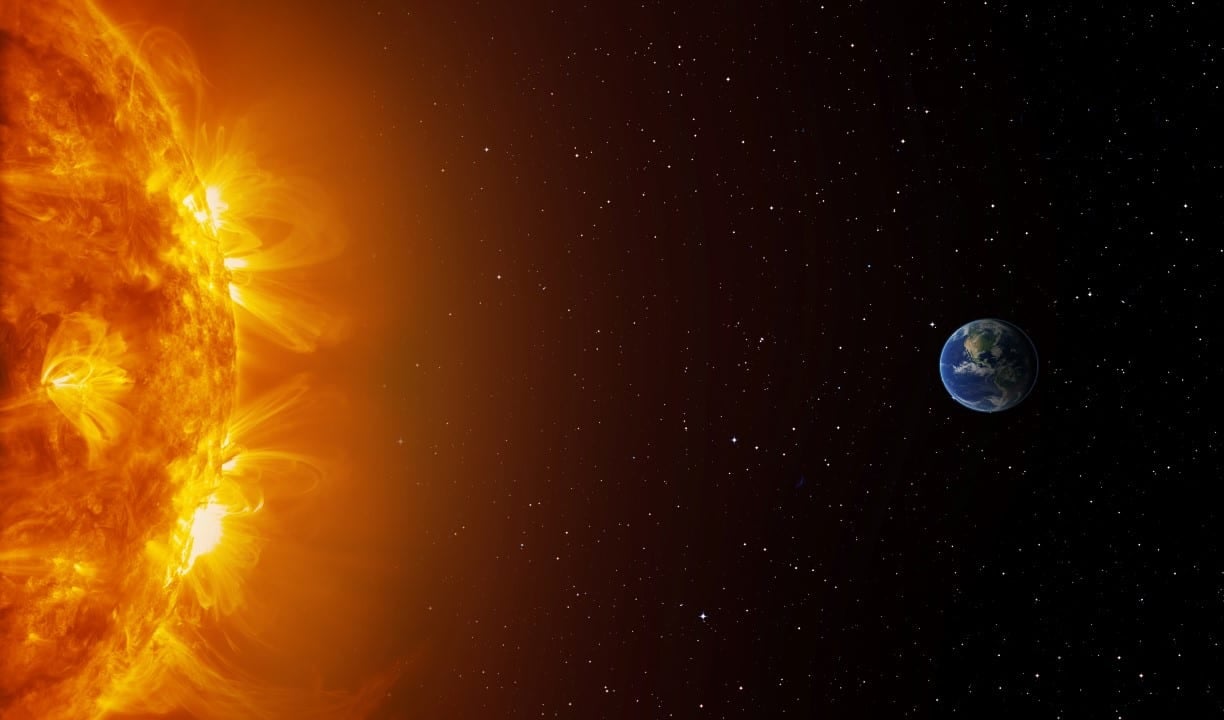
The orbital environment of Terra is being hit by the most severe solar radiation storm of the 21st century. The flow of solar protons has reached extraordinary levels, exceeding 30 thousand particle flux units (pfu), which led space agencies to classify the event as S4 on a scale that goes up to S5. The Este phenomenon, triggered by a series of recent solar flares, exposes astronauts aboard the Estação Espacial Internacional (ISS) to significantly high doses of radiation, requiring the activation of immediate safety protocols.
The event was triggered by a powerful solar flare, including an X1.9 class flare, which accelerated a massive volume of high-energy particles towards our planet. Embora the ISS crew is on alert, experts confirm that there is no risk to the population on the Earth’s surface. The natural protection offered by the planet’s magnetic field and atmosphere is robust enough to completely block the penetration of these dangerous particles.
Space agencies around the world, including NASA and Roscosmos, are continuously monitoring the situation to ensure crew safety and the integrity of space systems. The intensity of the phenomenon is the highest recorded in more than two decades, surpassing all peaks observed in previous solar cycles since the beginning of the 2000s, making it an event of great scientific and operational interest.

What does the S4 rating mean?
The S4 rating on the Administração Nacional Oceânica and Atmosférica (NOAA) radiation storm scale of the Estados Unidos indicates an event of “severe” severity. Este level is triggered when the flow of protons with energy greater than 10 Megaeletronvolts (MeV) exceeds 10,000 pfu. The current event, having surpassed the 30,000 pfu mark, positions itself firmly in this category, bringing with it a number of significant implications for space operations. Para astronauts, especially those who could be carrying out extravehicular activities (EVAs), or “spacewalks”, exposure to this amount of radiation would represent a serious and unacceptable biological risk, potentially causing cellular damage and increasing the risk of long-term disease. For this reason, all activities outside of station protection are immediately canceled during S4 alerts.
In addition to biological risks to humans in space, the S4 level represents a concrete threat to technology in orbit. The intense bombardment of energetic particles can cause electronic failures in satellites, affecting everything from communication and navigation systems, such as GPS, to meteorological and scientific research satellites. Electronic components can suffer from “single-event upsets” (SEUs), which are data corruption in memory, or even permanent damage to solar panels and sensors. Operadores of satellites are forced to put their equipment into “safe mode” to protect the most critical systems, which could result in temporary interruptions to services that depend on this orbital infrastructure.
Safety protocols for astronauts on alert
Faced with the intensity of the radiation storm, the crew of Expedição 74 on Estação Espacial Internacional adopted strict protective measures. The main guideline is to seek shelter in the most shielded areas of the station, known as “radiation shelters”.
These locations, such as the Zvezda service module and other central sections of the ISS, have walls reinforced with dense materials such as polyethylene and aluminum specifically designed to absorb high-energy particles and minimize crew exposure.
Monitoring of the radiation dose received by each crew member is intensified. Dosímetros personnel are constantly scanned, and data is sent in real time to mission control centers on Houston and Moscou, allowing medical teams to assess accumulated exposure and adjust procedures as needed to keep astronauts within the safety limits established for their careers.
Satellites and navigation systems under threat
The fleet of satellites orbiting Terra is particularly vulnerable during severe solar radiation events. The proton flow can penetrate equipment, causing operational anomalies ranging from temporary failures to permanent damage.
Electronic components, especially microprocessors and memory chips, can experience bit errors, where the charge on a particle changes the state of a transistor. Isso may lead to incorrect commands or loss of data critical to satellite operation.
Global navigation systems, such as GPS, may experience degradation in signal accuracy. The Earth’s ionosphere, disturbed by the arrival of solar particles, can alter the path of radio signals, introducing positioning errors that affect aviation, logistics and other dependent applications.
Communication satellite operators are also on high alert, as the noise generated by the storm could interfere with signals, causing interruptions in television, internet and telephone services. In many cases, backup systems are activated to ensure the continuity of essential services.
Terra’s natural protection prevents scratches on the surface
Despite the severity of the event in space, life on the planet’s surface remains completely safe. Terra has a highly effective natural defense system against solar radiation, mainly composed of the magnetic field, or magnetosphere, and the dense atmosphere.
The magnetosphere acts as an invisible shield, deflecting the vast majority of charged particles, such as protons, that travel from the Sol. The particles that manage to penetrate this field are channeled to the polar regions, where they interact with the upper atmosphere and create the spectacular northern and southern lights, a harmless visual effect of this defense process.
Comparison with historical radiation events
To contextualize the magnitude of the current event, it’s helpful to compare it to historic solar storms that have left their mark. The most famous episode of the 21st century was the “Storms of Halloween” from October and November 2003, which also achieved an S4 rating. On Naquela occasion, intense solar activity caused damage to several satellites, forced the diversion of flights crossing polar routes to lower altitudes and caused a blackout in the city of Malmö, in Suécia. The current event rivals the intensity of that period, highlighting the strength of the current solar cycle. Olhando further back, the August 1972 storm was so powerful that it would have been fatal for astronauts on mission Apollo if they had been on Lua. The gold standard for extreme events, however, remains the Evento of
The origin of the phenomenon in recent solar flares
The direct cause of this radiation storm was a particularly active solar region that has produced a series of flares in recent days. The main trigger was an X-class eruption, the most powerful category, which released an enormous amount of energy and matter from the solar corona.
The Essa explosion accelerated protons to speeds approaching that of light, allowing them to cross the 150 million kilometer distance between the Sol and the Terra in a matter of hours. This rapid arrival is what characterizes solar particle events, which often precede the arrival of Ejeções of Massa Coronal (CMEs), plasma clouds that travel more slowly and cause geomagnetic storms a few days later.
Continuous surveillance by space agencies
Space weather forecasting and monitoring is a global, non-stop operation. Satélites like NOAA’s GOES series and NASA/ESA’s Solar and