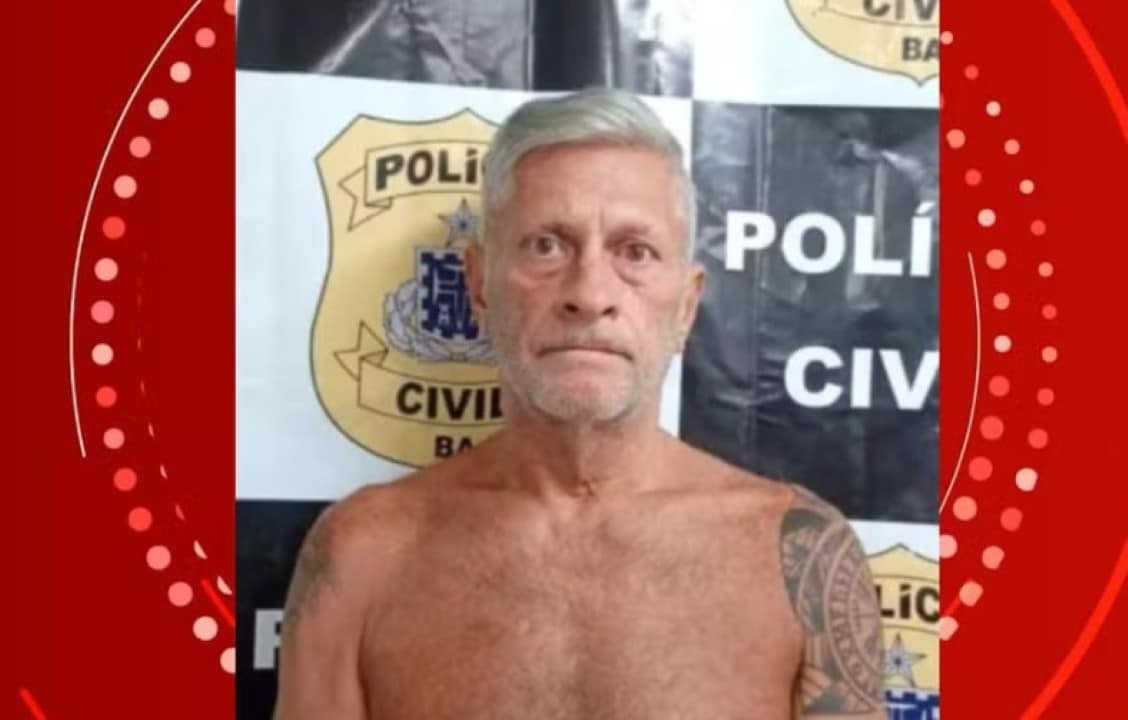
Security camera footage obtained by CNN Brazil has recently revealed the moment businessman Sérgio Nahas was identified and apprehended in Praia do Forte, Bahia. This significant arrest, occurring recently on a Saturday, comes nearly 24 years after Nahas was accused of fatally shooting his wife, Fernanda Orfali, in the upscale Higienópolis neighborhood of São Paulo in May 2002. The footage played a critical role in confirming his identity, leading to his capture.
Nahas was taken into custody at the same Bahia tourist destination where he and Orfali had spent their honeymoon months before the crime. Fernanda Orfali was only 28 years old when her life was tragically cut short, a detail that continues to resonate with her family.

Authorities from the Bahia Civil Police (PCBA) confirmed Nahas was identified through advanced facial recognition cameras. Following a custody hearing, he was transferred to the correctional system. During the arrest, officials seized 13 sachets containing a substance suspected to be cocaine, three mobile phones, and a vehicle.
The protracted legal battle and conviction
The murder of Fernanda Orfali in May 2002 initiated a lengthy and complex legal process that spanned years, marked by numerous appeals and significant public attention. Orfali sustained a fatal gunshot wound to her chest after reportedly expressing her desire to end the relationship with Nahas, leading to a contention between the prosecution and defense regarding the circumstances of her death.
Throughout the forensic investigations, expert analyses consistently pointed to Nahas as the perpetrator of the crime, a critical element that shaped the prosecution’s strategy. Consequently, the Public Ministry argued for his conviction on charges of aggravated homicide, highlighting the severity and nature of the offense. In stark contrast, Nahas’s defense maintained that Fernanda Orfali had committed suicide, an assertion that has continued to fuel outrage and grief among her family members to this day.
Details of Fernanda Orfali’s tragic death
Fernanda Orfali, a vibrant 28-year-old, was found dead in May 2002, suffering a single gunshot wound to the chest. This devastating event occurred in a period following her expressed intent to separate from Sérgio Nahas, her husband at the time.
The initial investigations and subsequent forensic reports provided crucial evidence, consistently linking Nahas to the fatal incident. These findings were central to the Public Ministry’s case, which sought to classify the crime as qualified homicide due to the circumstances surrounding Orfali’s death.
Appeals and increased sentencing in 2025
After a protracted legal battle that saw numerous appeals, Sérgio Nahas was ultimately convicted 16 years after the crime. However, the initial popular jury verdict differed from the Public Ministry’s request, convicting him of simple homicide rather than qualified homicide. The first-instance sentence imposed a seven-year prison term, to be served under a semi-open regime.
The Public Ministry, dissatisfied with the initial verdict, promptly appealed the decision. This subsequent legal action proved successful, leading to an escalation of Nahas’s sentence. His prison term was increased to eight years and two months, shifting to a closed regime, reflecting a more stringent judicial outcome.
In 2025, a new arrest warrant was formally issued against Nahas, intensifying the search for the businessman. His name was consequently added to Interpol’s Red Notice list, a critical measure designed to alert international law enforcement agencies. This designation empowered authorities in other nations to apprehend him if he had attempted to leave the country.
International warrant and Nahas’s defense
The issuance of a Red Notice by Interpol in 2025 significantly broadened the scope of the search for Sérgio Nahas, transforming it into an international effort. This measure ensures that member countries are alerted to his status, enabling his arrest beyond national borders should he attempt to evade justice.
Despite the escalating legal pressures, Nahas’s defense team has maintained his innocence, labeling the case as one of the country’s most profound injustices. They assert that Nahas had already been residing in Bahia for several years, long before the 2025 arrest warrant was even issued, indicating no intention to circumvent judicial mandates.
Family’s enduring fight for justice
Fernanda Orfali’s family continues to express profound indignation regarding the penalties applied to Nahas and the extensive time it took for the justice system to reach a conviction. They steadfastly believe that Nahas’s considerable financial resources played a decisive role in prolonging the legal proceedings through the judicial system.
Seizure during arrest and ongoing investigations
Upon his arrest recently on a Saturday, Sérgio Nahas was found in possession of several items that raised further questions for investigators. Among the seized belongings were 13 small containers, commonly known as “pinos,” which contained a substance suspected to be cocaine.
Additionally, authorities confiscated three cellular phones, crucial devices often analyzed for communication records and other digital evidence. A vehicle believed to be used by Nahas was also impounded as part of the ongoing investigation.
These seizures have prompted additional lines of inquiry for the Bahia Civil Police (PCBA), extending the scope beyond the original homicide case. The presence of suspected narcotics suggests potential new charges, further complicating Nahas’s legal standing. The investigation into the origins of these items and their connection to Nahas continues as he remains in the correctional system.
Nahas’s attorney maintains client’s innocence
In a statement to CNN Brazil, Sérgio Nahas’s defense attorney highlighted that their client had been living in Bahia for several years, predating the issuance of the arrest warrant. The defense vehemently asserts that Nahas had no intention of disregarding judicial orders, pointing out that requests for review are currently pending in higher courts, with progress hampered by the ongoing legal recess. The attorney characterized the situation as “one of the greatest injustices in our country,” emphasizing Nahas’s age and reported serious health issues. The defense pledged to continue pursuing all available legal avenues to challenge the conviction, citing what they believe are numerous flaws in the process and a commitment to preventing an innocent man from remaining incarcerated.
