

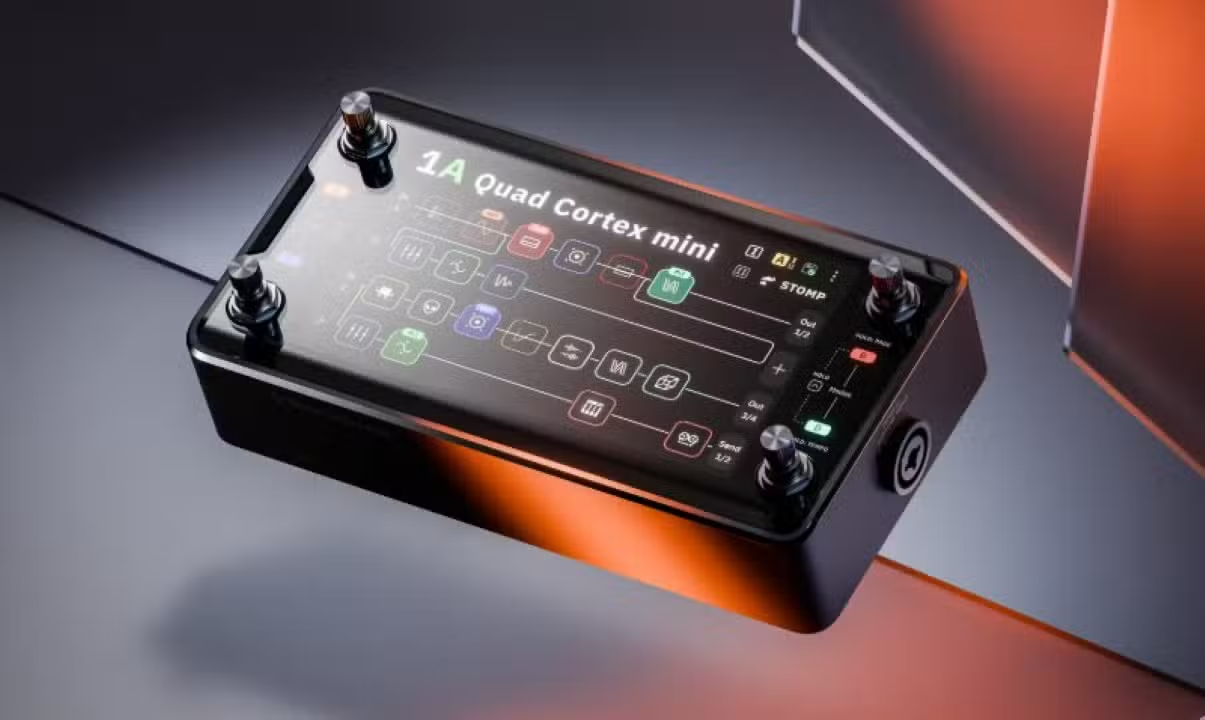
Neural DSP shook up the music equipment market by announcing the Quad Cortex mini during the NAMM 2026 show, at Anaheim, at Estados Unidos. The new digital modeler for guitar and bass promises to deliver all the processing power and acclaimed Neural Capture technology of its bigger brother, the Quad Cortex, but in a chassis less than half the size. The launch, made official on January 21, 2026, directly meets the growing demand for setups from musicians who demand portability without sacrificing sound quality.
With a weight of just 1.5 kg and dimensions of 22.8 x 11.8 x 6.5 cm, the device presents itself as a versatile solution for studios, stages and travel. The Finnish company, founded in 2017, seeks to consolidate its leadership position in the digital modeling segment, offering a product that balances high performance with practicality. The equipment is now available at authorized resellers, accompanied by the important CorOS 4.0.0 system update.
This new version of the operating system, shared between the two models in the line, expands the ecosystem with new effects and tools, ensuring that mini format users have immediate access to the platform’s latest innovations. Full compatibility with presets and captures from the original model reinforces integration between products and the user community. The Neural DSP’s strategy seems clear: offering the same power in different formats to suit different profiles of musicians.
Compact design and robust construction
The design of the Quad Cortex mini was designed to maximize efficiency in a minimum space. Seu anodized aluminum chassis not only provides a modern look, but also ensures the durability necessary for heavy use on tours and live performances. The heart of the interface continues to be the 7-inch touchscreen, which allows intuitive editing of signal chains through a visual grid, one of the main differentiators of the Quad Cortex line. Essa drag-and-drop approach simplifies the creation of complex tones, making the process faster and more creative.
For real-time control, the device has four rotating stainless steel footswitches, strategically positioned in the corners of the unit. Essa arrangement was designed to optimize space and facilitate triggering during performances, allowing the musician to switch between presets, scenes or individual effects with ease. The combination of touchscreen and physical controls provides a hybrid workflow, adaptable for both detailed editing in the studio and direct control on stage, keeping operation fluid and seamless.
Processing capabilities and neural capture technology
The main promise of the Quad Cortex mini is that it fully maintains the power of its predecessor, and this is reflected in the processing architecture. The device utilizes the same hardware platform, ensuring studio-grade audio quality without compromise. Neural Capture technology, one of the cornerstones of Neural DSP, is fully implemented, allowing users to create accurate digital clones of their favorite amps, cabinets, and overdrive, fuzz, or compression pedals.
The equipment comes standard with more than 2000 high-quality captures, covering a wide range of classic and modern tones. Além Additionally, the effects library includes more than 50 algorithms, from reverbs and delays to modulations and utilities. Essa Vast sonic palette gives musicians the tools needed to build virtually any type of rig imaginable, all within a single compact unit.
Integration with the Cortex Cloud expands the possibilities even further, allowing access to a growing library of presets and captures shared by other users around the world. The platform also offers automatic cloud backup, ensuring that the settings and tones created by the musician are always safe and accessible. Mesmo without an internet connection, offline mode guarantees full functionality for rehearsals and shows.
Connectivity and functionality as an audio interface
Despite its small size, the Quad Cortex mini does not skimp on connectivity options, positioning itself as a central hub for any recording or performance setup. Ele functions as an 8-in, 8-out multi-channel USB-C audio interface, operating at 24-bit/48kHz. Essa feature makes it a powerful tool for direct recording, re-amping and processing multiple audio sources simultaneously in a home or professional studio.
The rear panel reveals a full range of inputs and outputs, including combo jacks (XLR/1/4″), balanced XLR outputs for direct connection to PA systems or mixers, and 1/4″ TS outputs. Dois Independent and stereo effects loops provide the flexibility to integrate external pedals into the digital signal chain. The presence of a dedicated headphone output makes it easy to practice silently in any environment.
MIDI support connecting to a computer for content management.
Versatile operating modes
Control flexibility is a strong point of the platform, offering different operating modes to adapt to any situation. The Preset, Scene, The Gig View optimizes the display of on-screen information during shows, displaying only essential data in large, readable fonts, ensuring clarity even on dark stages.
The Parameter Focus System automatically maps an effect block’s most relevant controls to the rotary footswitches, allowing for quick, precise adjustments without needing to dive into menus. Cada preset can contain up to eight scenes, accessible through pages on the footswitches, offering a huge range of sonic variations at your fingertips.
CorOS 4.0.0 Update
The launch of the Quad Cortex mini coincides with the release of the CorOS 4.0.0 update, which brings significant new features to the entire ecosystem. Entre What’s new are new reverb algorithms, such as Nordic Concert Hall, Blossom and Studio Plate 70, which expand the ambience options. Além Additionally, the update introduces the Phase Doctor utility, a tool designed to help phase align signals in stereo or multi-amplifier setups, a valuable resource for producers and sound engineers.
Strategic positioning in the market
With a launch price of €1,299, the Quad Cortex mini is competitively positioned in the high-end styler market. Ele fills a gap between the Nano Cortex, a more affordable and limited option, and the original Quad Cortex, which offers more physical controls but at a greater size and cost. The new Esta unit directly challenges established competitors such as the Line 6, Fractal Audio and IK Multimedia, offering a package that combines top-notch processing with an extremely portable format, appealing to musicians who prioritize mobility.
According to Douglas Castro, CEO and co-founder of Neural DSP, the company’s goal has always been to set the standard for all-in-one digital rigs, and the mini model preserves the architecture and technology that made the original such a success. Francisco Cresp, co-founder and CPO, added that size should not be a limitation to creative capacity, and the new device delivers the same depth and sound quality in a format that opens up new application possibilities.
Main technical characteristics
The Quad Cortex mini’s set of specifications reinforces its proposal of being complete professional equipment in a compact body. Seus key highlights include the 7-inch touchscreen display with grid-based interface, the four stainless steel rotary footswitches, the inclusion of over 2000 Neural Captures from the factory, and the USB-C audio interface functionality with 8 inputs and 8 outputs. The unit also features dual effects loops, multiple I/O options, integrated Wi-Fi for access to the Cortex Cloud, and full compatibility with the Quad Cortex ecosystem, all in a package weighing just 1.5 kg. The evolution of the Neural DSP product line demonstrates clear attention to the needs of modern musicians, who seek solutions that combine extreme portability with uncompromised sound performance.