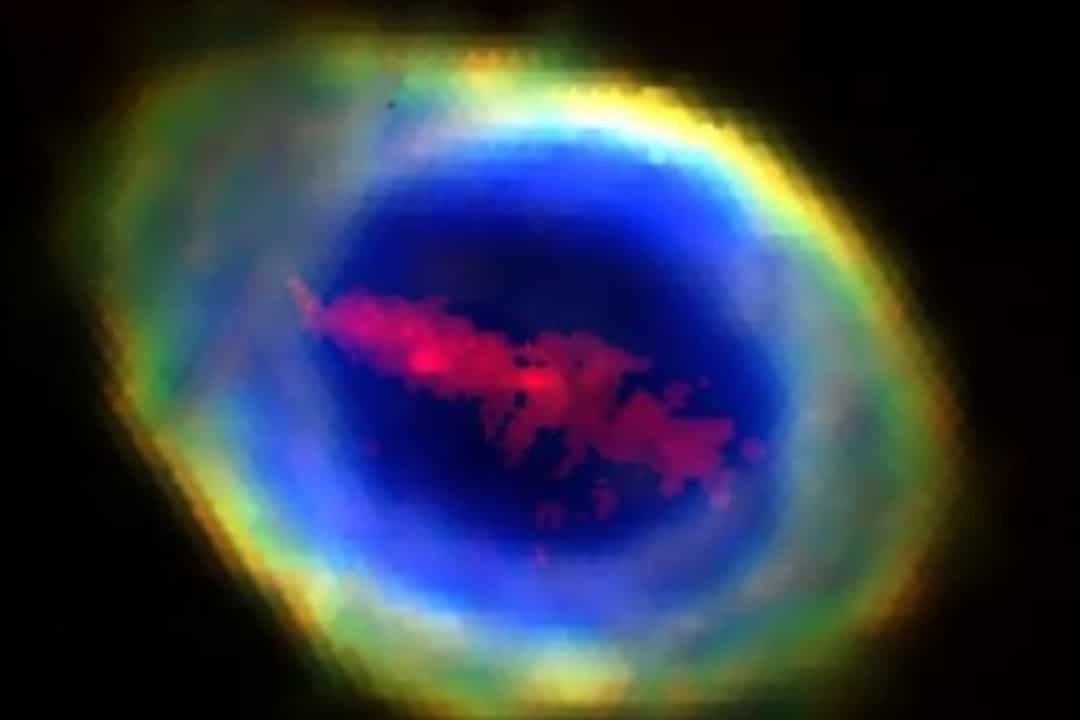
A surprising discovery at the heart of the iconic Nebulosa of Anel (M57), some 2,600 light-years from Terra, is intriguing the scientific community. Astrônomos identified a vast rod-shaped structure, composed of iron plasma, that extends approximately 40,000 astronomical units. Esta colossal dimension is equivalent to five hundred times the diameter of the orbit of Plutão.
Nebulosa of Anel is a well-known planetary nebula often observed for its beauty and distinctive eye-like shape. Formada in the final stages of a star’s life like Sol, it manifests when the central star ejects its outer layers of gas and dust, which are then ionized by ultraviolet radiation, emitting light.
The research team, led by Roger Wesson of Universidade of Cardiff, announced the detection of this mysterious iron bar, whose existence was unknown until then. The estimated total mass of iron in this formation is comparable to that of the planet Marte, adding an extra layer of complexity to the study of stellar and nebula evolution.
The fascinating nature of planetary nebulae
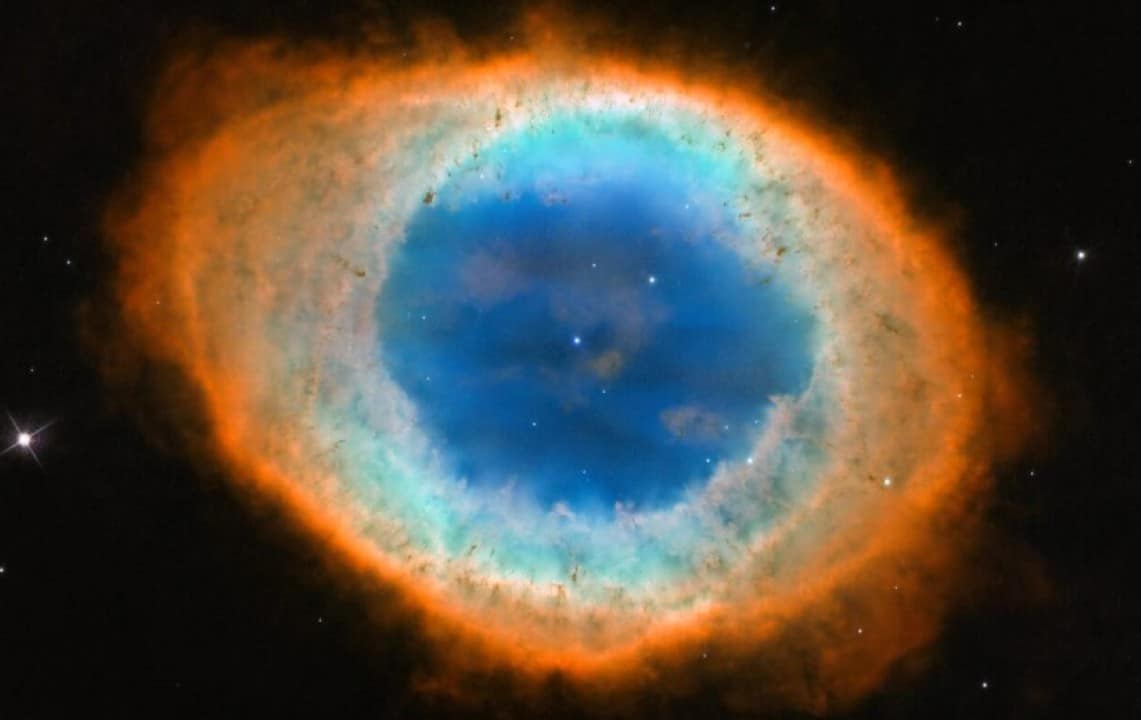
Planetary nebulae, like M57, represent a crucial chapter in the evolution of stars with masses less than eight times that of Sol. Essas stars do not culminate in supernova explosions, but rather in a more gradual and spectacular process of releasing material. As a star consumes its nuclear fuel, it expands into a red giant.
During this phase, the outer layers of gas and dust are expelled into the surrounding space. Eventualmente, the star’s core contracts to form a white dwarf, a dense and compact star. The intense ultraviolet light emitted by this white dwarf ionizes the ejected gas, making it glow and making the nebula visible at long distances in the cosmos. Esse phenomenon creates the complex and colorful shapes that are characteristic of these celestial structures.
Details of the enigmatic discovery
The bar-shaped structure was first observed using the WEAVE spectroscopic device, installed at Telescópio William Herschel (WHT) at Ilhas Canárias. The analyzes revealed that the central area of Nebulosa of Anel, illuminated in red in the spectrum, is composed of highly ionized iron ions, an unprecedented detection. Diferentemente from the known ring shape of oxygen ions on the periphery, this new formation presents an elongated and distinct appearance.
The length of the structure is approximately 40,000 astronomical units, a distance that challenges understanding of its origin and formation. The substantial mass of iron present suggests a significant event that resulted in the concentration of this heavy element in such a peculiar way.
Space observatories assist in investigation
Nebulosa’s historical observations of Anel, dating back to its discovery by Charles Messier in 1779, are now complemented by data from modern instruments. The Telescópio Espacial Hubble (HST) had previously provided detailed images of M57, allowing for in-depth morphological studies. However, identifying the iron plasma required the use of WEAVE’s advanced spectroscopic capabilities.
Subsequently, data from Telescópio Espacial James Webb (JWST) was crucial in offering new clues. The infrared image captured by JWST’s MIRI instrument showed that the same region where the iron bar was found has a darker band with a lower concentration of dust. Essa correlation is vital to hypotheses about structure formation.
Hypotheses about the origin of the iron bar
The formation of the iron rod remains a mystery to researchers. Inicialmente, the team considered the possibility that it was a high-speed jet of gas ejected from the central star. Contudo, detailed kinematic analyzes ruled out this theory, indicating that the structure does not behave like a conventional jet.
One of the main hypotheses raised by the research team is that iron may have been released from the destruction of dust particles. The JWST observation, which revealed less dust in areas with high concentrations of iron ions, supports this idea. However, the absence of a sufficiently powerful energy source in Nebulosa and Anel to pulverize this dust on such a scale is still an obstacle to a definitive conclusion.
Another intriguing theory suggests that the iron could be the remnant of a rocky planet that was disintegrated by its host star in its process of expanding to become a red giant. Essa possibility, if confirmed, would open new perspectives on the interaction between evolving stars and their planetary systems, in addition to providing valuable information about the mechanism of ejection of material that forms the nebula.
Next steps and the future of research
The discovery of the iron structure in Nebulosa of Anel represents a new challenge and opportunity for astrophysics. The lack of important information about the exact formation process requires further investigation. The Wesson team and other scientists are looking forward to new observations of Nebulosa from Anel, as well as other planetary nebulae.
The expectation is that these additional studies may reveal crucial clues about the origin of iron and the complex mechanisms that shape these beautiful and enigmatic cosmic structures. Cada new observation with state-of-the-art telescopes contributes to unlocking the secrets of the universe and refining our understanding of the life and death of stars.
