

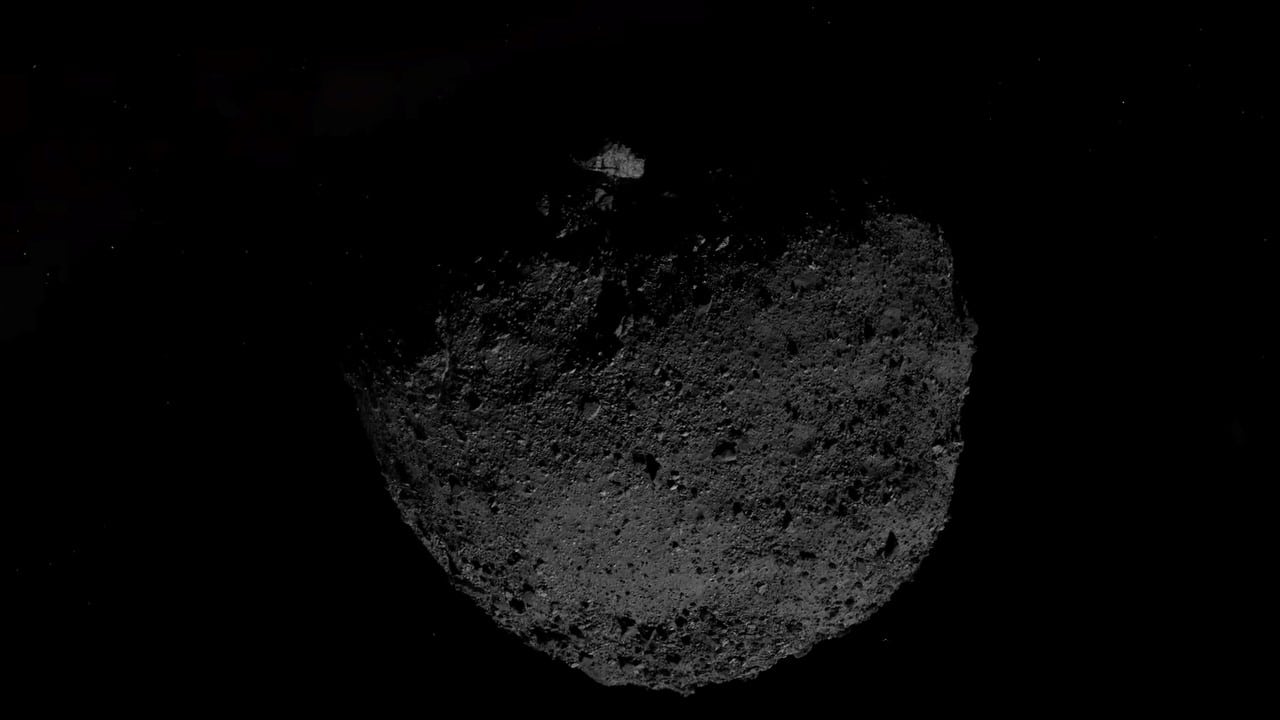
A monumental discovery was announced by scientists at Nasa, revealing the presence of tryptophan, an essential amino acid, in pure samples collected from the asteroid Bennu. The identification, made from material brought to Terra by the OSIRIS-REx mission, represents a milestone in astrobiology and significantly strengthens the theory that the building blocks of life were transported to our planet by celestial bodies billions of years ago.
Tryptophan is a fundamental molecule for terrestrial biology, used by the human body in the production of proteins and vital substances such as serotonin, a neurotransmitter that regulates mood, and melatonin, the hormone responsible for controlling sleep cycles. Its detection in an extraterrestrial environment, preserved in the conditions of space, offers an unprecedented window into the chemistry that preceded life on Terra.
The analysis was conducted by a team led by geochemist Angel Mojarro, from Goddard Space Flight Center of Nasa, in collaboration with researchers from Universidade of Arizona. Este finding is the result of years of planning and the successful execution of the OSIRIS-REx mission, which achieved the feat of collecting and returning material from an asteroid without it being altered by entry into the Earth’s atmosphere.
Details of the unprecedented discovery
The identification of tryptophan is notable mainly because it is an extremely fragile organic molecule. Ela degrades easily when exposed to high temperatures, which is why it has never been detected in meteorites that fall into Terra. Friction with the atmosphere during the fall heats these space rocks to thousands of degrees, destroying delicate compounds like this amino acid.
Thanks to the collection and return method of the OSIRIS-REx mission, the Bennu samples were kept in a controlled and protected environment. Detection was possible through high-precision analytical techniques in laboratories on Terra, which allowed the molecule to be identified without the interference of terrestrial contamination and confirming its extraterrestrial origin.
What else was found in Bennu
The asteroid Bennu turned out to be a true treasure trove of organic compounds. Além of tryptophan, the researchers confirmed the presence of another 14 previously reported amino acids and, even more significantly, found the five nucleobases that make up DNA and RNA: adenine, guanine, cytosine, thymine and uracil. Essas molecules are the fundamental components of the genetic code of all known life, and their presence in Bennu expands the inventory of prebiotic ingredients available at the beginning of Sistema Solar. The chemical diversity, which also includes non-biological compounds, reinforces the idea that the asteroid and its parental body had an environment rich in liquid water in the past, allowing complex reactions to occur that gave rise to this variety of molecules.
The importance of tryptophan for biology
For life on Terra, tryptophan is classified as an essential amino acid, which means it cannot be produced by the human body and must be obtained through food. Sua main function is to act as a building block for the synthesis of proteins, which perform a wide range of tasks within cells, from structuring tissues to catalyzing metabolic reactions. Além In addition, tryptophan serves as a precursor for the production of specialized molecules with critical functions. The best known is serotonin, a neurotransmitter that plays a central role in regulating mood, appetite and sleep. Outra molecule derived from tryptophan is melatonin, the hormone that governs our biological clock, or circadian cycle. Sua presence in Bennu demonstrates that molecules of high complexity and biological relevance can form in non-living environments.
How the OSIRIS-REx mission preserved samples
The success of the detection lies entirely in the engineering and execution of the OSIRIS-REx mission. Lançada in 2016, the spacecraft traveled for more than two years until reaching the asteroid Bennu, where it spent almost two years mapping its surface in detail before collecting it. In October 2020, the probe performed the “Touch-And-Go” (TAG) maneuver, extending a robotic arm to touch the asteroid’s surface for a few seconds and releasing a jet of nitrogen, which lifted dust and small rocks into a collection compartment. Esse innovative method ensured that the material collected was as pure as possible. The capsule containing the samples was then hermetically sealed for the return journey. In September 2023, the capsule detached from the main spacecraft and performed a controlled re-entry into the atmosphere of Terra, protected by an advanced heat shield that prevented extreme heat from damaging its contents. By avoiding atmospheric burning that destroys meteorites, the mission delivered to scientists a fragment of the pristine Sistema Solar in its original state.
Implications for the search for extraterrestrial life
This discovery has profound implications for astrobiology. Ela provides some of the strongest evidence to date for the panspermia, or exogenesis, hypothesis, which posits that life on Terra may have been seeded with essential ingredients from space. Durante the period known as “Intense Bombardeio Tardio”, about 4 billion years ago, Terra was massively hit by asteroids and comets. If bodies like Bennu, rich in water and complex organic compounds, were common, then the early planet received a constant supply of raw materials for the origin of life.
At the same time, the find serves as a note of caution for the search for life on other worlds, such as Marte. The presence of complex organic molecules alone is not definitive proof of biological activity. Nature has demonstrated, through Bennu, that it is capable of synthesizing these compounds in abiotic environments. Portanto, scientists will need multiple lines of evidence to distinguish between prebiotic chemistry and true biosignatures in future planetary exploration missions.
Varied composition of the asteroid
Detailed analysis of samples from Bennu confirmed that the asteroid is a “gap”, a celestial body formed by the agglomeration of rock fragments with different origins and histories. Essa characteristic makes it a geological archive of the early Sistema Solar, containing pieces of one or more parental bodies that were destroyed long ago.
Scientists observed significant variations in mineralogical and chemical composition between different grains in the sample. Algumas portions show clear evidence of having been altered by liquid water in the distant past, a process that may have facilitated the formation of complex organic molecules. Outras parts appear to have a more primitive composition, preserving an even older chemical record. Essa heterogeneity indicates that multiple processes, occurring at different locations and times, contributed to the molecular diversity found on the asteroid.
Next steps of the research
The discovery of tryptophan in Bennu is just the beginning of a long journey of analysis. The research team now plans to carry out additional studies to validate and deepen the understanding of the origin of the molecule. Entre the techniques to be used are the analysis of enantiomeric and isotopic composition. The first will seek to determine the “chirality” or “handedness” of the amino acid, as life on Terra exhibits a strong preference for “left-handed” amino acids. Encontrar a mixture of “left-handed” and “right-handed” forms would be a strong indication of its non-biological, extraterrestrial origin. Isotopic analysis, in turn, will measure the proportions of different isotopes of elements such as carbon and hydrogen, which can provide a distinct signature to differentiate between terrestrial and extraterrestrial material. The continued study of samples from Bennu, along with future sample return missions from other asteroids, is considered essential to unlocking the secrets of the chemistry that gave rise to life on Sistema Solar.