

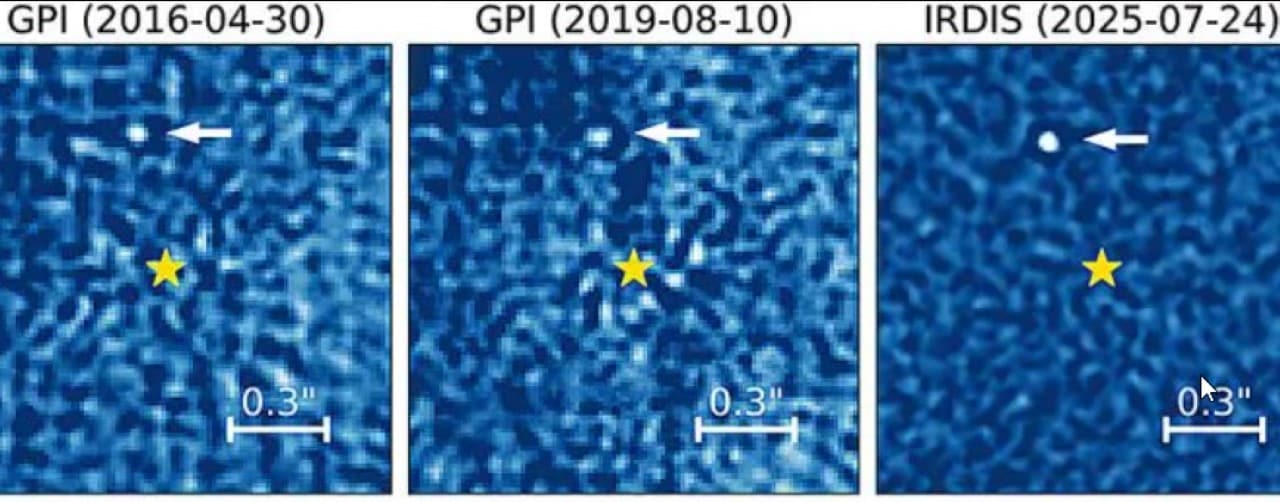
An international team of astronomers, involving researchers from Northwestern University and Universidade of Exeter, has confirmed the identification of a gas giant exoplanet orbiting a pair of stars. The discovery evokes images from science fiction, reminiscent of the planet Tatooine from the Star Wars saga, known for having two suns in its sky.
The planet, cataloged as HD 143811 AB b, is located approximately 446 light-years from our Sistema Solar. Ele is part of the Scorpius-Centaurus stellar association, a vast star-forming region relatively close to Terra, which makes it a frequent target for studies on the evolution of young planetary systems.
This finding is particularly significant because it represents the direct image of a circumbinary exoplanet — which orbits two stars — closest to its stellar pair ever recorded to date. The confirmation was made possible by reanalysis of archived data, combined with new observations, demonstrating the ongoing potential of astronomical archives for new discoveries.
Characteristics of the newly discovered gas giant
HD 143811 AB b is a world of impressive proportions, classified as a gas giant with a mass estimated at six times that of Júpiter, the largest planet in our Sistema Solar. Sua youth, just 13 million years old, is a crucial factor for its detection. In cosmic terms, this age is considered recent, which means that the planet still retains much of the heat generated during its formation process. Essa residual heat emission makes it brighter in the infrared spectrum, making it easier to see using direct imaging techniques. The temperature on its surface is extremely high, estimated at around 769 degrees Celsius, an inhospitable environment and very different from anything found in our system. The combination of its high mass, high temperature and proximity to two sources of stellar radiation makes it a natural laboratory for studying the extreme conditions under which planets can form and evolve in complex and dynamic environments.
The system’s complex orbital dance
The orbital dynamics of the HD 143811 AB b system is a fascinating example of gravitational interactions. The giant planet completes a single revolution around its two stars in a period of approximately 300 Earth years. Sua’s orbit is vast, placing it at a distance of about 60 astronomical units (AU) from the stellar pair’s center of mass, which is equivalent to 60 times the average distance between Terra and Sol. Apesar of this great separation, this is the closest orbit ever imaged for a circumbinary planet.
As the planet makes its long journey, the two host stars perform their own orbital dance, rotating around each other at a much faster pace, with a period of just 18 days. Essa configuration of a compact stellar pair with a distant planet in a stable orbit provides valuable data for scientists modeling the formation and stability of planetary systems in binary configurations, which are common in our galaxy.
The detection and confirmation method
The discovery of HD 143811 AB b was the result of meticulous data review work. The research teams analyzed files from the Gemini Planet Imager (GPI), an instrument that operated on the Gemini South telescope, located at Chile, between 2016 and 2019. The GPI was designed specifically to detect the faint light emitted by young exoplanets orbiting nearby stars.
After the closure of GPI operations in the Southern Hemisphere, scientists dedicated themselves to combing through its vast collection of data in search of signals that might have been missed in initial analyses. A faint point of light near the binary star system caught the researchers’ attention.
To confirm that the object was indeed a planet and not a distant background star, astronomers used additional observations of Observatório W. M. Keck, at Havaí. By comparing images from different times, they were able to verify that the point of light moved together with the pair of stars, confirming their gravitational association.
Notably, the data reanalysis approach allowed two different research groups to reach the same conclusion independently, strengthening the validity of the discovery and highlighting the importance of preserving and reexamining astronomical data.
The rarity of planets in binary systems
Although more than 6,000 exoplanets have been confirmed to date, only a small fraction of them have been found orbiting binary star systems. Detecting these worlds, known as circumbinary planets, is a considerable technical challenge. The main difficulty lies in the intense brightness of the host stars, which tends to overshadow the faint light reflected or emitted by any companion planets.
The direct imaging technique, used in this case, is one of the most difficult, but also one of the most rewarding, as it allows you to capture photons that come directly from the planet. However, it is mainly effective for giant, young planets in orbits far from their stars. Apenas a handful of circumbinary planets have been discovered using this method.
These systems are extremely valuable for science, as they allow the simultaneous study of stellar and planetary orbits. The complex gravitational interaction between three bodies (the two stars and the planet) provides a rigorous testing ground for theories about orbital dynamics and planet formation.
Hypotheses about planetary formation
The exact process that led to the formation of HD 143811 AB b is still a topic of debate among experts. Traditional theories of planet formation face challenges when trying to explain the existence of gas giants in such wide orbits within binary systems.
One of the main hypotheses is that of gravitational instability, in which the disk of gas and dust that originally surrounded young stars fragmented due to instabilities in its own gravity, leading to the formation of one or more giant planets relatively quickly. Outra possibility is the core accretion model, where a rocky core forms first and then accumulates a vast gas atmosphere, followed by a migration to a more distant orbit due to interactions with the disk or other bodies.
Visualization and future studies
To illustrate the discovery, the researchers created a sequence of time-lapse images that show the planet’s orbital movement around the stellar pair over the years of observation. Esse visual recording not only confirms the planet’s trajectory, but also helps refine the parameters of its orbit.
The confirmation of HD 143811 AB b paves the way for future observations. Astronomers plan to continue monitoring the system to more accurately map its full orbit. The detailed study, published in the scientific journal Astronomy & Astrophysics, serves as a basis for future research into the demography and characteristics of planets in multiple star systems.
The importance of the Scorpius-Centaurus association
The system’s location in the Scorpius-Centaurus association is key to the discovery. The Esta region is the closest massive star forming area to the Sol and contains thousands of young stars. The relatively young age of these stars means that any planets orbiting them will also be young, emitting more heat and making them an easier target for direct imaging detection.