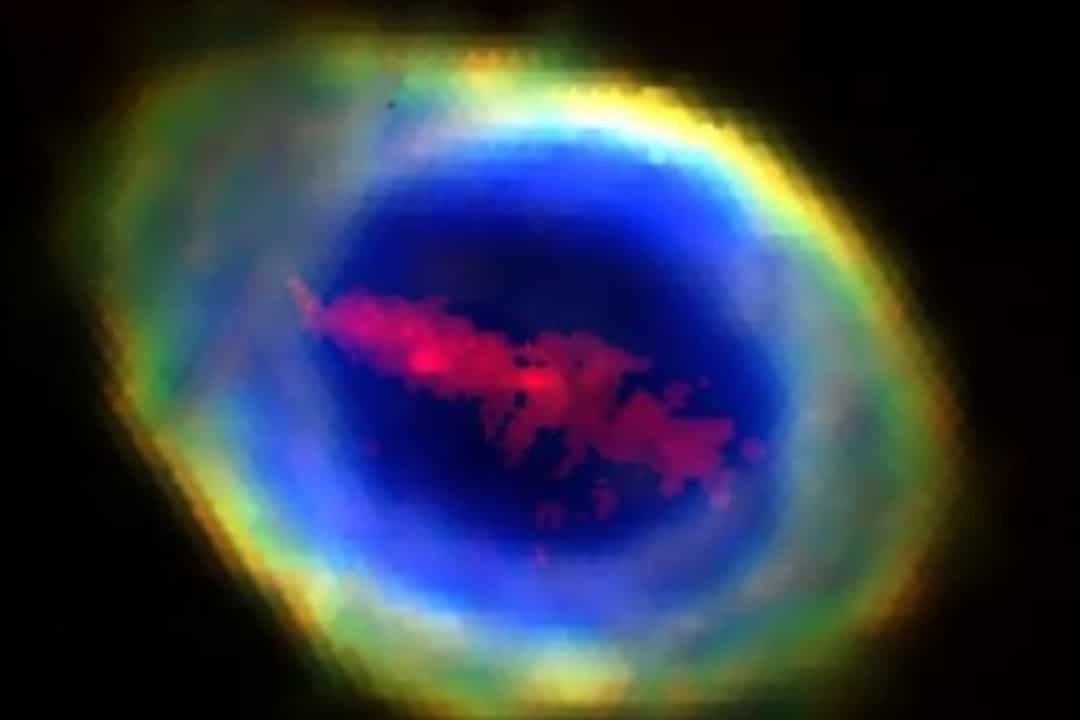
An international team of scientists recently identified a surprising and unprecedented formation inside Nebulosa of Anel (M57), one of the most studied celestial objects. Localizada approximately 2,600 light years from Terra, in the constellation of Lira, this structure is a long and narrow bar composed of ionized iron, extending for trillions of kilometers in the heart of the nebula. The discovery, detailed in the scientific publication *Monthly Notices of the Royal Astronomical Society*, represents a profound enigma for researchers.
The detection of this singularity was possible thanks to the advanced capabilities of the WEAVE instrument, recently installed on Telescópio William Herschel, located at Ilhas Canárias. WEAVE allows the capture of highly detailed spectra of vast portions of the nebula, revealing a cloud of iron atoms that emit light in a linear fashion, something never before observed in planetary nebulae. The amount of iron contained in this bar is comparable to the mass of the molten core of our own planet, or even that of Marte, an unexpectedly large concentration of a single chemical element in such a peculiar configuration.
The technique that revealed the cosmic mystery
The observation of this iron bar represents a significant milestone in astronomy, mainly due to its unprecedented nature. Técnicas Previous spectroscopic images, often focused on narrower bands of the nebula, failed to capture this formation, which remained hidden outside their fields of view. WEAVE’s ability to analyze broad regions with high spectral resolution was key to the revelation.
This new instrument not only mapped the distribution of iron, but also allowed astronomers to study the material’s velocity and temperature, providing crucial clues about the formation and evolution of M57. Spectroscopic analysis is a powerful tool, capable of breaking down light from celestial objects into their components, revealing the chemical composition, temperature, density and movement of gas and dust in deep space.
The enigmatic origin of the iron bar
Scientists are actively investigating several hypotheses to explain the presence and shape of this iron bar. One of the most discussed theories suggests that the structure could be a vestige of a rocky planet that was subjected to a vaporization process. Esse event would have occurred when the nebula’s progenitor star, upon entering its final stages of life, expelled its outer layers and transformed into a white dwarf, a scenario that, although intriguing, remains in the field of speculation.
Another possibility lies in the complex asymmetric dynamics of material ejection from the dying star. The way the star expels its mass can create unusual patterns and unique structures, like this iron bar, rather than a homogeneous expansion. Essas ejections can be influenced by stellar magnetic fields, the presence of companion stars or even internal processes within the main star, which result in directed flows of material with specific compositions.
Understanding Nebulosa of Anel and its star formation
Nebulosa of Anel, also known as M57 or NGC 6720, is a classic example of a planetary nebula. Ela forms from gas and dust expelled by a star similar to Sol in its final stages of life. As the star uses up its nuclear fuel, it expands into a red giant before ejecting its outer layers into space, leaving behind a hot, dense core known as a white dwarf. The ultraviolet radiation emitted by the white dwarf ionizes the ejected gas, causing it to glow in spectacular colors.
These nebulae are natural laboratories for studying stellar evolution, offering insights into the future of stars like our own Sol. Elas generally exhibit a variety of complex structures, including concentric rings, lobes, and filaments of gas, which are shaped by the interaction of the stellar wind with the ejecta. The discovery of the iron rod in M57 adds a new layer of complexity to these already fascinating objects, challenging existing models and expanding our understanding of the processes that occur during the end of a star’s life.
Implications for the evolution of planetary systems
The existence of a structure as unusual as the ionized iron rod in M57 has profound implications for understanding the evolution of planetary systems around stars similar to Sol. If the vaporized planet hypothesis turns out to be true, it could suggest that many star systems may have rocky planets that would not survive the final phase of their host star. Tal scenario would offer a new perspective on the ultimate fate of planets and the recycling of material in galaxies.
Furthermore, detailed analysis of the composition and dynamics of this bar can offer clues about the extreme physical processes that occur during the transition from a star to a white dwarf. Compreender How heavy elements like iron are distributed and reconfigured in the environment of a planetary nebula can refine our models of star and planetary formation, elucidating fundamental questions about the origin and abundance of elements in the universe. The planned additional observations, with even higher spectral resolution, are eagerly awaited, as they promise to unlock the secrets behind this mysterious cosmic formation.
Advances and perspectives in astronomical research
The revelation of this iron bar in Nebulosa of Anel not only adds a new element of surprise to one of the most studied objects in the sky, but also highlights modern astronomy’s growing ability to uncover microscopic details on cosmic scales. The continued evolution of instruments like WEAVE allows scientists to push the limits of what can be observed and understood, revealing structures and phenomena that were previously unimaginable.
Research into planetary nebulae, which previously focused primarily on spherical or bipolar shapes, is now expanding to include investigation of complex chemical compositions and dynamics in their cores. Next steps will include higher-resolution observations to analyze the bar in more depth, looking for subtle variations in its composition or movement that could provide further evidence about its formation. Essas future investigations will be crucial to transform current hypotheses into more concrete theories and, perhaps, solve the mystery of this cosmic iron structure once and for all.
—
Palavras key: Nebulosa of Anel, ionized iron, astronomy, white dwarf, telescope WEAVE
Palavra long-tail key: Descoberta iron bar in Nebulosa of Anel M57 intrigues scientists
