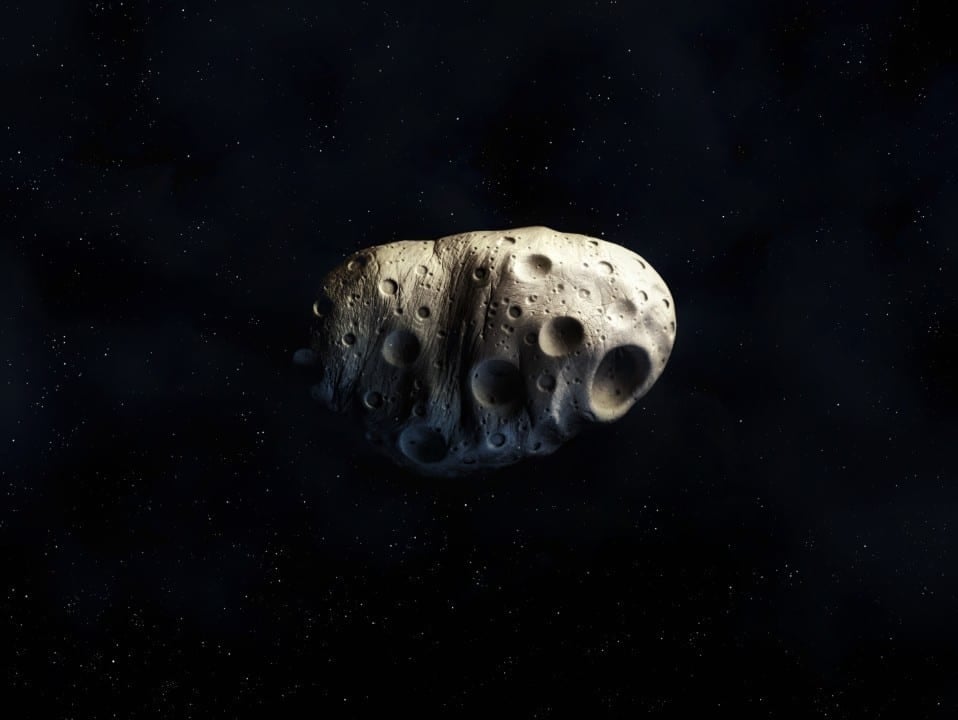
An asteroid with dimensions comparable to those of a commercial aircraft made a close pass to Terra on December 9, 2025, an event that was closely monitored by global space agencies. The object, cataloged as 2025 XM, reached its closest approach at a safe distance of 475 thousand kilometers from our planet, moving at a speed of approximately 15,700 kilometers per hour.
The trajectory of the rocky body was calculated with high precision by NASA’s Laboratório from Propulsão to Jato (JPL), which confirmed there was no risk of collision. The passage offered a valuable opportunity for scientists and astronomers to carry out detailed observations, collecting data on its composition, size and rotation, contributing to the improvement of planetary defense models.
Although the approach was notable, 2025 XM was not classified as a potentially hazardous object. Essa category is reserved for celestial bodies that meet specific size and proximity criteria, which this asteroid did not meet, ensuring that its journey through our solar system would continue without posing a direct threat.

Orbital approach details
The distance of 475 thousand kilometers places the passage of asteroid 2025 XM at a mark higher than the average distance between Terra and Lua, which is around 385 thousand kilometers. Essa margin, although it seems small in astronomical terms, was more than enough to guarantee a safe crossing. The object’s high relative speed, exceeding 4.3 kilometers per second, limited the observation window, requiring telescopes to quickly track its movement to capture spectral and albedo data.
The precise calculation of its elliptical orbit is a testament to the technological capabilities of monitoring centers like JPL. Utilizando a network of terrestrial and space observatories, experts can predict these trajectories years in advance. The gravitational forces of Sol and other planets constantly influence the path of these objects, making continuous monitoring an essential task for space safety and planetary science.
The criterion of a potentially dangerous object
The classification of a celestial body as Objeto Potencialmente Perigoso (PHO) is determined by strict guidelines established by the international astronomical community and followed by NASA. Para receives this designation, an asteroid or comet must have a diameter greater than 140 meters and its orbit must cross that of Terra at a distance of no more than 7.5 million kilometers. The asteroid 2025 NASA’s Defesa Planetária program has cataloged more than 30,000 NEOs of all sizes, a small fraction of which fall into the PHO category. Esse Cataloging work is fundamental, as it allows scientists to prioritize the monitoring of objects that could, in theory, pose a threat in future passages, guaranteeing time for the development of mitigation missions, if necessary.
The global space surveillance network
Monitoring of objects like 2025 XM is coordinated by NASA’s Escritório of Coordenação of Defesa Planetária (PDCO). Esta division centralizes efforts to detect, track and characterize asteroids and comets approaching Earth’s orbit.
Initial detection usually occurs using wide-field scanning telescopes, such as the Pan-STARRS system on Havaí and the Catalina Sky Survey on Arizona. Esses instruments photograph large areas of the night sky repeatedly, and image analysis software identifies points of light that move relative to background stars.
Once a new object is identified, observatories around the world are notified to perform follow-up observations. Esses additional data allows us to refine the calculation of the object’s orbit, determine its size, rotation period and, in some cases, obtain information about its composition through spectroscopy.
This international collaboration is vital as it ensures continuous coverage and cross-validation of information. Agências like Agência Espacial Europeia (ESA) also play a crucial role, sharing data and resources to maintain a comprehensive and up-to-date global catalog of all known NEOs.
Comparison with other celestial bodies
The week in which 2025 XM made its passage was particularly busy in the cosmic neighborhood of Terra. The following day, December 10, 2025, two other asteroids also crossed the region, although at greater distances.
The first of them, called 2019 XN3, was about 15 meters in diameter and passed at a safe distance of 1.36 million kilometers. Sua passage illustrates how often smaller, harmless objects cross our space.
On the same day, asteroid 1999 SF10, a significantly larger rocky body measuring 43 meters, approached within 1.95 million kilometers. Eventos such as these highlight the importance of continuous monitoring, as they demonstrate that the inner solar system is a dynamic environment, with constant traffic of objects of different sizes and trajectories.
Implications for space research
Each transition from Objeto Próximo to Terra offers a unique opportunity for science. Data collected from 2025 XM, for example, helps refine models about the population of asteroids in the solar system, especially those whose orbits bring them close to our planet. Analysis of its composition, based on the sunlight it reflects, can reveal information about the conditions of the early solar system, as many of these asteroids are remnants of the formation of planets.
Furthermore, the detailed study of their trajectories allows us to test and improve our understanding of celestial mechanics and gravitational effects. The information obtained is crucial not only for planetary defense, but also for planning future space missions, whether robotic or manned, that will need to safely navigate this environment. The ability to accurately predict the return of these objects in future decades is one of the main objectives of the monitoring program.
The legacy of the DART mission
Asteroid monitoring is not limited to passive observation. NASA and its international partners are actively developing technologies to mitigate potential impact threats. The most significant proof of concept to date was the DART (Double Asteroid Redirection Test) mission, successfully completed in 2022. The mission involved deliberately crashing a spacecraft into the small asteroid Dimorphos, which was orbiting a larger asteroid,
The impact successfully altered the orbital period of Dimorphos, demonstrating that the “kinetic impact” technique is a viable strategy for deflecting an asteroid from a collision trajectory with Terra. The knowledge gained from DART is fundamental for planning future planetary defense missions, transforming a theoretical concept into a proven ability to protect the planet.
