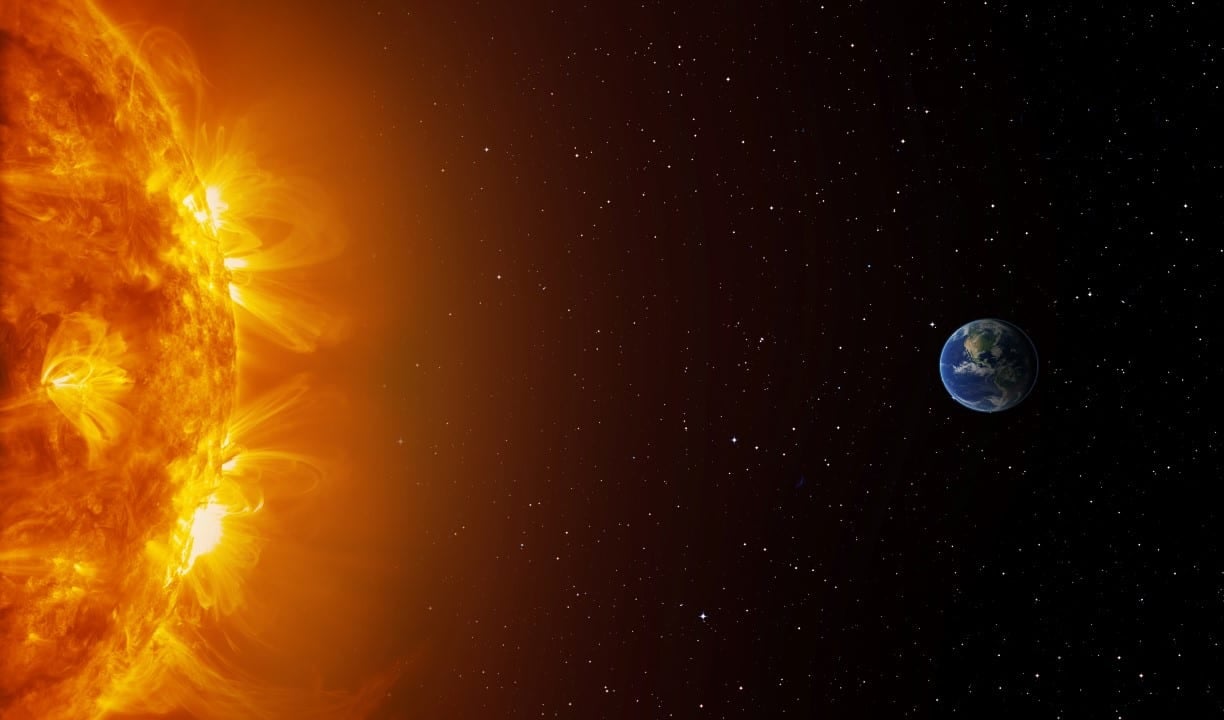
A new international study has revealed the identification of an exoplanet with characteristics remarkably similar to those of Terra, reigniting the debate about the likelihood of life outside our solar system. Batizado provisionally known as HD 137010 b, this celestial body has about a 50% probability of being located in the habitable zone of its star, a crucial factor in supporting liquid water on its surface.
Located approximately 146 light-years from our solar system, in the constellation of Lupus, the candidate planet has dimensions close to Earth’s and an orbit that is similar in length to the year in our own world. Essa combination of factors makes it one of the most intriguing targets for future astronomical investigations in the field of astrobiology.
Research detailing these revelations was recently published in the journal Astrophysical Journal Letters, generating great anticipation and excitement in the global scientific community. Data for the detection was initially collected in 2017, marking one of the many legacies of NASA’s prolific and successful Kepler space telescope mission.
Details of the discovery of HD 137010 b

HD 137010 b was identified using the planetary transit method, a technique that monitors variations in a star’s brightness. Quando an exoplanet briefly crosses in front of its host star, it causes a slight and temporary decrease in starlight, a characteristic signal that allows astronomers to infer the presence, size and orbit of distant planets.
Initially, the discovery had a citizen science feel, with the first indication of the planet’s existence coming from a group of enthusiasts, including a high school student. Essa nomination was a starting point for validation, demonstrating how public participation can accelerate scientific progress in space exploration.
Orbital characteristics and host star
Scholars estimate that HD 137010 b has an orbit lasting approximately 355 days, a period that remarkably aligns with the 365 days it takes for Terra to circle Sol. Essa Orbital similarity is one of the aspects that most intrigue scientists, suggesting relatively stable planetary dynamics comparable to ours.
The star around which HD 137010 b orbits is classified as being cooler and dimmer than our own Sol. Essa characteristic has direct implications for the surface conditions of the exoplanet, influencing its temperature and the potential presence of an atmosphere capable of supporting life, even under more extreme conditions than those on Earth.
The habitability potential
The designation “habitable zone” is crucial in astrobiology, representing the ideal distance from a star where the temperature allows liquid water to exist on the surface of a planet, a fundamental requirement for life as we know it. That HD 137010 b has about a 50% chance of being in this zone is highly significant, positioning it as a promising candidate for in-depth study.
Researcher Chelsea Huang of Universidade of Sul of
By comparison, Kepler-186f, another exoplanet in the habitable zone of a star similar to Sol, is approximately four times as far away and is 20 times fainter in terms of apparent brightness. The relative proximity and brightness of the HD 137010 b system facilitates data collection and potential atmospheric characterization with current and future technologies, including the use of spectroscopy to identify biomarkers.
The role of citizen science
The contribution of citizen scientists in the initial identification of HD 137010 b illustrates the power of open science and public engagement in space exploration. Indivíduos without formal academic training, armed with passion and online tools, they are able to help analyze vast volumes of data that could otherwise overwhelm research teams, highlighting the value of distributed collaboration in large-scale projects.
Environmental conditions and comparisons
Despite its similar size to Terra and its almost identical orbit, the estimated weather conditions on the surface of HD 137010 b are considerably different from ours. Projections indicate that temperatures could be as low as -70°C, making it more similar to Marte in thermal terms than to Terra.
This low temperature is a direct consequence of the host star being cooler and less luminous than Sol. Mesmo being within the habitable zone, the intensity of the radiation received is lower, which impacts atmospheric conditions and the potential presence of liquid water, which could be under the surface or in the form of ice, protected from extreme temperatures.
The comparison with Marte does not extend to its current habitability, but serves to contextualize the extreme conditions that may prevail in HD 137010 b. The complexity of the interaction between the star, the planet’s possible atmosphere and its geological composition will determine the real capacity to support life forms, requiring deeper analyses.
Efforts to characterize planets like this one include analyzing their atmospheres to detect biosignatures, gases that could indicate biological processes. Embora challenging due to the distance, each new discovery improves the techniques and models for this search, pushing the limits of astronomical observation.
Implications and the future of space research
The discovery of HD 137010 b serves as a powerful catalyst for the ongoing and tireless search for exoplanets that could harbor life. Cada identification of a new world refines scientists’ understanding of planetary diversity in our galaxy and the specific conditions that may be favorable for the development and maintenance of habitable environments, improving theoretical and computational models.
Astrophysicist Sara Webb, of Universidade of Ela, however, issued an important warning about the vast distances involved in space exploration, which remain a significant obstacle.
Webb pointed out that although HD 137010 b is relatively close in cosmic terms, a journey to reach it with current propulsion technologies would take “tens of thousands, if not hundreds of thousands of years.” Isso highlights the enormous technological challenges that humanity still needs to overcome to make the direct exploration of exoplanets a viable reality and not just a fictional concept, stimulating research into advanced propulsion.
The legacy of the Kepler telescope and new missions
The Kepler mission, which operated successfully between 2009 and 2018, revolutionized astrophysics and the search for exoplanets, detecting thousands of new worlds using the transit method. Although the specific data that led to the discovery of HD 137010 b was collected in 2017, the legacy and wealth of information provided by this telescope continues to generate significant revelations years after the end of its primary operations. Scientists are still extracting new insights from their archives, demonstrating the longevity and lasting impact of space missions.
The astronomical community’s ongoing work, utilizing both historical data from previous missions and the advanced capabilities of next-generation telescopes such as Telescópio Espacial James Webb (JWST), promises to further deepen knowledge about HD 137010 b and a myriad of other exoplanets. Estes new and more powerful instruments have the unprecedented ability to more accurately characterize the atmospheres of these distant worlds, analyzing their chemical composition and identifying potential biomarkers. Essa analytical capacity brings humanity closer to the final answer to the ancient question about the existence of life beyond Terra, transforming speculation into rigorous scientific investigation based on concrete data.
