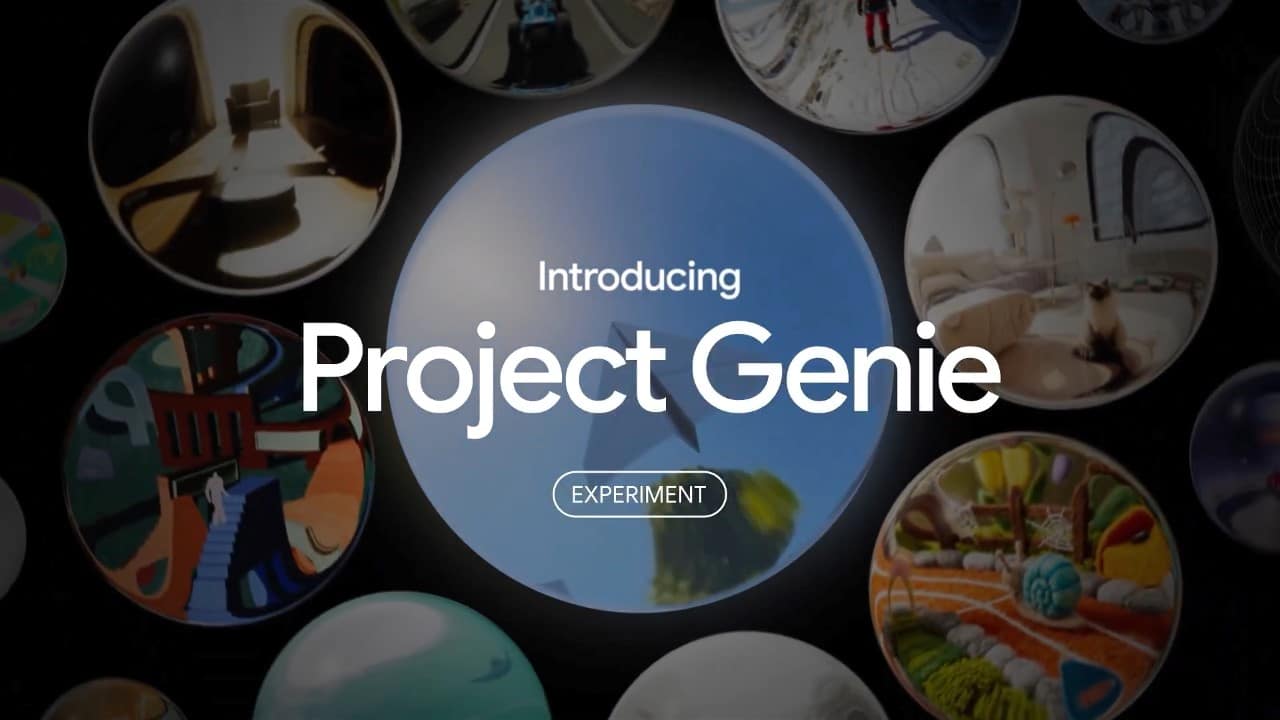
Google DeepMind has begun shipping the Project Genie, a research prototype that allows users to create and explore interactive virtual worlds generated by artificial intelligence. The service is initially available only to subscribers of the Google AI plan Ultra or Estados Unidos, with a minimum age of 18. The rollout began on January 29, 2026, and the company plans to expand access to other regions in the future.
The tool uses the Genie 3 model, presented in August 2025, to generate real-time environments from text prompts or images sent by users. The worlds are rendered in 720p resolution at a rate of 24 frames per second, allowing navigation with basic controls such as WASD keys and arrows to move the camera.
Participants can download videos of their explorations and share creations for other users to remix with new descriptions.
Key features of the prototype
Project Genie offers three main modes of interaction that make it easy to create and explore virtual environments. Users start by describing the desired world via text or sending reference images, adjusting details such as the main character’s appearance, perspective of vision and way of moving.
After the initial generation, you can explore the environment in real time as the model predicts and renders new elements based on the actions you take. The tool also allows you to remix existing creations, applying new prompts to worlds generated by other users or yourself.
- Generation of worlds from text or image
- Interactive exploration with keyboard controls
- Remixing creations shared on the platform
- Download videos of exploration sessions
These options make the prototype accessible for creative experimentation, although still limited in scope.
Step inside Project Genie: our experimental research prototype that lets you create, edit, and explore virtual worlds. 🌎pic.twitter.com/HQr1FRNlpy
— Google DeepMind (@GoogleDeepMind)January 29, 2026
Technology behind Genie 3
Genie 3 is a general world model capable of simulating environmental dynamics and predicting the effects of actions in varied environments. Diferente than traditional game engines, it learns physics patterns and interactions through autoregressive training, without the need for pre-programmed rules.
The model maintains temporal consistency for a few minutes, remembering previous elements to generate coherent transitions during navigation. Essa capacity represents an improvement over previous versions, such as Genie 1 and Genie 2, which focused on more restricted environments.
Integration with Project Genie allows everyday users to test these features in a controlled environment. Current resolution and frame rate meet the demand for real-time interactivity, prioritizing fluidity over maximum graphic quality.
Limitations identified at launch
The prototype has technical restrictions that affect the complete user experience. Generation sessions are limited to 60 seconds, and world consistency may break down in longer or more complex interactions.
In some cases, environments do not strictly follow the laws of real physics or the details of the prompt provided, resulting in less realistic elements. Latency when controlling characters varies depending on the complexity of the scene, and not all movements respond with immediate precision.
- Maximum duration of 60 seconds per generation
- Possible visual and physical inconsistencies
- Variable latency when controlling characters
- Lack of traditional game mechanics
These limitations are expected in an experimental version and should be improved in future updates.
Examples of user-created worlds
Users with early access demonstrated diversity in creations made with Project Genie. Alguns generated environments inspired by well-known games, such as scenarios similar to open forests or classic platforms, exploring possibilities for recreation.
Others focused on original themes, such as marshmallow castles, cosmic landscapes or reconstructed ancient cities. The tool allows for experimentation with vehicles, swimming, or flight, depending on the descriptions provided in the initial prompt.
These demonstrations highlight the model’s flexibility for interpreting varying prompts. The community has been sharing short videos showing explorations in different styles, from first-person adventures to third-person views.
Context of world model development
World models have represented a priority research area at Google DeepMind for more than a decade. Esses systems simulate the evolution of environments and impacts of actions, serving as a basis for training AI agents in unlimited scenarios.
Genie 3 moves in this direction by generating unprecedented diversity of interactive environments from simple inputs. The autoregressive approach allows prediction of subsequent frames while maintaining basic visual and physical coherence.
This progress contributes to long-term goals in artificial general intelligence. Project Genie serves as a practical interface to collect feedback on real-world applications of these models.
Access and expansion requirements
Access currently requires subscription to the Google AI Ultra plan, Google’s most advanced level of AI services. The prototype is restricted to users aged Estados Unidos, with age verification for those over 18 years old.
The company informed that the rollout will be gradual even within the initial eligible audience. Planos expansion to other countries will be implemented as tests and technical adjustments progress.
Interested users can follow updates on Google Labs, where Project Genie is hosted. The platform also displays sample generated worlds for inspiration before full access.
Available customization features
Customization begins in the sketching phase, where users define detailed parameters of the world. It is possible to specify elements such as lighting, climate, objects present and behavior of the controlled character.
The image upload option speeds up the process, serving as a visual base for the model to interpret and expand. Após generation, adjustments by new prompts refine the environment without the need for a complete restart.
- Setting Perspective (First or Third Person)
- Choice of locomotion methods (running, swimming, flying)
- Inclusion of dynamic events in the prompt
- Real-time adjustments during exploration
These features increase creative control within current technical limitations.
Initial community feedback
Reliable testers have reported an impressive array of uses not initially anticipated by the development team. Muitos highlighted the ability to generate immersive experiences in just a few seconds from simple ideas.
Others have pointed to potential for rapid prototyping in areas like game design or virtual education. Sharing creations encourages collaboration, with users remixing other people’s worlds to create unique variations.
The general response indicates high interest in the concept of accessible world models. The company monitors these returns to prioritize improvements in the next versions of the prototype.
