

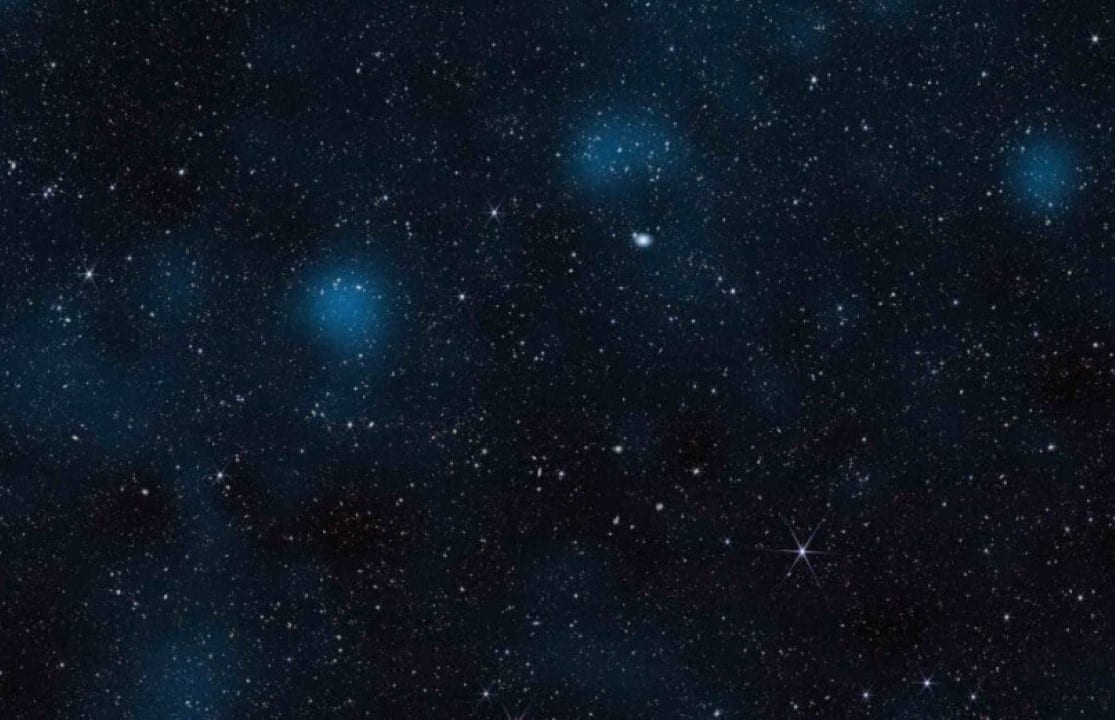
An international team of astronomers, using the powerful Telescópio Espacial James Webb, has managed to produce the most detailed map ever made of dark matter, the invisible substance that makes up most of the mass of the universe. The image reveals with unprecedented clarity the vast and complex network of filaments that connect galaxies, often described as the “cosmic skeleton” on which the visible universe is built.
The research, the result of more than 255 hours of observation focused on a region of the sky in the direction of the constellation Sextans, identified the position of almost 800 thousand galaxies. Analysis of this data allowed scientists to map how the gravitational force of dark matter organizes ordinary matter, confirming fundamental theories about the formation of cosmic structures since the beginning of the universe, shortly after Big Bang.
Published in the prestigious magazine Nature Astronomy, the study represents a milestone in modern cosmology. The accuracy of the new map not only validates existing theoretical models, but also opens new windows to investigate the enigmatic nature of dark matter, which, despite making up about 26% of the cosmos, has never been directly detected.
The Technique Behind Invisible Mapping
To visualize what is inherently invisible, the researchers employed a phenomenon predicted by the Einstein theory of relativity, known as weak gravitational lensing. Dark matter, like any matter, has mass and therefore exerts a gravitational force that bends the fabric of space-time around it. Quando light from very distant galaxies travels towards us and passes through a large concentration of dark matter, its trajectory is slightly deflected. Esse deviation causes a subtle distortion in the image of the galaxy we observe, making it appear slightly stretched or deformed.
The Telescópio Espacial James Webb is uniquely suited for this task due to its unprecedented sensitivity to infrared light and its superior spatial resolution. By observing hundreds of thousands of background galaxies, scientists have statistically measured these tiny distortions in their shapes. Compilando these data, it was possible to reconstruct the gravitational field and, consequently, the distribution of the invisible mass that causes the effect. The Webb’s ability to see further back in time and with greater clarity enabled mapping that was twice as accurate as previous efforts, such as those undertaken by the Telescópio Espacial Hubble.
Unprecedented resolution and new discoveries
The main advantage of this new map is its improved resolution. Estruturas that previously appeared blurry or completely undetectable on previous maps are now visible in sharp detail. Astronomers were able to identify much thinner dark matter filaments and more compact clusters, which function as the superhighways and great intersections of the cosmic web.
This superior clarity allows us to study the universe at a crucial time in its history, when it was about half its current age and star formation was at its peak. Detailed observation of these substructures offers valuable clues about how matter was funneled into denser regions, fueling the growth of the galaxies we see today.
By comparing the new data with computer simulations, scientists can refine models that describe the evolution of the cosmos. Cada new detail observed in the distribution of dark matter serves as a rigorous test for cosmological theories, helping to better understand gravitational accretion processes at different scales.
International scientific collaboration
This monumental breakthrough was made possible by broad international collaboration. The initiative was led by scientists from Universidade of Durham, in Reino Unido, in close partnership with the North American space agency, NASA, and Escola Politécnica Federal of The project brought together dozens of experts in cosmology, observational astrophysics and data analysis from around the world.
The essential data was collected as part of the COSMOS-Webb program, an ambitious effort to map a relatively large area of the sky with James Webb’s cutting-edge infrared instruments. The project’s success demonstrates the strength of global scientific cooperation in tackling some of the biggest questions about the origin and evolution of our universe.
What is the cosmic web
The concept of the “cosmic web” is fundamental to modern cosmology and describes the large-scale structure of the universe. Instead of galaxies being randomly distributed, they are organized into a vast interconnected network, similar to a three-dimensional spider web. Essa network is composed of dense clusters of galaxies (the nodes of the web), long filaments that connect them, and vast regions of emptiness almost devoid of matter. What the new map of James Webb reveals is that dark matter forms the invisible scaffolding of this web. Logo after Big Bang, small fluctuations in the density of primordial dark matter began to grow due to gravity. The slightly denser regions attracted more and more dark matter, forming the halos that would become the network’s nodes. The ordinary, or baryonic, matter that forms stars, planets and ourselves was subsequently drawn into these gravity wells, settling along the filaments and accumulating in the halos to form galaxies. Sem dark matter, the gravity of ordinary matter alone would not have been strong enough to form the complex structures we have observed in the time since Big Bang.
Confirming the composition of the universe
The results of the James Webb survey reinforce the standard model of cosmology, known as Lambda-CDM. Este model describes a universe composed of three main ingredients. Ordinary matter, which includes all known atoms and particles, constitutes only about 5% of the total mass-energy density of the cosmos.
Dark matter, the invisible gravitational component mapped in this study, represents a much larger portion, estimated at around 26%. Sua presence is inferred solely by its gravitational effects, such as maintaining the integrity of rotating galaxies, which would shatter if they relied solely on the gravity of their visible matter.
The remainder, approximately 69%, is made up of the even more mysterious dark energy. Acredita This form of energy is believed to be an intrinsic property of the vacuum and the driving force behind the accelerating expansion of the universe, a discovery that yielded the Prêmio Nobel of Física in 2011.
The new map provides one of the most robust confirmations of these proportions, offering precise data that helps constrain the parameters of the Lambda-CDM model and guide the search for the physical identity of dark matter particles.
The process of formation of the first structures
The research offers a clear view of how the universe’s first structures took shape. Dark matter, as it does not interact with light, could begin to coalesce gravitationally long before ordinary matter. Ela formed so-called “dark matter halos”, which acted as gravitational seeds.
These halos created the wells of gravitational potential needed to capture the hydrogen and helium gas that permeated the early universe. Dentro from these halos, gas was able to cool, condense, and ultimately collapse to form the first stars and galaxies, ushering in the era of light in the cosmos.
Future investigations and the legacy of Webb
This map is just the beginning. Scientists plan to expand the observation area to other regions of the sky, creating an even more complete picture of the cosmic web. Combining data from James Webb with that from other observatories, such as Euclid missions from Agência Espacial Europeia and NASA’s upcoming Telescópio Espacial Nancy Grace Roman, promises to create dynamic three-dimensional reconstructions of the evolution of the universe. The search for the fundamental nature of the dark matter particle continues, and each new detailed map like this one provides crucial clues that could one day lead to its final identification.