
A yellow supergiant identified as M31-2014-DS1, located in the Andrómeda galaxy, recorded a gradual decline in brightness between 2014 and 2022. Pesquisas indicate that the phenomenon arises from the direct collapse of the stellar core into a black hole, without the occurrence of a conventional supernova explosion.
The object is located approximately 2.5 million light-years from Terra and exhibited stable luminosity until the accentuated darkening process began. Dados collected by Telescópio Espacial James Webb and Observatório Chandra in 2024 support the hypothesis of a dark remnant surrounded by ejecta.
Study led by Kishalay De, co-authored by Avi Loeb, interprets the event as a failed supernova. The parent star, with an initial mass estimated at 12 solar masses, expelled part of its envelope as the core collapsed.
The resulting black hole is about 5 solar masses. The ejection of material occurred at low energy, unlike typical explosions observed in massive stars.
Characteristics of the observed decline
The star M31-2014-DS1 showed constant brightness in records from 2005 to 2012. From 2022 onwards, the luminosity reduced drastically, reaching around 7% of the progenitor’s original value.
Models fitted to the data indicate an abrupt transition to an extremely red source. The circumstellar shell blocks visible radiation and concentrates infrared emission.
Spectral observations reveal absorption by expanding molecular gases. The absence of intense optical emission distinguishes the case from traditional supernovae.
Recent infrared data
James Webb recorded spectra in December 2024 with NIRSpec, MIRI LRS and MIRI instruments. The lines show strong blue-shifted absorption of CO, CO2, H2O and SO2.
Modeling confirms dust on a scale comparable to the solar system surrounding the remnant. The central fountain continues to darken progressively.
Gas expansion reaches about 100 kilometers per second at the inner edge. The molecular mass corresponds to approximately one-tenth of the solar mass.
The opacity of the shell explains the intense red color observed since 2022. The remaining radiation derives from low-efficiency accretion.
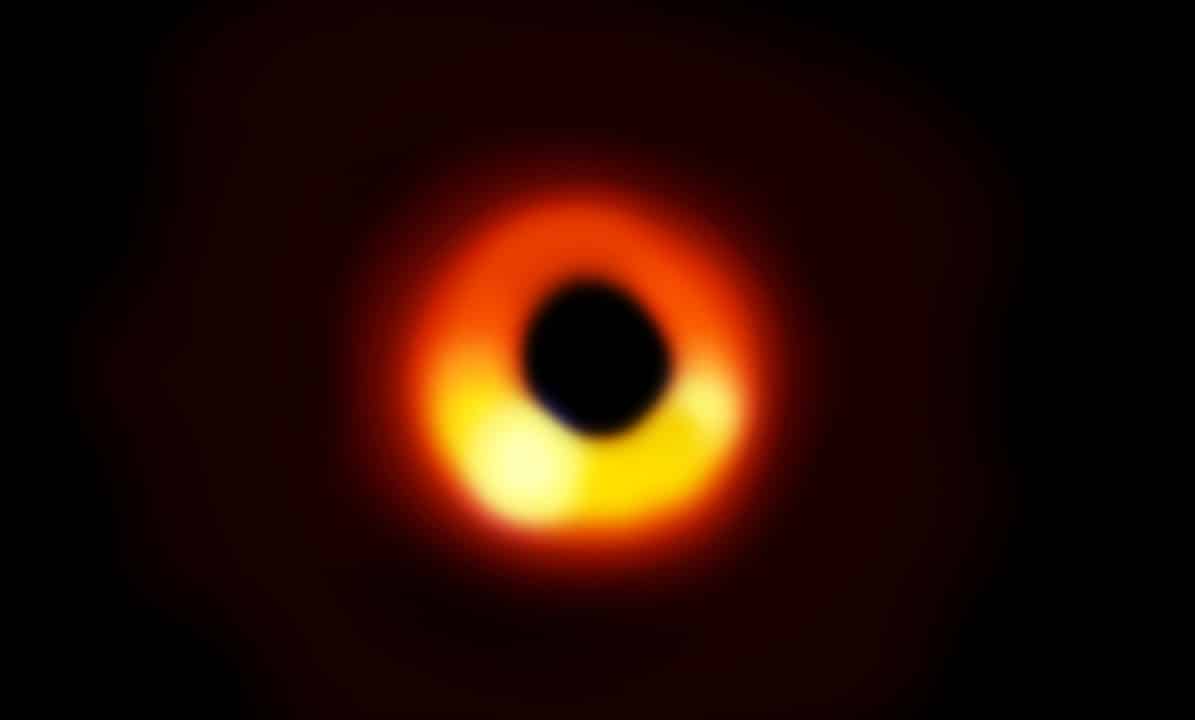
Absence of radiation in X-rays
Observations of Chandra in 2024 detected no X-ray source at the object’s position. Essa feature reinforces the minimum accretion model on the central black hole.
The remainder incorporates only weakly bound material, equivalent to 0.1% of the original envelope. The radiative efficiency remains around 0.5%.
Silent collapse mechanism
Stars with a mass greater than eight times that of the Sun usually end in a supernova or gamma-ray explosion. In certain cases, strong gravity allows direct collapse without significant outburst.
M31-2014-DS1 exemplifies failed supernova in hydrogen-depleted supergiant. The hydrogen-rich envelope was partially ejected during the process.
A shock of moderate energy, in the order of 10^48 erg, facilitated the expulsion. The core collapsed, forming a black hole hidden by opaque dust.
Via Láctea contains an estimated ten million similar stellar black holes. Observar real-time formations require prolonged monitoring of large populations.
Ejected Envelope Properties
The shell of dust and molecular gas originates from the progenitor envelope. The expansive movement indicates asymmetric ejection during collapse.
Internal components move in the opposite direction to the main flow. The structure supports a material fallback model about the black hole.
- Mass of molecular gas: about 0.1 solar mass;
- Expansion speed: 100 km/s;
- Shell scale: similar to the solar system;
- Accretion efficiency: low, with faint radiation.
These parameters align with theoretical predictions for low-energy collapses.
Comparison with similar events
Rare cases of missing stars suggest a common mechanism in nearby galaxies. An earlier candidate in NGC 6946 features overlapping signatures.
Both involve massive progenitors with depleted envelopes. The proximity of Andrómeda allows for superior detail via current telescopes.
Evolution of bolometric luminosity
Light curves document stable progenitor until 2012. Modelos adjustment accurately reproduces brightness of yellow supergiant.
Decline accelerates from 2022 onwards, with data from Webb confirming continued dimming. Linhas colored spectra highlight transition to dominant infrared emission.
The evolution reflects prolonged fallback on the remainder. The source remains shrouded in dust, reducing visibility at short wavelengths.
Contributions to stellar astrophysics
The event provides direct evidence of discrete stellar black hole formation. Silent Colapsos explain part of the invisible population in spiral galaxies.
Future monitoring of Andrómeda may identify additional cases. Combining multi-wavelength data advances understanding of extreme stellar ends.
Complementary research analyzes observational signatures under alternative models. The rarity of the phenomenon stimulates debates about dominant mechanisms.
The discovery highlights the ability of space telescopes to capture rare stellar transitions. Unified Observações reinforce the credibility of the proposed model.
