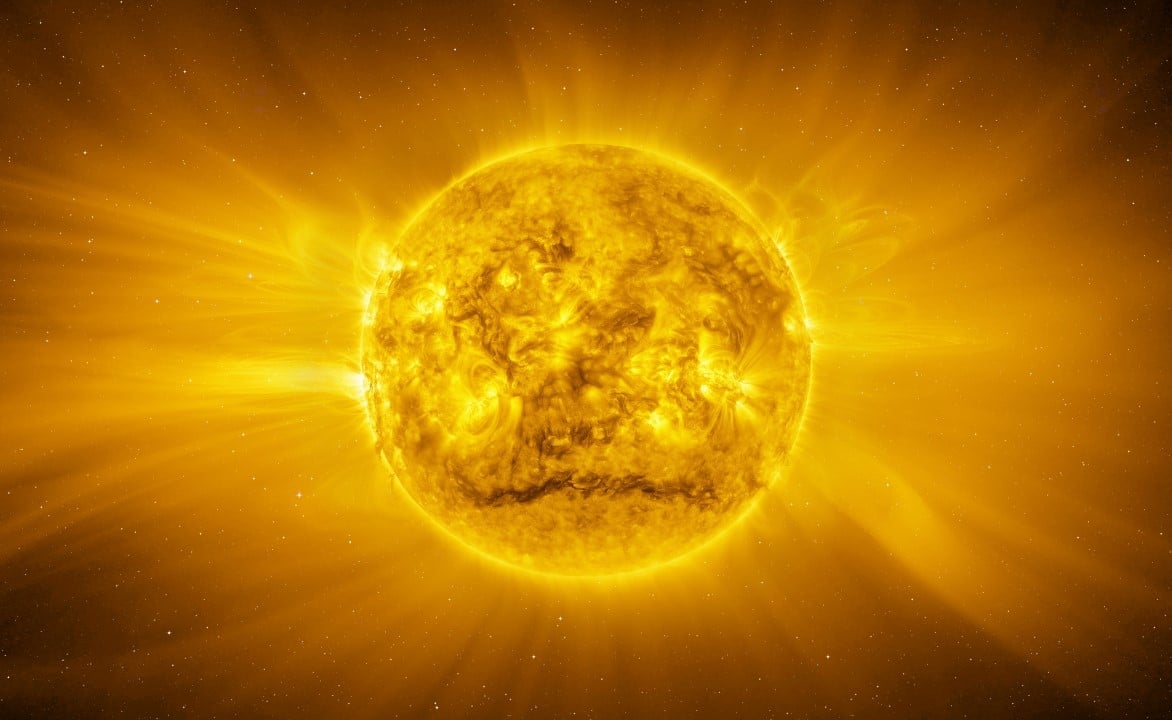
A recent and sudden intensification of solar activity has put global monitoring agencies on high alert. The reason is a single, gigantic sunspot that triggered a sequence of more than 20 eruptions in a period of less than 24 hours, generating concern among scientists and space technology operators.
The active region, cataloged as AR4366, was the source of three Class X eruptions, the most powerful category, as well as at least 17 other explosions of lesser intensity. Essa Frantic activity has already caused significant disruptions to radio communications in several parts of the globe, demonstrating the power of the phenomenon.
Space weather experts are closely monitoring the evolution of the sunspot, whose accelerated growth and magnetic complexity point to a high probability of new eruptive events in the coming days. The situation represents a potential risk for satellite infrastructure and electrical energy distribution networks in Terra.
The immediate effects of Class X flares
The most significant event in this series of eruptions was a powerful X8.1 class explosion, which reached its peak intensity on February 1st. Essa massive emission of extreme ultraviolet radiation caused drastic and immediate ionization in the upper atmosphere of our planet.
As a direct result, there was a widespread and wide-ranging blackout in shortwave radio signals. The main affected area was the vast region of Pacífico Sul, directly impacting communications in places such as Austrália and Nova Zelândia.
Amateur radio operators and communications services that rely on these frequencies have reported a complete loss of signal below 30 MHz for several hours. The phenomenon caused considerable disruptions to vital channels for air and maritime navigation, which use this spectrum band for long-distance communications.
NOAA’s Centro of Previsão of Clima Espacial (U.S. Administration Nacional Oceânica and Atmosférica) classified the event as R3, a designation that indicates a high-intensity radio blackout, underlining the severity of the impact generated by solar activity.
The origin and complexity of sunspot AR4366
Since rotating into the field of view of Terra, positioning itself in the northeast quadrant of Sol, sunspot AR4366 has shown remarkable growth. What was once a discrete spot evolved rapidly, reaching a size comparable to half the historic sunspot responsible for the Evento Carrington of 1859, the strongest solar storm on record. Essa accelerated expansion fuels a magnetic instability that serves as fuel for the powerful eruptions observed, making the region extremely volatile and dangerous.
The energy behind these explosions lies in their complex magnetic configuration, known as a “delta”. Nessa structure, the positive and negative magnetic poles are very close and entangled, creating extreme tension, similar to elastic bands twisted to the limit. Quando this tension breaks, the accumulated energy is released violently, giving rise to solar flares. The classification scale runs from class A (weakest) to class X (strongest), with each letter representing a tenfold increase in intensity, putting the recent eruptions at the top of the danger scale.
The threat of coronal mass ejections and the risk for Terra
After solar flares of such magnitude, scientists’ main concern turns to the possibility of an associated Ejeção of Massa Coronal (EMC). CMEs are gigantic clouds of plasma and magnetic field, containing billions of tons of solar material, which are thrown into space at speeds that can exceed millions of kilometers per hour. Observatórios space, such as SOHO (Solar Observatory and Caso if an EMC with an impact trajectory is confirmed, it could reach our planet in one to three days, triggering a geomagnetic storm. Embora Even if a side effect is the creation of dazzling aurora borealis visible at lower latitudes, the technological risks are immense. A severe storm can induce uncontrolled electrical currents in power grids, causing damage to transformers and triggering large-scale blackouts. Além In addition, orbital infrastructure is highly vulnerable, with communications, GPS and meteorology satellites at risk of suffering short circuits and permanent damage, affecting essential services for modern society.
Contextualizing the peak of solar cycle 25
This significant increase in solar activity represents one of the highest points recorded in the current solar cycle. The phenomenon reinforces evidence that Sol is approaching or has already reached the so-called solar maximum of Ciclo Solar 25, the period of greatest volatility for the star.
Solar cycles are approximately 11-year patterns that alternate between a period of low activity (solar minimum) and a period of high activity (solar maximum). Durante maximum, the frequency and intensity of sunspots, flares and CMEs increase considerably.
Initial forecasts for Ciclo Solar 25 indicated that it would be relatively weak, similar to the previous cycle. However, activity observed in recent months has consistently exceeded these projections, suggesting that the current spike is stronger and more energetic than expected.
Global monitoring in a state of alert
Faced with the intensification of events, space weather agencies and satellite operators around the world have raised their alert levels. The continuous analysis of data from solar observatories is essential for issuing warnings that allow the adoption of protective measures.
Experts reinforce the importance of uninterrupted monitoring of the AR4366 spot as it continues its crossing of the face of Sol facing Terra. The ability to predict the trajectory and intensity of future eruptions is vital to mitigating potential damage to global technological infrastructure.
Forecasts for the next few days
Space meteorologists predict that the AR4366 region’s magnetic instability is likely to persist, with a high probability of generating more M-class and even X-class eruptions in the coming days, keeping monitoring teams on continuous readiness.
Impacts already recorded in communications
Although a large-scale geomagnetic storm has not yet been confirmed as a direct result of these events, the immediate effects of the eruptions have already been felt in concrete ways. Radio blackouts serve as a clear example of the impact of solar activity on technology.
These outages act as a warning about the vulnerability of modern society to the whims of Sol, highlighting the urgent need to develop more resilient technological systems and increasingly accurate space weather prediction models.
