A detailed analysis of the chemical composition of the interstellar comet 3I/ATLAS has revealed an anomaly that is fueling intense debate in the scientific community. The detection of significant quantities of methane gas, released only after the object’s closest approach to Sol in October 2025, challenges conventional models of cometary activity. The phenomenon caught the attention of astrophysicist Avi Loeb, from Universidade Harvard, who proposes a controversial explanation: the possibility that the gas is a byproduct of biological activity.
The data, collected by cutting-edge observatories such as Telescópio Espacial James Webb and SPHEREx, confirm a rich mix of organic compounds in the comet’s tail. However, the late release of methane, a highly volatile gas, suggests an unusual origin mechanism. Essa peculiarity differentiates 3I/ATLAS from other extrasolar visitors and places it at the center of the discussion about panspermia, the theory that life can be transported between stars.
The passage of 3I/ATLAS through Sistema Solar represents a unique opportunity to study material from another planetary system. The observations provide direct insights into the chemistry of distant worlds and reignite fundamental questions about the origin of life on Terra and its possible existence elsewhere in the galaxy.
A visitor from another star system
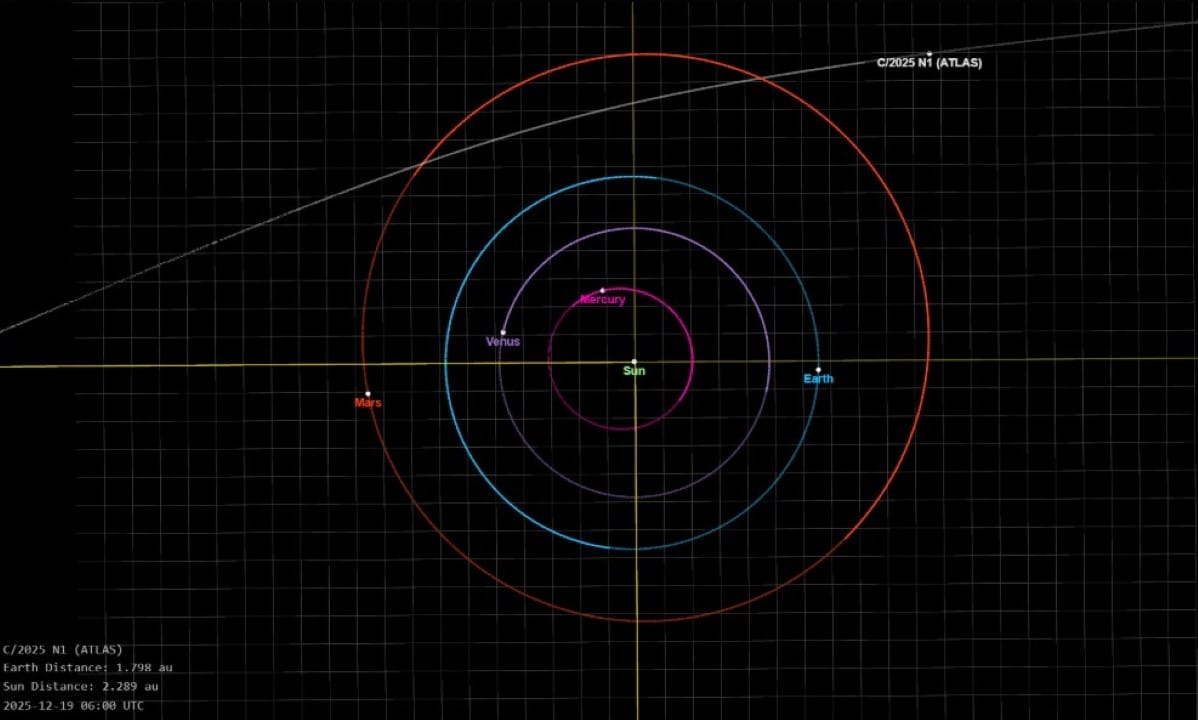
Comet 3I/ATLAS was officially identified on July 1, 2025 by the ATLAS astronomical survey system (Asteroid Terrestrial-impact Last Alert System), at Chile. Sua hyperbolic trajectory, a sharp curve indicating a velocity too high to have originated within our Sistema Solar, quickly confirmed its status as the third interstellar object ever detected, following 1I/’Oumuamua and 2I/Borisov.
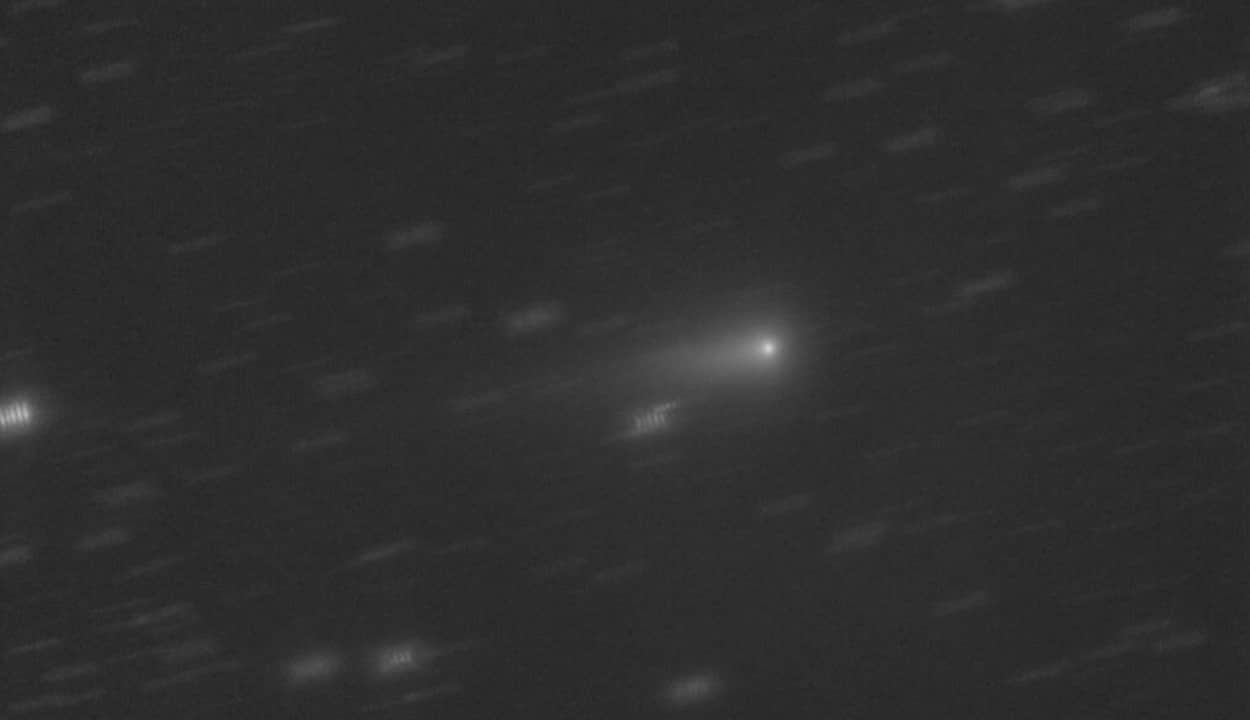
As it approached Sol, the object became increasingly active, developing a tail of gas and dust that stretched hundreds of thousands of kilometers. The point of closest approach, known as perihelion, occurred on October 29, 2025. Foi It was precisely after this event that the composition of its tail presented the chemical change that intrigued astronomers.
The unusual chemical composition of 3I/ATLAS
Spectral analysis of the light reflected by the comet’s tail allowed scientists to identify its composition. Advanced Instrumentos have detected the presence of expected compounds, such as water (H2O), carbon dioxide (CO2) and carbon monoxide (CO), which are common in comets from our own system.
In addition to these substances, complex organic molecules were found, such as methanol and ethane, which are considered precursors of amino acids and other molecules essential to life. Essa discovery reinforces the idea that the “building blocks” of life are abundant throughout the galaxy.
The element that turned 3I/ATLAS into an exceptional object of study, however, was methane (CH4). Sua’s presence in itself is not surprising, but the timing of its detection contradicts current knowledge about the sublimation of gases in comets.
The mystery of late methane release
Methane is an extremely volatile compound. In theory, as a comet approaches Sol and its surface heats up, methane should be one of the first gases to sublimate and escape into space, long before water. Observações from 3I/ATLAS confirmed that even more volatile compounds, such as carbon monoxide, were released early on their approach.
Contrary to expectations, methane was only detected in abundance after the comet passed perihelion and began to move away from Sol. Essa late production demands an explanation that goes beyond standard models of cometary composition.
One of the most conservative hypotheses suggests that the methane was trapped in pockets of water ice in the deepest layers of the comet’s nucleus. Solar heat would have taken time to penetrate these layers and release the gas. Outra possibility involves chemical reactions on the surface, driven by intense solar radiation, that could have converted other organic molecules into methane.
Avi Loeb, however, presented a third way, arguing that the anomaly could be a biosignature. Ele postulates that microorganisms in a dormant state inside the comet could have been reactivated by heat and the presence of temporary liquid water, initiating metabolic processes that released methane as waste.
Panspermia: a controversial theory gains traction
The Loeb hypothesis fits directly into the theory of panspermia, which proposes that life did not originate on Terra, but was brought from elsewhere by comets or asteroids. 3I/ATLAS, with its peculiar chemistry, becomes a candidate for study in this context. The idea is that a comet’s icy interior could protect microbes from cosmic radiation during journeys that can last millions of years between star systems.
In his articles, the astrophysicist argues that, although not definitive proof, the 3I/ATLAS data are consistent with what would be expected from an object carrying microbial life. Reactivation by solar heat would perfectly explain the delayed release of methane, a process analogous to that observed in methanogenic microbes in extreme environments in Terra, such as hydrothermal vents at the bottom of the ocean.
The legacy of interstellar messengers
The arrival of objects such as 3I/ATLAS, ‘Oumuamua and 2I/Borisov ushered in a new era in planetary astronomy. Cada one of these visitors demonstrated unique features, revealing the incredible diversity of bodies that form around other stars. Enquanto ‘Oumuamua intrigued by its shape and anomalous acceleration, and Borisov resembled an “ordinary” comet, 3I/ATLAS introduces a chemical complexity that defies simple classifications. Esses objects function as natural probes, bringing samples from other planetary systems directly to our telescopes. Studying its composition offers valuable clues not only about the formation of planets, but also about the distribution of organic matter throughout Via Láctea, a crucial factor in assessing the likelihood of extraterrestrial life.
Skepticism and debate in the scientific community
The Avi Loeb proposal is met with great skepticism by most astronomers. The scientific community, by default, seeks to exhaust all natural and non-biological explanations before considering the possibility of life. The prevailing position is that the chemistry of 3I/ATLAS, although unusual, probably reflects the specific conditions of its home stellar system, and that the mechanisms of gas release in comets are more complex than currently understood.
The future of the search for extraterrestrial life
Despite the controversy, discussions around 3I/ATLAS are seen as a positive stimulus for science. Elas force researchers to refine their models and design new forms of observation. The comet’s passage reinforces the need to develop space missions capable of intercepting and, perhaps, collecting samples of these rare interstellar visitors.
As 3I/ATLAS moves away to return to the void of deep space, it leaves behind a treasure trove of data and a debate that will drive astrobiology forward for many years to come. The definitive confirmation or refutation of hypotheses such as that of Loeb will depend on the direct analysis of one of these messengers from other stars.
