

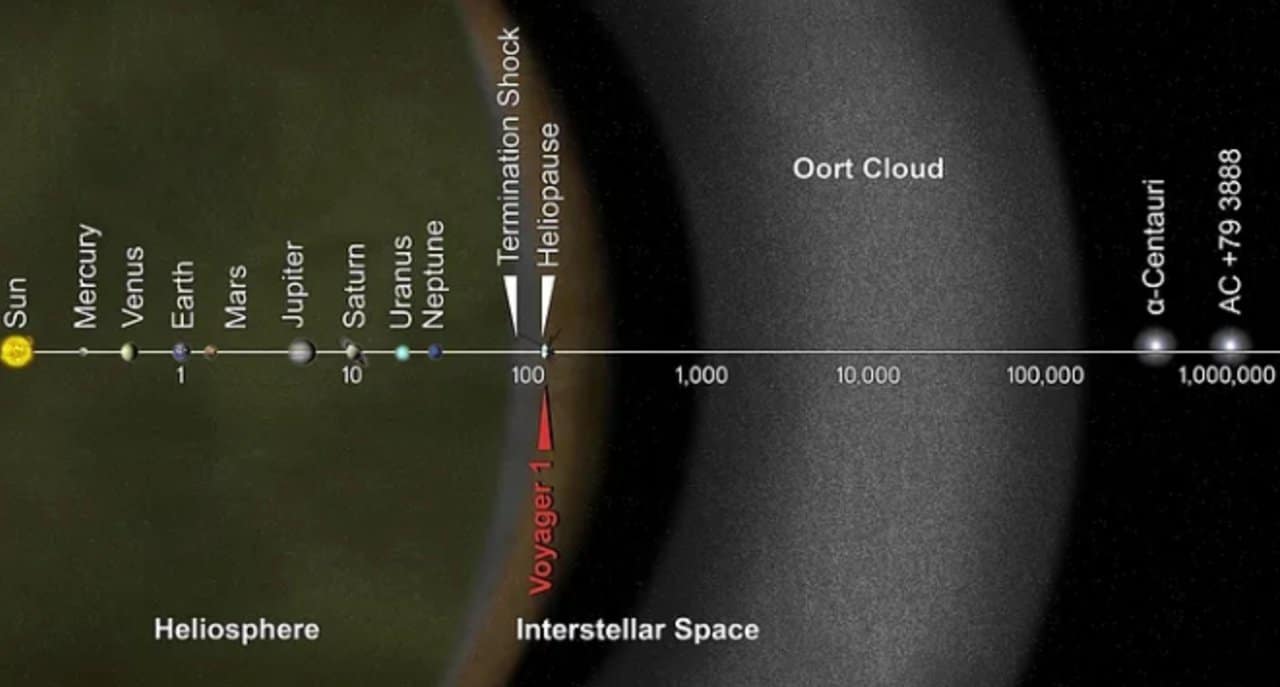
An astronomical reassessment, driven by detailed observations of the interstellar object 3I/ATLAS, suggests that our solar system is visited by a colossal number of celestial bodies from other stars. The new estimates point to the existence of trillions of these cosmic travelers, a much larger population than previously imagined, challenging understanding of the dynamics of interplanetary space.
The discovery, which comes from the analysis of a single comet, has profound implications for cosmology. The presence of such a vast population of wandering objects in Nuvem of Oort, the boundary of our system, raises new questions about planet formation and the distribution of matter across Via Láctea. The search was intensified after the identification of 3I/ATLAS on July 1, 2025.
Scientists are now working to determine whether 3I/ATLAS represents an ordinary comet ejected from another star system or whether its unique characteristics indicate a more complex origin. The answer to this question could redefine models for how planetary systems, including our own, evolve and interact with the galactic environment around them.
The unique characteristics of comet 3I/ATLAS
Identified by the ATLAS asteroid warning system (Asteroid Terrestrial-impact Dados recent studies have allowed us to estimate that its core has a radius of approximately 1.3 kilometers. Based on an average density of 0.5 grams per cubic centimeter, its total mass is estimated to be about 5 billion tons, a considerable amount for an interstellar visitor.
Detecting bodies like 3I/ATLAS remains a significant technical challenge for astronomers. Most of the light that makes it visible, around 99%, does not come from its solid core, but rather from its coma, a cloud of dust and gas that formed around it after it entered the Júpiter orbit. Objetos interstellar stars that do not develop this bright plume, because they are inactive, are practically invisible to current telescopes, which suggests that many others may go unnoticed.
The Nuvem of Oort as a cosmic reservoir
The Nuvem of Oort represents the gravitational boundary of the Sistema Solar. Trata is a vast spherical cloud of icy bodies that extends a distance of up to 100,000 times the path between Terra and Sol.
In this remote region, the gravitational pull of Sol becomes so weak that it competes with the influence of neighboring stars and the galaxy itself. It is in this balance of forces that objects can be both captured by our system and ejected into interstellar space.
This dynamic makes Nuvem of Oort a gigantic repository, containing not only comets originating from our own system, but also serving as a transit area for visitors from other stars, such as 3I/ATLAS.
Calculating a population of trillions of travelers
The estimate that trillions of interstellar objects reside in Nuvem of Oort is the result of a mathematical extrapolation based on concrete observations. Astronomers have calculated that, at any given time, there are likely to be between one and two 3I/ATLAS-sized objects within Júpiter’s orbit. When considering this detection frequency in a relatively small area and projecting it to the immense three-dimensional volume of Nuvem of Oort, the numbers grow exponentially. Esse calculation leads to the impressive figure of ten trillion similar objects, indicating that the space that surrounds us is much more populated by matter from other stars than previously thought. Essa total mass of interstellar icy rocks may be equivalent to 100 times the mass of Terra, a value that transforms our perception of the density of the local galactic medium and the amount of material exchanged between stellar systems over billions of years.
Implications for the formation of planetary systems
The confirmation of such a large mass of interstellar material in Nuvem of Oort has direct consequences for theories of planetary formation. The combined mass of these ten trillion objects would be approximately ten times the mass of Terra.
This value is surprisingly comparable to the total mass of comets believed to be native to our Sistema Solar and which also reside in Nuvem of Oort.
This parity suggests that the amount of rocky material ejected from planetary systems during their formation is much greater than that retained. In comparison, the mass of all the planets in our system is about thirty times smaller.
If this ratio is a norm in Via Láctea, it means that each star could have expelled about 100 Earth masses of rock and ice into space, enriching the interstellar medium with the building blocks for future generations of planets.
The debate over the origin of the object
The rarity of detections of interstellar visitors, such as the pioneering 1I/`Oumuamua and 3I/ATLAS, fuels intense debate in the scientific community. 3I/ATLAS, being much more massive than `Oumuamua, offers a crucial new data point for understanding this population.
However, an important caveat accompanies the conclusions. If 3I/ATLAS is not a typical natural comet, but an object with anomalous characteristics — such as its peculiar trajectory and the release of certain gases — the statistical inference about a vast natural population may be invalidated. Isso would open the possibility that its route was intentional, a minority hypothesis, but one that continues to be explored in preliminary studies.
Rubin Observatory and the next era of astronomy
The main task for astronomers now is to distinguish whether objects like 3I/ATLAS are isolated events or representatives of a constant and intense cosmic traffic. The definitive answer to this question is one of the great promises of Observatório Vera C. Rubin.
With operations scheduled to begin within the next decade, this observatory will have the capacity to map the sky with unprecedented speed and depth. Sua technology will enable the routine detection of transient and dim objects, revolutionizing the cataloging of interstellar visitors and providing the data needed to confirm or refute current estimates about their population.