


Bitcoin, the market’s main cryptocurrency, registered a sharp drop this Thursday, February 5, 2026, with its value falling below the US$70,000 mark. Este movement represents the first time that the digital asset has operated at this level since November 2024, signaling a period of instability for investors. The pullback comes amid a broader sell-off affecting several global risk assets.
As of 8:09 a.m. ET, Bitcoin was trading at approximately $69,552, according to data compiled by CoinMetrics. The devaluation took the cryptocurrency to a low of US$69,055.46, raising concerns about the sustainability of the price in the short term.
The selling pressure is attributed to a combination of factors, including significant liquidations in the crypto market and a reversal in demand from large institutional investors. Este scenario reflects growing caution among global financial market participants.
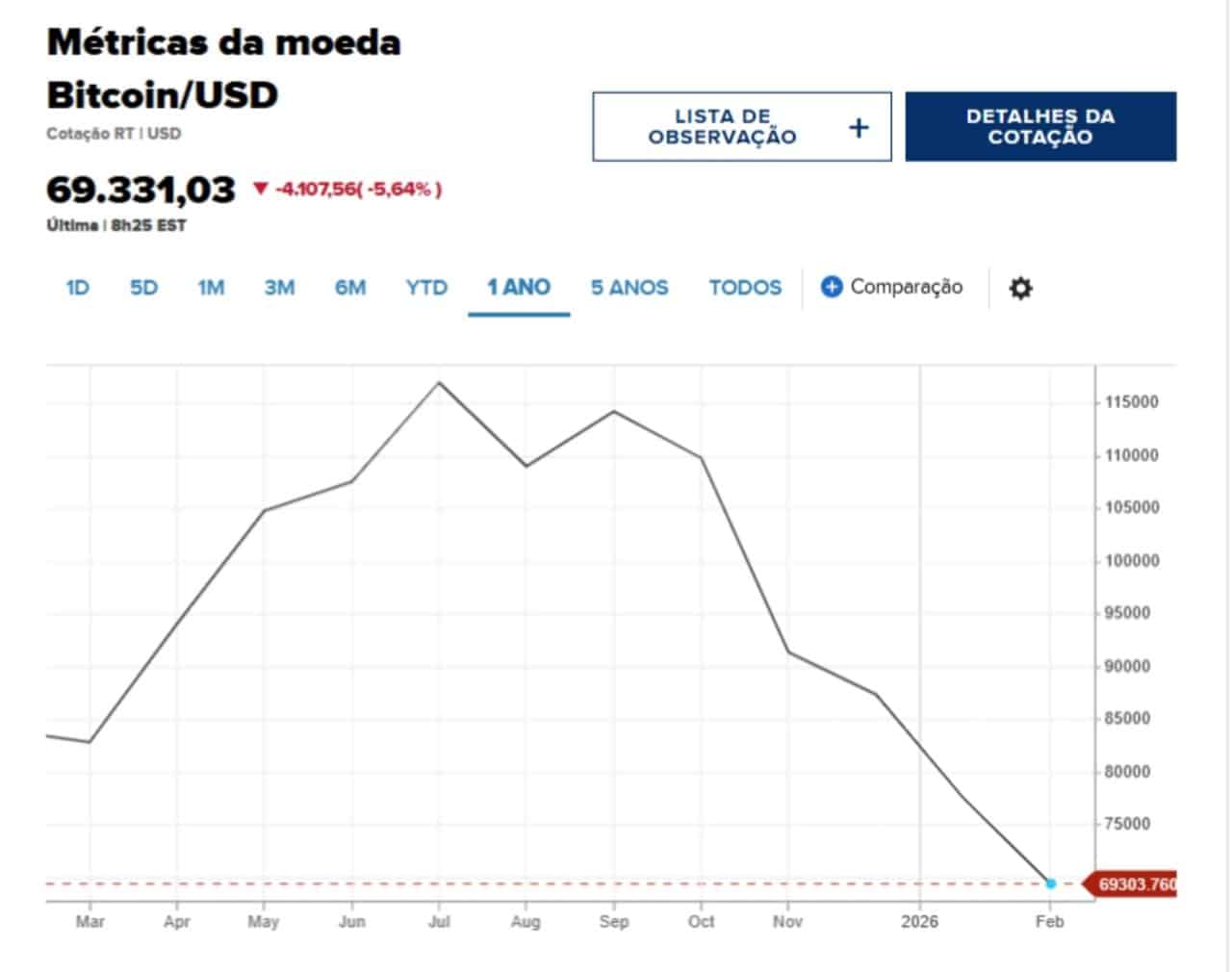
Recent performance of the leading cryptocurrency
The recent drop in Bitcoin marks a turning point for the asset, which had been oscillating at higher levels. The loss of $70,000 support raises questions about upcoming price movements and investor confidence in what is the largest digital asset by market capitalization.
Since its historic peak recorded in October, when it reached values above US$126,000, Bitcoin has already accumulated a devaluation of around 40%. Essa significant pullback places the cryptocurrency in a period of considerable adjustment, distinct from the euphoria observed in previous moments.
Crucial Levels and Expert Projections
Market analysts observe the US$70,000 level as a fundamental support point, the break of which could indicate a deepening of the decline. Current volatility generates uncertainty and the need to reevaluate investment strategies.
James Butterfill, head of research at Coinshares, called the $70,000 level a “key psychological level.” Segundo the expert, the inability to maintain this brand could pave the way for even greater devaluations in the future.
Butterfill projects that if Bitcoin fails to sustain above $70,000, “a move toward the $60,000 to $65,000 range becomes quite likely.” Essa outlook reinforces the need for close monitoring on the part of investors and market participants.
The settlement scenario and its triggers
The cryptocurrency market has been impacted by a wave of massive liquidations, where investor positions are automatically sold upon reaching certain prices. Nesta week, more than US$2 billion in long and short positions in cryptocurrencies were liquidated by Thursday, according to data from Coinglass.
This significant volume of liquidations exerts considerable downward pressure on the prices of digital assets. The momentum intensifies volatility, creating a challenging trading environment for traders and investors.
The drop in Bitcoin is a reflection of a widespread sell-off that also hit technology stocks at Estados Unidos on Wednesday, extending to the crypto sector. Esse movement suggests a growing correlation between traditional risk markets and digital assets. Factors contributing to this surge include:
– Pressão of sales in technology stocks.
– Liquidações forced cryptocurrency positions.
– General Cautela with risky assets.
– Volatilidade persistent in precious metals such as gold and silver.
Analysis of institutional demand
Historically, the participation of large institutional investors has been seen as a pillar of support for the price of Bitcoin. Contudo, recent reports indicate a significant reversal in this dynamic, with these same participants showing signs of selling. Institutional demand, which previously drove prices, now appears to be a pushing factor.
A report from CryptoQuant, released on Wednesday, pointed out that US exchange-traded funds (ETFs), which last year acquired 46,000 bitcoins in the same period, are expected to be net sellers in 2026.
Historical context and market vision
The current phase of Bitcoin differs from previous periods driven by enthusiasm and narrative. Maja Vujinovic, CEO of digital assets at FG Nexus, highlighted in an interview with CNBC’s “Worldwide Exchange” program that “The linear rise that many people expected has not yet materialized. Essa analysis suggests a market maturity, where fundamentals and financial flows predominate over unbridled speculation, marking a phase of revaluation for the asset.
Key Technical Indicators
CryptoQuant also emphasized a worrying technical data point: the Bitcoin has broken its 365-day moving average for the first time since March 2022. Essa breakout is traditionally interpreted as a sign of weakness in the market and may precede longer-lasting bearish moves.
The company’s analysts warned that, after the last break of this moving average in 2022, Bitcoin fell 23% in the subsequent 83 days. Historical Tal, combined with the current scenario, suggests a “possible drop to the range of US$70,000 to US$60,000”, corroborating the projections of other experts.
Short-term outlook
Negative volatility in cryptocurrencies is likely to persist, with sell-offs and declines in traditional stocks putting continued pressure on the sector. The scenario requires caution and an in-depth analysis of market fundamentals by investors, as Bitcoin seeks new levels of stability.



