
Comet 3I/ATLAS, the third confirmed object of interstellar origin to visit Sistema Solar, continues to provide valuable data to astronomers in 2026. Observações carried out by space telescopes and NASA probes indicate a chemical composition dominated by carbon dioxide, with proportions much higher than that of water, unlike most known comets. Essa feature suggests the comet formed in a distant, cold environment, possibly beyond the CO2 ice line in another star system.
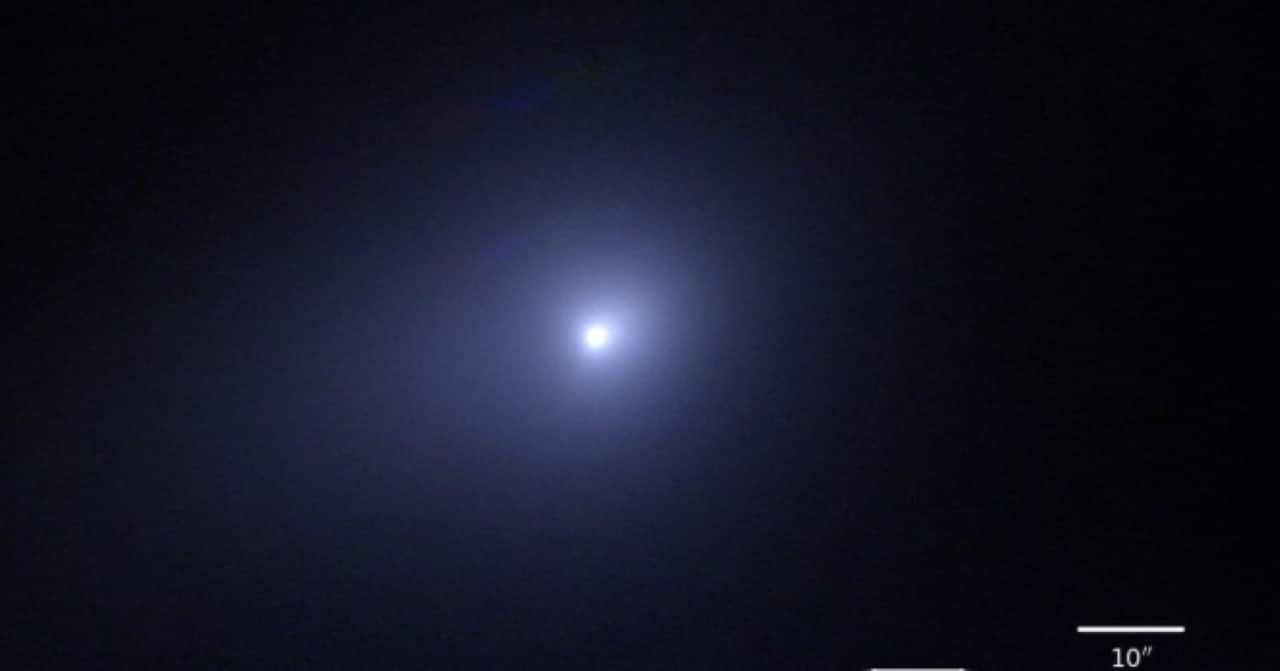
Several space missions captured images of 3I/ATLAS during its trajectory. Instrumentos as well as Telescópio Espacial Hubble and James Webb recorded details of the nucleus and coma, while probes such as STEREO-A, Lucy and MAVEN obtained unique views from different angles. Essas observations confirm the presence of an extensive coma, with a diameter greater than 700 thousand kilometers in certain periods.
- Main instruments involved in captures:
- Hubble: images of the nucleus and brightness variations.
- James Webb: spectroscopy revealing specific gases.
- STEREO-A: image compositions between September 2025.
- MAVEN: coma records from the orbit of Marte.
Different chemical composition
Comet 3I/ATLAS has a ratio of CO2 to water that is eight times higher in some pre-perihelion measurements. Dados of James Webb indicate production rates of 129 kg/s for carbon dioxide, compared to lower values for water vapor. Essa dominance suggests formation in outer regions of a planetary system different from ours.
Post-perihelion observations, carried out in December 2025 and January 2026, detected methane and nickel in notable quantities. The presence of methane, a hypervolatile compound, only appeared after maximum heating, indicating internal layers exposed by sublimation. Vaporized atomic nickel was also identified, without associated iron, which adds peculiarities to the object’s chemical signature.
Jets and surface dynamics
Jets of material emanate from the 3I/ATLAS core with slow changes in direction over consecutive nights of monitoring. Esses flows follow regular patterns, associated with the core rotation estimated at around 16 hours. The detected non-gravitational activity reinforces the influence of these jets on the trajectory.
Terrestrial and space telescopes have recorded oscillations in the jets, possibly linked to active regions on the surface. The observed non-gravitational acceleration corroborates the asymmetric expulsion of gases and dust. Esses phenomena differ from typical solar comets, which exhibit more abrupt jets.
Anti-tail and dust structure
An antitail was identified in 3I/ATLAS observations, with a dust stream pointing toward Sol. Esse optical effect occurs when larger grains of dust are pushed by solar radiation pressure in a different way than gases. The phenomenon was captured by observatories such as Tenerife and confirmed by images from Hubble.
Dust has grains of varying sizes, including particles of several micrometers. The antisolar main tail achieved significant extensions, while the antisolar tail highlighted the complexity of particulate dynamics. Essas structures indicate a composition rich in refractory materials.
The reddish coma suggests dust similar to that of other known interstellar comets. Taxas of dust ejection reaches tens of kg/s, contributing to the visibility of the object.
Core size and mass
Recent estimates point to a core with an effective diameter of approximately 2.6 kilometers, based on data from post-perihelion Hubble. Essa measurement considers typical albedo of 0.04 and observed brightness variations. Outras analyzes suggest ranges between 0.5 and 5.6 kilometers, depending on the assumed density.
The estimated mass places 3I/ATLAS as 40 times more massive than comet 2I/Borisov. Essa scale makes it the largest active interstellar object detected to date. The elongated shape of the nucleus contributes to modulations in the light curve.
Monitoring by space missions
Several NASA probes recorded the passage of 3I/ATLAS in different phases. The Lucy probe captured images in September 2025, from a distance of hundreds of millions of kilometers. MAVEN, orbiting Marte, observed the coma and surrounding hydrogen in October.
The SOHO mission recorded the comet close to perihelion, in the middle of the coronagraphic field. Telescópio Espacial TESS detected early activity as early as May 2025, before the official discovery. Essas multiple contributions allow detailed reconstruction of the object’s evolution.
Other observations include the Perseverance rover at Marte and the Psyche probe. International coordination involved telescopes such as the Very Large Telescope and the Gemini Sul.
Searches for technological signals
Projects like Breakthrough Listen have directed radio telescopes toward 3I/ATLAS in search of artificial emissions. Instrumentos like Allen Telescope Array and MeerKAT did not detect signs indicating technological origin. The Telescópio of Green Bank also confirmed the absence of localized radio emissions.
The general conclusion points to natural astrophysical processes consistent with an ordinary comet. Apesar from initial speculation on social networks, the data reinforces the nature of the object as a primordial celestial body.
Astrophysicist Avi Loeb, from Harvard, highlighted that the limited observation period prevents definitive ruling out of anomalies. Ele advocates continuous monitoring of similar objects, without stating alternative hypotheses.
Current activity and trajectory
3I/ATLAS reached perihelion on October 29, 2025, at 1.356 astronomical units from Sol. Sua hyperbolic velocity exceeded 58 km/s, ensuring permanent exit from Sistema Solar. The closest approach to Terra occurred in December 2025, at 1.8 astronomical units.
As of February 2026, the comet remains observable by professional telescopes, although it has decreased in brightness. Sublimation activity reduced post-perihelion, with a sharp drop in water production. The trajectory will take it close to Júpiter in March 2026, at 0.358 astronomical units.
These minimal gravitational interactions do not significantly alter the hyperbolic path. The object continues to provide insights into planetary formation in other star systems.
