New astronomical evidence suggests a vast and previously underestimated population of interstellar objects, like the enigmatic 3I/ATLAS, that constantly transit our planetary system. Observações’s recent Telescópio Espacial Hubble has revealed crucial details about these celestial bodies, challenging previous conceptions about the composition of interplanetary space.
The detection of a single object, 3I/ATLAS, boosted estimates that point to the presence of up to ten trillion similar entities in the vast Nuvem of Oort. Essa discovery raises profound questions about the origin and dynamics of the materials surrounding Sol, as well as our system’s interaction with the interstellar medium.
Scientists are now seeking to understand whether 3I/ATLAS is a typical example of a natural population of wandering comets or whether its unique trajectory and characteristics indicate a more complex and perhaps even artificial origin. The distinction between these hypotheses could redefine the understanding of planetary formation and life in the universe.
3I/ATLAS object characteristics and detection
Comet 3I/ATLAS, identified by the ATLAS asteroid warning system, had its nucleus estimated at 1.3 kilometers in radius, according to recent data from Telescópio Espacial Hubble. Considerando its average density is 0.5 grams per cubic centimeter, its mass is approximately 5 billion tons.
Despite their grandeur, detecting objects like 3I/ATLAS is a significant challenge for astronomy. Most of its observed light (about 99%) comes from its surrounding dust plume, which formed after its discovery on July 1, 2025, within the orbit of Júpiter. Inactive Objetos, without this bright coma, remain almost invisible to current telescopes.
Oort Cloud: A Vast Repository of Visitors
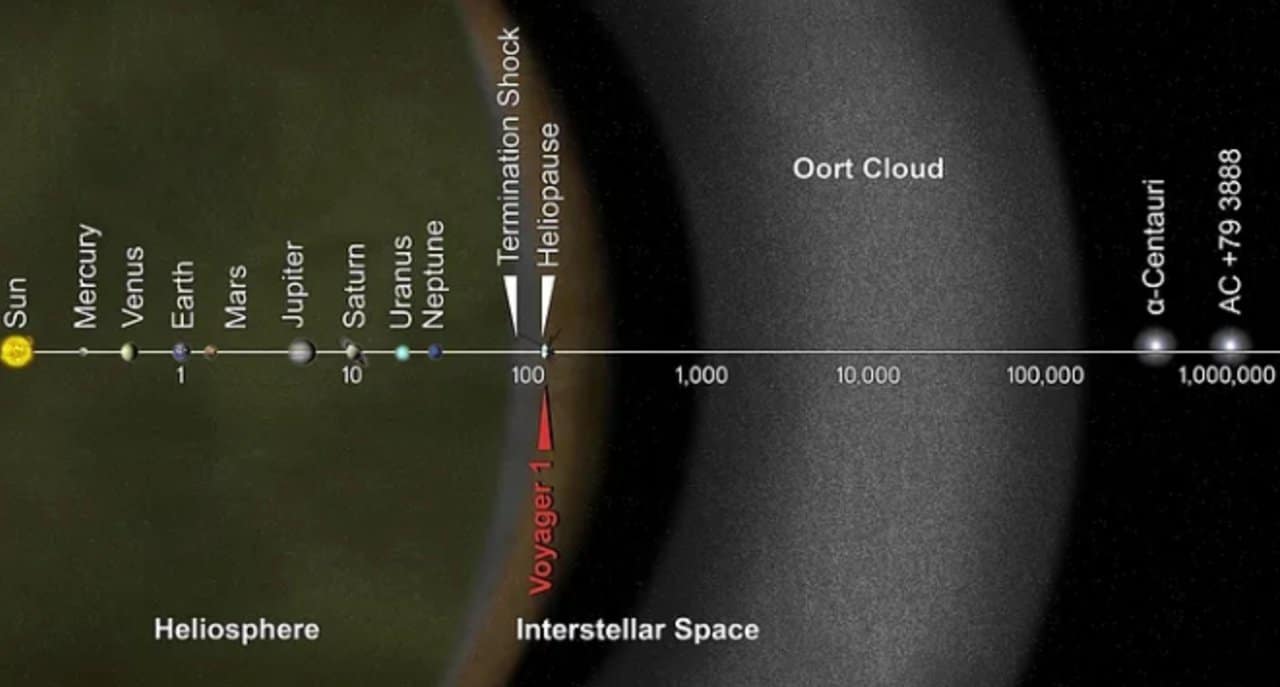
The gravitational limit of Sistema Solar extends to Nuvem of Oort, a spherical region that reaches about 100,000 times the distance between Terra and Sol. It is at this outer edge that solar gravity becomes weaker than the influence of neighboring stars or Via Láctea itself, allowing objects to be released or captured.
Considering the data obtained on the frequency of detection of bodies like 3I/ATLAS within the orbit of Júpiter — estimated at 1 to 2 objects at any given time — and extrapolating to the vast volume of Nuvem from Essa interstellar population represents a considerable amount of cosmic matter.
Total mass and cosmic implications
The combined mass of this immense population of interstellar objects, if the estimate is confirmed, would be about ten times the mass of Terra. Esse value is comparable to the total mass of comets gravitationally bound to Sol that already reside in Nuvem of Oort.
This equivalence raises a series of implications:
- Interstellar icy rocks:The total mass of interstellar icy rocks within Nuvem of Oort may be on the order of 100 Earth masses, a surprisingly high value.
- Planetary comparison:In contrast, the total amount of rocky material contained on all the planets in Sistema Solar is only a few Earth masses, about thirty times smaller.
- Planetary ejection:If these numbers are consistent, they imply that each star in Via Láctea may have ejected about 100 Earth masses of rock and ice from its initial planetary systems. Sistema Solar, in particular, would have ejected ten times more mass in icy rocks than the rocky mass retained on its own planets.
The detection challenge and open hypotheses
The rarity of detections of interstellar objects, such as 1I/`Oumuamua and 3I/ATLAS, has led to intense debate. 3I/ATLAS, with a mass four orders of magnitude greater than that of 1I/`Oumuamua, offers a new perspective for analyzing these populations. The difficulty in identifying them when they are inactive and without the characteristic glow of a dust coma contributes to the underestimation of their presence.
There is an important caveat that accompanies these statistical conclusions. If 3I/ATLAS is not a randomly chosen natural comet, but rather an object whose characteristics – such as the alignment of its trajectory with the ecliptic, the symmetry of its minijets and the delayed release of methane – suggest an artificial or intentional origin, statistical inferences about the vastness of the population of natural objects would not hold. Isso would open the possibility that 3I/ATLAS was intentionally targeted at the internal Sistema Solar, as explored in preliminary studies of the object.
The future of research with Observatório Rubin
Distinguishing between a rare, singular interstellar visitor and a member of a vast population is one of astronomy’s next big challenges. The analogy is simple: determining whether a car passing near your home is an isolated event or part of heavy traffic of similar vehicles.
The data that will be collected by NSF-DOE’s Observatório Rubin over the next decade is eagerly awaited, as it promises to provide a clear answer to this fundamental question. Este new observatory has the ability to track and catalog celestial objects with unprecedented accuracy and scope, revolutionizing the way we identify and understand interstellar visitors.
The expectation is that Observatório Rubin, with its ability to map the sky on a large scale, will no longer miss bright interstellar visitors like 3I/ATLAS. The experience will be comparable to encountering an intriguing visitor from a foreign country and subsequently anxiously awaiting the arrival of other individuals from the same population, enriching our understanding of cosmic traffic.