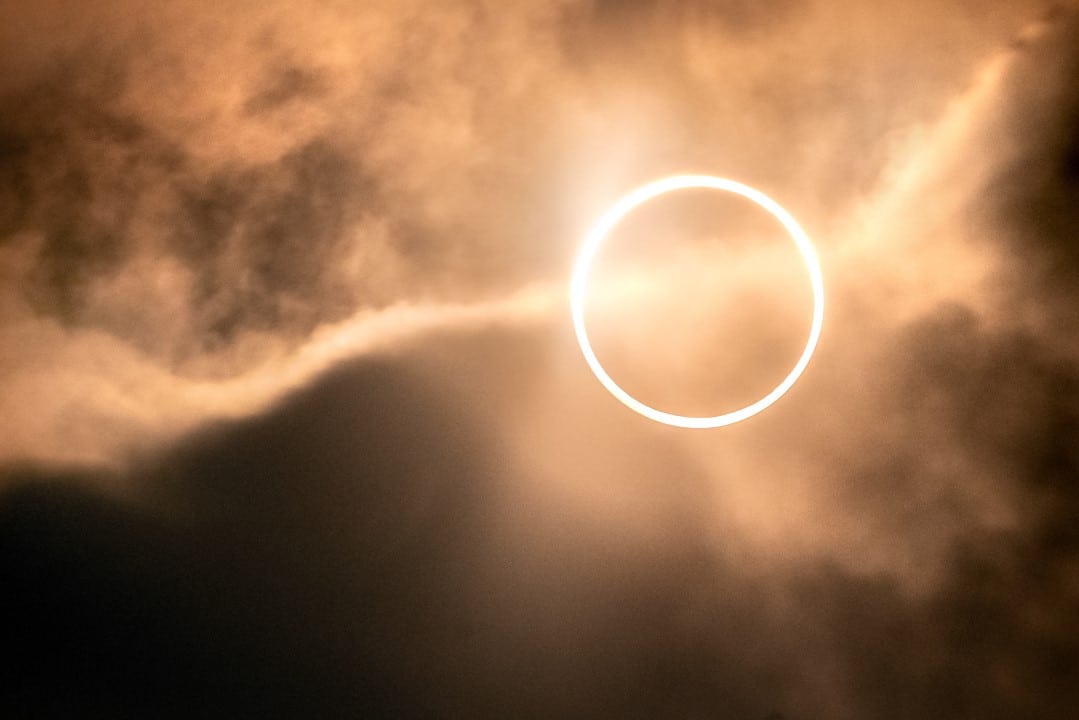
An eagerly awaited astronomical spectacle, the annular solar eclipse, popularly known as the “ring of fire”, is scheduled to take place on February 17. Este phenomenon will involve a celestial alignment that promises stunning visuals for observers in specific regions of the planet.
Strategically positioned between Terra and Sol, Lua will not be able to completely cover the larger star due to its orbital distance. The result is the formation of a luminous halo, a true ring of sunlight visible around the lunar silhouette, providing a striking visual effect.
Despite the spectacularity of the event, direct observation with the naked eye will be restricted to some parts of the globe. Para In many locations, including a large part of the national territory, safe and practical monitoring will take place through online transmissions, ensuring that the public can witness the phenomenon without risk.
Antártida will be the privileged place to witness the entire “ring of fire”, where the phenomenon will present itself in its maximum plenitude. Enquanto this, other areas such as the extreme south of the American continent and parts of África Austral will have the opportunity to follow the eclipse partially, providing a unique experience for the inhabitants of these regions.
The enigma behind the solar ‘ring of fire’

The annular solar eclipse is distinguished from a total eclipse by a fundamental characteristic: the distance of the Lua in relation to the Terra. Quando to Esse size misalignment prevents Lua from covering the entire solar disk, resulting in the appearance of a bright ring.
This specific positioning is what gives the event its popular name and its particular beauty. Diferentemente of a total eclipse, where the solar corona is visible, in the annulus, what is seen is a luminous edge of the Sol, a vivid reminder of the complex gravitational dance between the Terra, the Lua and the Sol. Compreender this dynamic is essential to appreciate the rarity and precision of these celestial events that delight scientists and enthusiasts alike.
Regions blessed by visibility
The privilege of observing the “ring of fire” in its entirety will belong to Antártida, which will offer the best view of the eclipse on February 17th. Exploradores and researchers in the region will have a unique and unforgettable experience, contemplating the solar disk almost completely covered by Lua, with only a thin edge of golden light surrounding it.
In contrast, parts of the extreme south of América and Sul, such as Chile and Argentina, as well as some areas of África Austral, will witness the eclipse in a partial way. Nessas locations, the Sol will be obscured to varying degrees depending on the viewer’s geographic position, but will still provide a remarkable spectacle.
For those in other regions of the world, including vast expanses of Hemisfério Norte, direct observation of the annular eclipse will not be possible. Contudo, modern technology offers an affordable and safe alternative: online broadcasts. Diversas digital platforms and specialized astronomy channels plan to cover the event live, allowing a global audience to share the experience in real time.
Preparation and observation safety
Observing any solar eclipse requires strict precautions to protect your vision. Olhar directly to Sol, even during a partial or annular eclipse, without adequate protection can cause irreversible damage to the retina. Óculos eclipse certificates or specific solar filters for telescopes and binoculars are essential items for anyone planning to follow the phenomenon in person.
It is essential that observation instruments are equipped with quality solar filters and that people avoid using common sunglasses, X-ray plates or other improvised materials, which do not offer sufficient protection. Eye safety should be the top priority when viewing the grandeur of an eclipse.
For most people, the safest and most widely available alternative is live streaming. Canais specialized in science and digital platforms usually offer detailed coverage, with comments from experts and high-quality images, providing an immersive experience without any risk to visual health.
Other notable astronomical events of the year
The year holds other celestial events of great interest for astronomy enthusiasts. On March 3, a total lunar eclipse is predicted, popularly known as “Lua of Sangue”. Durante this phenomenon, the Moon acquires reddish tones, the result of the refraction of sunlight by the Earth’s atmosphere, creating a scene of rare beauty in the night sky.
This total lunar eclipse will have a wide area of visibility, covering much of Américas, Ásia and Austrália. Milhares people will have the opportunity to watch Lua sink into the shadow of Terra, an event that has inspired cultures and sparked curiosity for millennia.
Later, on August 12, a total solar eclipse promises to turn day into night for a few minutes. Este impressive event will be visible in nations like Groenlândia, Islândia, Espanha, Rússia and Portugal. The totality of a solar eclipse is an intense and memorable experience, where the solar corona reveals itself, and the ambient temperature can drop considerably, surprising observers.
These phenomena, each with their unique characteristics, offer valuable opportunities for the observation and study of celestial mechanisms. The sequence of eclipses demonstrates the complexity and predictability of the solar system’s orbital mechanics, providing moments of wonder and reflection on the vastness of the universe.
The rarity of solar eclipses close to the national territory
The occurrence of total or annular solar eclipses in the same geographic region is not a common event, making each observation opportunity a special moment. Enquanto the February 17th eclipse will be visible on other continents, observers in the national territory will have to wait a little longer to experience a similar phenomenon up close. The country’s next chance to watch an annular solar eclipse is scheduled for February 6, 2027.
This time lag highlights the importance of taking advantage of online broadcasts and detailed information about eclipses occurring globally. The study and dissemination of these events contribute significantly to astronomical education and to the promotion of scientific interest among the public. Understanding celestial cycles and their visible manifestations allows for a deeper connection with the universe that surrounds us, celebrating the precision and grandeur of the cosmic movements that govern our solar system. Patience and preparation are crucial to not miss the next chapters of this fascinating series of celestial events.
