

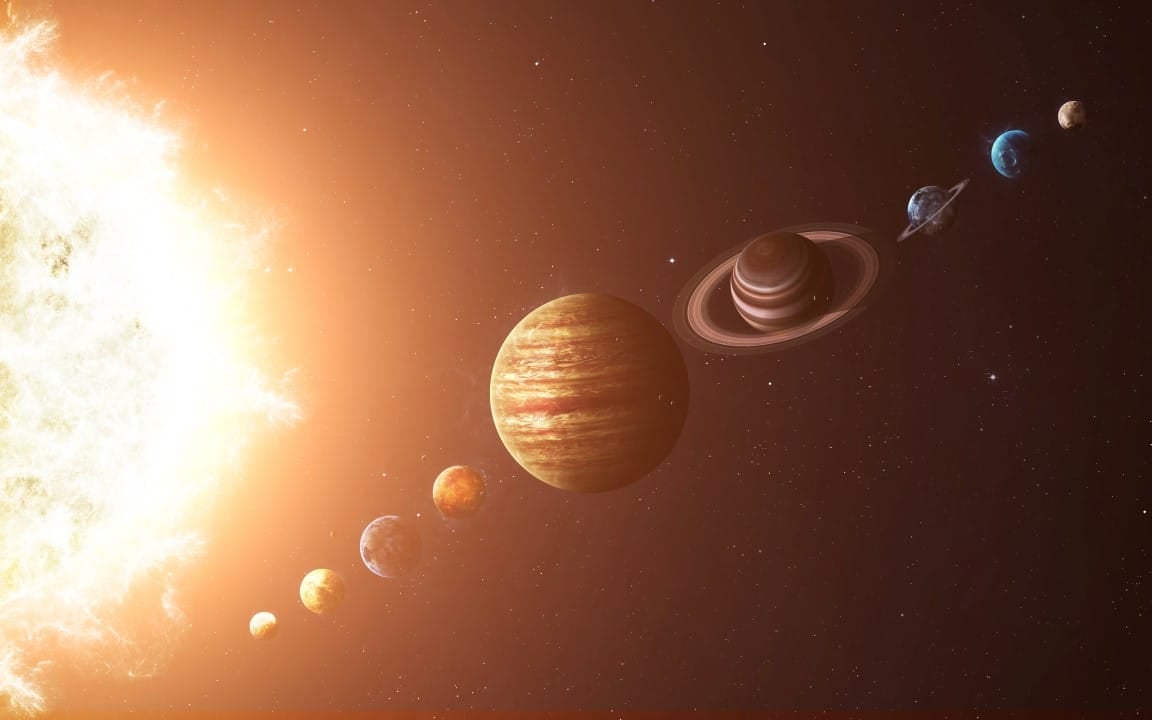
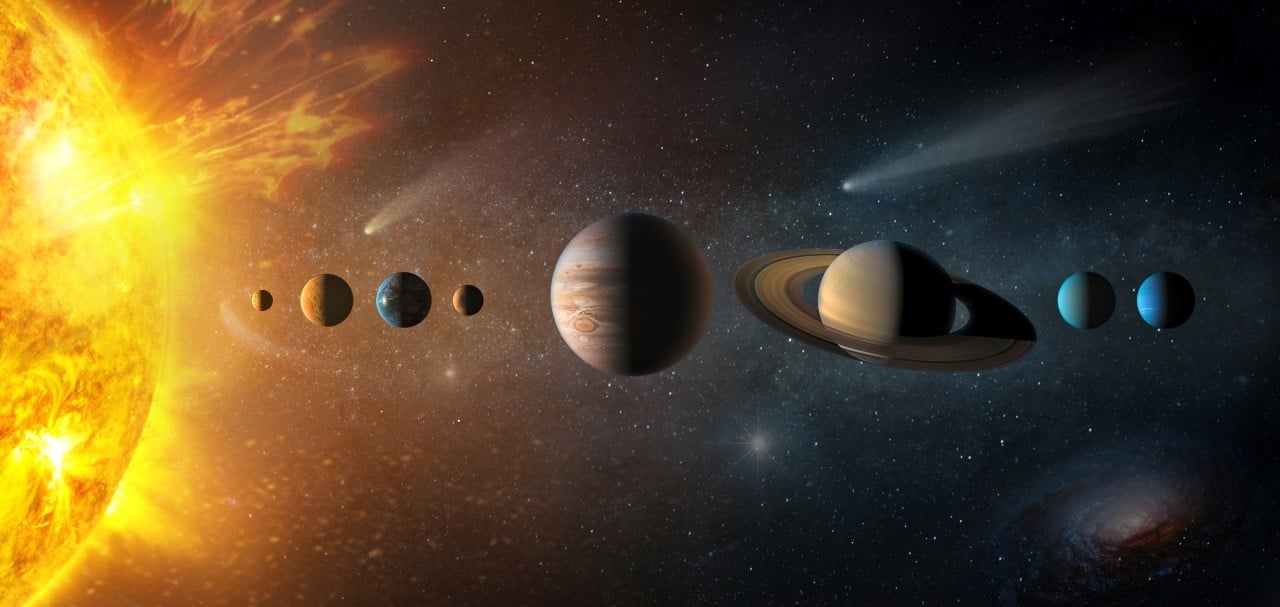
Six planets from Sistema Solar will be positioned in the same band of sky on February 28, 2026, allowing simultaneous observation shortly after local sunset. The phenomenon involves Mercúrio, Vênus, Júpiter, Saturno, Urano and Netuno distributed along the ecliptic. The configuration makes it easier to view at a convenient time for the general public.
The event is called a planetary parade by experts, a term that better describes the apparent concentration of the stars. Quatro planets can be identified with the naked eye under suitable clear sky conditions.
- Mercury, Vênus, Júpiter and Saturno do not require optical equipment.
- Uranus and Netuno require binoculars or telescopes for clear detection.
- Visibility varies depending on latitude and local atmospheric conditions.
The observation window extends for a few days around the main date, with the peak occurring on February 28 across much of the planet.
Configuration of the planets in the sky
The stars appear scattered from the western to the eastern horizon after twilight. Vênus stands out as the brightest, serving as an initial reference to locate the others.
Jupiter sits highest, followed by Saturno towards the west. Mercúrio remains challenging due to its proximity to the horizon.
Naked-eye visibility
Four planets offer enough brightness for observation without instruments. Vênus leads in luminous intensity, followed by Júpiter with high magnitude.
Saturn displays a constant yellowish tone, distinguishing it from nearby stars. Mercúrio appears briefly just after the sun sets, requiring an unobstructed horizon.
Planets that require instruments
Uranus is located in the middle region of the arc, close to known constellations. The planet has a faint greenish color when magnified.
Neptune is further away visually, requiring optics for adequate resolution. Ambos contribute to completing the visible sextet simultaneously.
Best time for observation
The ideal window begins about 30 minutes after local sunset. The period lasts for approximately two hours before the low stars disappear.
Cloudless skies and low light pollution improve the quality of vision. High Locais favor the complete capture of the planetary arc.
Differences by hemisphere
At Hemisfério Sul, the arc has an inverted inclination in relation to Norte. The order of the planets remains consistent regardless of location.
Equatorial regions obtain a balanced view of the stars. Áreas polars face challenges from prolonged twilight hours.
Specific positions on February 28
Mercury occupies a low position in the west, followed by Vênus and Saturno. Netuno is positioned close to Saturno, while Urano rises higher.
Jupiter dominates the eastern sector of the formed arc. The configuration allows progressive tracking of the planets as the night progresses.
Preparation for the phenomenon
Observers should choose locations with a western horizon free of obstacles. Verificação of the weather forecast days before helps with planning.
Moderate-power binoculars reveal additional details on distant planets. Aplicativos of astronomy guide identification in real time.
Explanation of apparent alignment
The planets orbit Sol in planes close to the Earth’s ecliptic. Essa geometry causes periodic visual concentrations from the perspective of Terra.
The phenomenon does not represent actual physical alignment in three-dimensional space. Trata is a perspective projection that brings together the stars in a celestial band.
The February 2026 configuration stands out for its inclusion of six visible planets. Eventos similar ones occur in variable cycles over the years.
Experts recommend the term parade to avoid confusion with true alignments. The concentration provides educational opportunities on orbital dynamics.
Detailed regional variations
In Brasil, cities such as São Paulo and Rio of Janeiro achieve good visibility of the four main planets. Instrumentos complement the observation of the weakest.
In Hemisfério Norte countries, such as Estados Unidos and Europa, the peak coincides exactly with February 28th. Regiões Asians obtain similar configurations in the same period.
Urban areas require moving to dark places. Zonas rural areas provide natural conditions favorable to the complete phenomenon.
Astronomical importance of the event
The parade represents an accessible moment for amateur study of the Sistema Solar. Observações contribute to public understanding of planetary orbits.
The simultaneity of six visible stars occurs relatively rarely. Configurações future ones will vary in number and arrangement.
The event reinforces interest in observational astronomy. Clubes and associations organize collective sessions in several cities.
Advanced Observation Tips
Start searching for Vênus as the main reference point. Prossiga to Júpiter and Saturno in logical sequence across the arc.
Avoid nearby artificial light sources during the session. Paciência allows the eyes to adapt to progressive darkness.
Photographic records require specific equipment to capture the set. Câmeras with long exposure reveals additional details.
Orbital context of planets
Each star maintains an independent trajectory around Sol. Apparent proximity results exclusively from relative terrestrial position.
Orbital periods vary significantly between participants. Mercúrio completes quick laps, while Netuno takes ages.
The ecliptic defines the plane of reference for these events. Desvios minima allow periodic visual concentrations like the one observed.
Participation in collective observations
Local astronomical associations promote public events for the phenomenon. Participação allows exchange of experiences between observers.
Shared telescopes facilitate viewing of Urano and Netuno. Orientação professional helps beginners with the correct location.
Educational activities accompany many organized sessions. The parade serves as a practical introduction to planetary astronomy.
The phenomenon of February 28, 2026 brings together favorable conditions on a global scale. The combination of accessible time and multiple visible planets attracts widespread attention.
Observation reinforces the connection between science and everyday life. Eventos celestial bodies like this promote continuous astronomical disclosure.



