

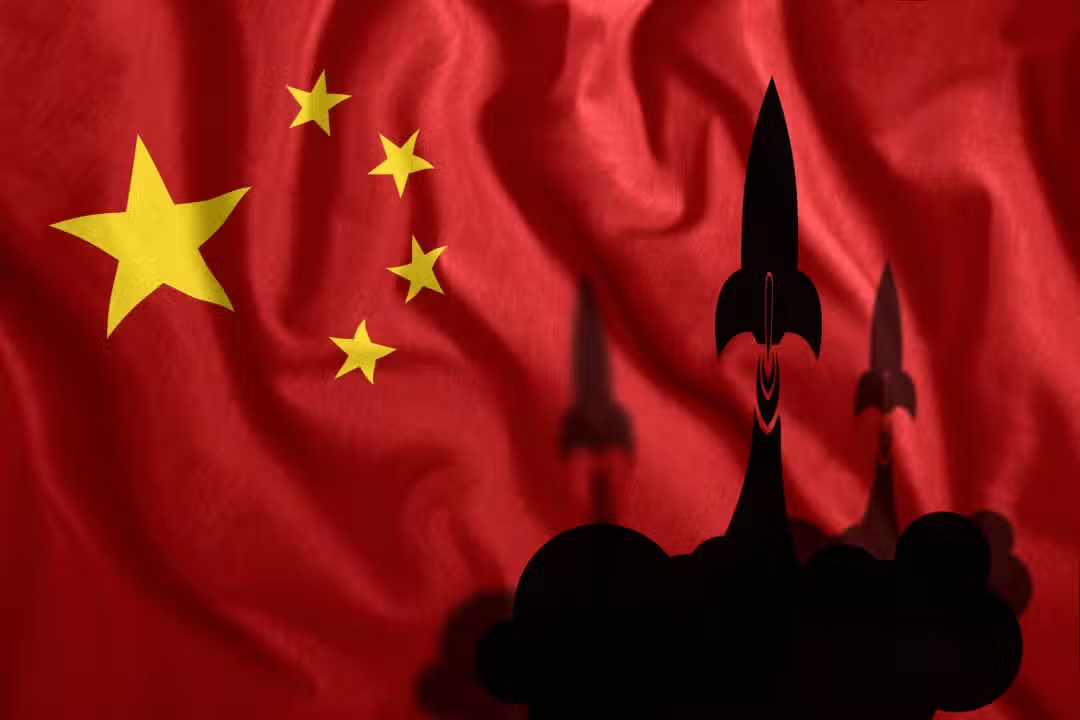
The Estados Unidos issued a serious formal accusation against the China this Friday, alleging that the Asian nation carried out a secret nuclear test in 2020. The accusation comes in a period of intense geopolitical volatility, precisely when the American administration has insisted on the need for a more comprehensive nuclear arms control agreement. Tal pact, in the view of
The American claim was made public one day after the expiration of the last nuclear arms control treaty between the US and Rússia, the Novo START, on February 5, 2026. Esta date marked a historic moment, leaving the two largest nuclear superpowers without formal limits on their arsenals for the first time in decades, creating a worrying vacuum in global security.
The international community now watches with trepidation as the implications of this new dynamic unfold. The situation raises the risk of an escalation in nuclear proliferation and weapons modernization, affecting global strategic stability and putting decades of diplomatic efforts towards denuclearization at risk.
Details of the accusation and the Chinese response
Thomas DiNanno, undersecretary of Estado for Controle of Armas and Segurança Internacional, was responsible for making the accusation public in a speech at Ele categorically stated that the US government had concrete information indicating that China had conducted tests with nuclear explosives, the predicted yield of which would be in the hundreds of tons. The specific date of the alleged event was detailed as June 22, 2020, although without providing additional technical data at the time of the announcement, intensifying pressures on Pequim.
DiNanno not only pointed out the testing, but also accused Chinese military forces of trying to “hide” these activities. Ele detailed that China would be employing methods such as “decoupling”, a technique that aims to reduce the effectiveness of international seismic monitoring. Decoupling involves the creation of large underground cavities around the blast point, which allows the shock energy to be partially absorbed by the ground and the cavity itself, resulting in seismic signals that are considerably weaker and harder to detect by global monitoring stations, making traceability and transparency difficult.
The geopolitical scenario after Novo START
The American complaint against China coincides with a period of profound strategic reassessment in the field of arms control. Novo Tratado START, which imposed verifiable limits on U.S. and Rússia deployed nuclear warheads and intercontinental ballistic missiles, expired on February 5, 2026, as previously communicated by the parties involved.
The absence of a formal arms control mechanism between the world’s two largest nuclear powers is unprecedented in decades, creating an environment of uncertainty and potential destabilization. Esta regulatory gap could pave the way for a race to modernize and expand arsenals, with each nation seeking to ensure its superiority or strategic parity, generating additional tensions in an already complex scenario.
Challenges for global nuclear monitoring
Organização of Tratado of Proibição Completa of Testes Nucleares (CTBTO), the entity that operates the Sistema Internacional of Rob Floyd, executive secretary of the CTBTO, stated in an official statement that the system “did not detect any event consistent with the characteristics of a nuclear weapon test explosion” on June 22, 2020. Subsequent Análises also did not change this conclusion, raising questions about the exact nature of the U.S. claimed test and detection capabilities for events of lesser magnitude.
Floyd specified that the IMS is capable of identifying nuclear explosions with a power equivalent to or greater than approximately 500 tons of TNT. Ele exemplified the effectiveness of the system by mentioning that all six nuclear tests conducted and declared by Coreia of Norte were detected by the system. Contudo, considering that the alleged Chinese test had a yield “in the hundreds of tons” – a number that DiNanno did not specify –, it is not clear whether the explosion would have reached the minimum detection limit of the CTBTO system.
Essa discrepância sugere que, em caso de utilização de técnicas como o desacoplamento, que atenuam os sinais sísmicos, eventos de menor rendimento podem, de fato, passar despercebidos. Isso highlights a potential gap in verification capabilities and reinforces the complexity of monitoring underground nuclear activities, especially when concealment is intended.
The nuclear testing moratorium and previous violations
The primary objective of the Tratado of Proibição Completa of Testes Nucleares (CTBT) is to prohibit any nuclear weapon test or other nuclear explosion in any environment. However, its full entry into force depends on ratification by a specific group of states with nuclear capabilities, including the USA and China, which has not yet occurred.
Apesar of both countries having signed the CTBT, neither Estados Unidos nor China have ratified it. Além In addition, Rússia took the decision to withdraw its ratification in 2023, which prevents the full activation of the treaty and its verification mechanisms. The lack of ratification by key nuclear powers prevents the use of more sophisticated mechanisms to deal with smaller explosions, such as those provided for in the treaty, compromising its effectiveness.
Implications of the end of unilateral US containment
Under Secretary of State Thomas DiNanno declared that February 5, 2026 symbolizes the “end of an era”, marking the end of the Estados Unidos’s unilateral containment of its nuclear arsenals, following the expiration of the Novo Tratado START. Embora did not directly state the intention to install new nuclear weapons, his words indicated a strong probability of easing. DiNanno emphasized that the country will continue its nuclear modernization programs, which began when Novo START was still in effect. Ele added that the US maintains an undeployed nuclear capability, which could be activated to respond to the new security scenario, if determined by the president. The primary objective is to maintain a robust, credible and modernized nuclear deterrent, ensuring security and preserving global peace and stability, while Washington seeks to negotiate from a position of strength.
Beijing rejects negotiations and its strategic reasons
The China has maintained a firm stance in rejecting proposals for trilateral arms control negotiations that include it, along with the Estados Unidos and the Rússia. The main justification presented by Pequim is that its nuclear arsenals are considerably smaller and are not on par with those of Washington and Moscou, which, in its view, would make any agreement disadvantageous.
Liu Pengyu, spokesperson for Embaixada of China in Washington, D.C., reiterated Pequim’s official position. Ele stated that China follows a “no first use” policy of nuclear weapons and adopts a nuclear strategy strictly focused on self-defense.
Liu Pengyu also highlighted China’s continued commitment to its nuclear testing moratorium and expressed a willingness to work with other parties to defend the authority of the CTBT and the international nuclear non-proliferation regime. Contudo, he also called on the US to fulfill its own obligations and commitments under the moratorium, so as to safeguard global strategic balance and stability.
Especialistas like Matthew Kroenig, of Atlantic Council, question Chinese logic, arguing that if disparity in arsenals is the concern, China should want arms control to limit American and Russian forces. Kroenig suggests that Pequim’s refusal may be motivated by a desire to build a superpower nuclear force, with significant investments already made in that goal and a reluctance to trade it away.
Next steps in arms control
Diante of the complex scenario, Daryl Kimball, executive director of Arms Control Association, stressed the urgency of a “sensible approach”, suggesting bilateral arms control negotiations. Ele emphasized that, regardless of the veracity of the alleged violations, the simple act of making accusations does not resolve the issue and that diplomatic channels must be prioritized. Kimball argued that the Estados Unidos and Rússia should, and could, continue to respect the central limits of what was the Novo START, in order to avoid unnecessary escalation and maintain a minimum of strategic stability at such a delicate moment.