

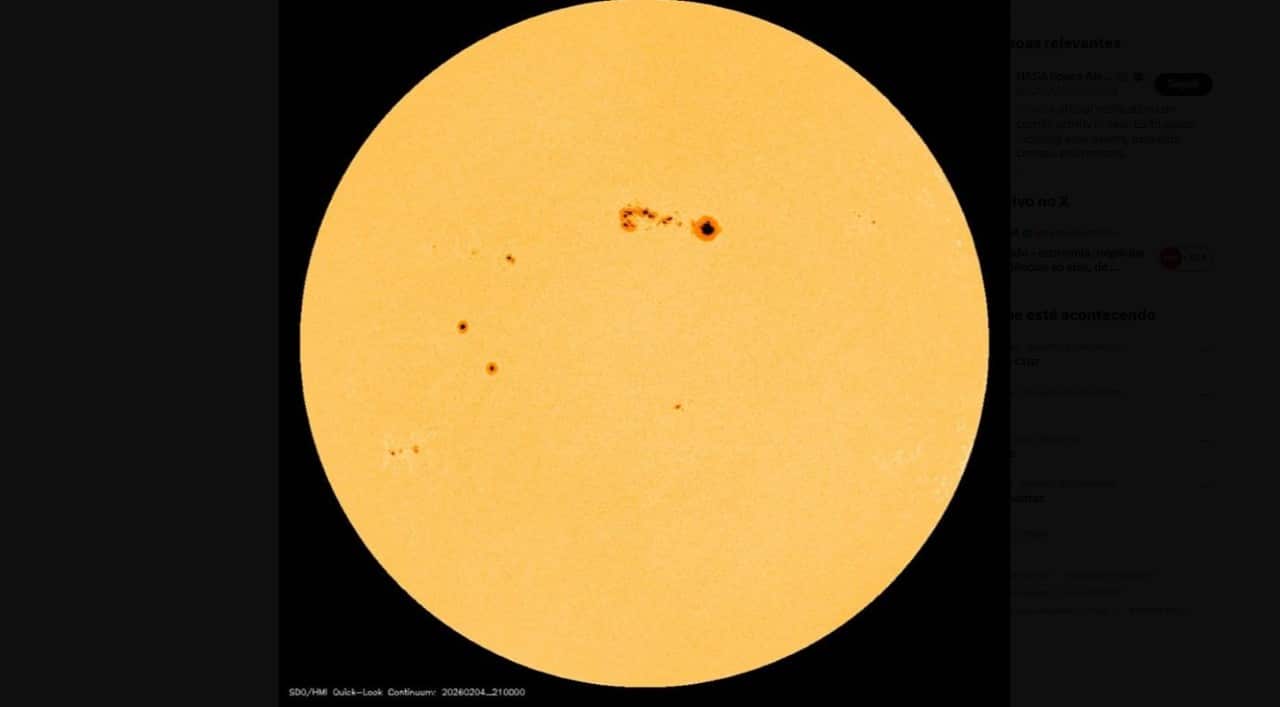
The North American space agency (Nasa) released an image of a sunspot that has a shape similar to a lying question mark. The capture was made on February 4, 2026 by Observatório of Dinâmica Solar (SDO).
The active region, identified as AR4366, emerged on January 30 and quickly concentrated high magnetic activity. Nos following days, satellites recorded multiple large solar flares.
The stain is approximately ten times the diameter of Terra. Especialistas highlight that the curious shape results from the alignment of magnetic fields in the solar photosphere.
- Image obtained by SDO’s HMI filter, specific for visible light
- Record taken during a period of intense activity of the star
- Format compared by Nasa to lying punctuation mark
- Plasma structures follow magnetic field lines
Curious shape of the active region
The visual pattern of spot AR4366 caught the immediate attention of scientists at Nasa. The configuration of the plasma structures followed magnetic field lines that, coincidentally, drew the outline of a slanted question mark.
This type of formation does not change the physical behavior of the region, but it facilitates visual identification in visible light images. SDO’s HMI filter is designed exactly to map these features on the solar surface.
https://twitter.com/NASASpaceAlerts/status/2020543147873386578?ref_src=twsrc%5EtfwAppearance and evolution of the spot
The AR4366 region emerged in the solar disk on January 30, 2026. Within days, it evolved into one of the most complex areas of the current cycle.
The rapid growth indicated strong concentration of magnetic energy. Esse process is typical of spots that reach large sizes during solar maximum.
The structure maintained enough stability to be observed for several days. Continuous Monitoramentos allowed recording the entire sequence of associated events.
Record of solar flares
Between January 30 and the first days of February, the spot generated dozens of eruptions. Satélites from Nasa detected at least 21 class C, 38 class M and five class X events.
Class X eruptions represent the highest level of intensity. Elas release energy capable of affecting communications and systems in orbit.
Classification of eruptions
Solar eruptions are classified according to the intensity of X-rays emitted. The scale divides events into classes A, B, C, M and X, with each letter representing a tenfold increase in power.
- Class C: weak events with minimal impact
- Class M: moderate eruptions capable of causing radio interference
- Class X: more powerful explosions with blackout potential at high frequencies
Within class X, numbers indicate relative strength. Valores above X5 are considered extremely intense.
Comparative size with Terra
The AR4366 spot reached an extension equivalent to about ten times the Earth’s diameter. Essa dimension places it among the largest recorded in solar cycle 25.
Regions of this size concentrate complex magnetic fields. Essas configurations favor the sudden release of accumulated energy.
Instrument responsible for capturing
The HMI (Helioseismic and Magnetic Imager) filter of Observatório of Dinâmica Solar was used to obtain the visible light image. Esse instrument maps movements and magnetic fields in the photosphere.
SDO has been operating in orbit since 2010 and provides continuous data about the star. Daily observations allow you to monitor the evolution of active regions in real time.
Context of solar cycle 25
Solar cycle 25 began in December 2019 and is now reaching its period of maximum activity. Previsões indicate that the peak occurs between 2025 and 2026.
During the maximum, the number of blemishes and rashes increases significantly. Esse behavior follows a pattern of approximately 11 years observed in previous cycles.
Current activity exceeds initial projections made by experts. Regiões complexes such as AR4366 become more frequent at this stage.
Constant monitoring of solar activity
Space agencies maintain permanent surveillance over the Sol using specialized satellites. The main objective is to predict events that could affect terrestrial and space infrastructure.
SDO data is complemented by other missions, such as Solar Orbiter and Parker Solar Probe. Essa network provides information at different wavelengths and distances.
Potential effects on Terra
X-class eruptions can generate planetary-directed coronal mass ejections. Quando reach the Earth’s magnetic field, causing geomagnetic storms.
These events interfere with high-frequency radio signals and navigation systems. In extreme cases, they affect electrical networks at high latitudes.
Satellites in orbit also face increased risks during periods of high activity. Partículas Energetics damage exposed electronic components.
Northern lights generation
Intense geomagnetic storms expand the regions where auroras become visible. Partículas charged interact with the upper atmosphere, producing colored lights.
Observers in mid-latitudes occasionally record the phenomenon during strong solar events. The intensity depends on the orientation of the ejection’s magnetic field.
Extreme event history
The Carrington event, which occurred in 1859, remains a reference for a severe solar storm. At the time, auroras were even seen in tropical regions.
Telegraph networks suffered widespread outages. A similar episode today would cause much greater impacts due to current technological dependence.
Studies estimate that events of this magnitude occur every few centuries. Modern Monitoramento allows anticipation and protective measures.
Importance of studying the photosphere
The photosphere represents the visible layer of Sol and where spots appear. Temperaturas in this region rotates around 5,500 degrees Celsius.
Detailed observations reveal characteristic graininess of plasma convection. Instrumentos as the HMI capture minute variations in surface motion.
Role of magnetic field lines
The shape observed in AR4366 results directly from the tracing of the magnetic field lines. Hot Plasma follows these trajectories, making them visible in specific images.
Complex configurations indicate a greater probability of magnetic reconnection. Esse process releases the energy responsible for the eruptions.
Contribution from Observatório from Valongo
Brazilian experts closely monitor current solar activity. Observatório of Valongo, linked to UFRJ, carries out complementary analyzes of international data.
Researchers highlight the exceptional size of the recorded spot. Comparações with previous events help to contextualize the episode.
Activity continuity perspective
Solar cycle 25 is expected to maintain high levels of activity for the next few months. Novas complex regions continue to emerge regularly.
Monitoring indicates that the gradual decline begins only after the main peak. Continuous Observações remain essential throughout the phase.
Advances in solar forecasting
Computational models have evolved significantly in recent decades. Previsões of eruptions gained precision using real-time data.
Agencies combine observations from multiple sources to issue alerts. Operadores of satellites and electrical grids receive advance information.
Relevance to heliographic science
Studies of active regions contribute to the understanding of the internal dynamics of Sol. SDO’s Dados help refine solar dynamo models.
Deeper understanding of magnetic cycles benefits several areas. Aplicações range from space climatology to protection of interplanetary missions.