
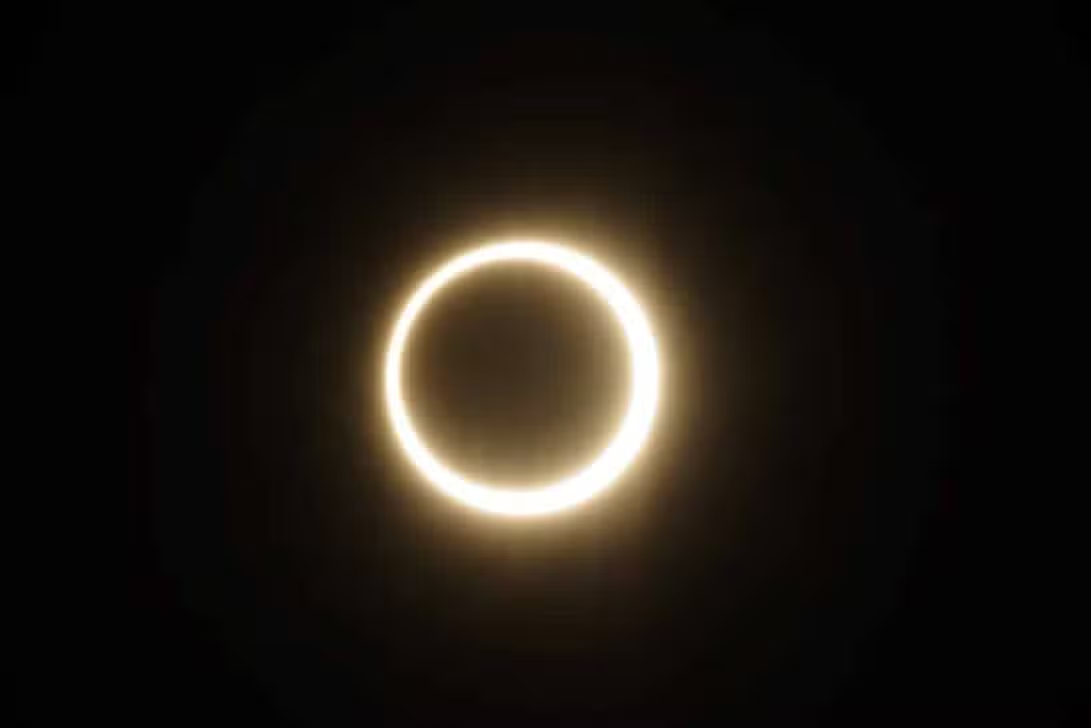
Expectations for the next annular solar eclipse, scheduled for February 17th, a Tuesday, are growing among astronomy enthusiasts. The event, popularly known as the “Ring of Fogo”, arouses curiosity due to its particularities and rare celestial display.
This specific type of eclipse happens when Lua is positioned between Terra and Sol. Contudo, due to its distance from our planet, it cannot completely cover the solar disk.
The result is a rim of sunlight that remains visible, creating a luminous circle that resembles a ring in the sky, hence the name “Ring of Fogo”. It is a visual spectacle that fascinates observers around the world.
Understand the mechanics of the ring of fire

An annular solar eclipse is a precise celestial alignment where the orbit of Lua around Terra and the orbit of Terra around Sol converge to create this unique configuration. Lua, at its furthest point from Terra (apogee), appears smaller in the sky, unable to completely block sunlight. Isso allows the light from Sol to outline the lunar silhouette, forming the characteristic ring.
The exact alignment is crucial for the phenomenon to be visible, briefly transforming the landscape into a mystical twilight. Mesmo Without a total “blackout”, the decrease in luminosity is noticeable, inviting us to contemplate the cosmos.
Where the celestial spectacle will be observed
The full visibility of the annular eclipse will be restricted to certain areas of the planet, making it an exclusive event for a few. Antártida is the only region where the phenomenon can be appreciated in its entirety, with the “Ring of Fogo” fully formed in the continent’s icy sky. Além In addition, some regions in the extreme south of América of Sul and certain areas of África Austral will have the chance to observe the eclipse in a partial way, where only a part of Sol will be covered by
For observers in these privileged locations, the start of the partial eclipse is scheduled for 9:56 am, followed by the annular phase at 11:42 am. The maximum point of the eclipse, with the most prominent ring of fire, will occur at 12:12 pm, ending its annular phase at 12:41 pm and the partial eclipse at 2:27 pm. Esses times, occurring on a Tuesday in February, offer a window into observing one of nature’s most impressive phenomena. The last time the annular phase was partially visible in some parts of our country was in 2023.
Impacts on luminosity and energy production
Although the annular solar eclipse is visually stunning, the idea that it would cause a “blackout” is a common misconception. In reality, the edge of Sol remains visible, which means that a continuous source of sunlight still reaches Terra, albeit in a reduced form. Isso results in a slight darkness, similar to a cloudy day or dusk, but never a complete interruption of daytime lighting.
NASA, the American space agency, clarifies that the phenomenon has no significant impact on the production of solar energy or the physical functioning of the Sol. The star continues its nuclear fusion process unchanged, and the brief decrease in light observed in Terra is merely a perspective effect caused by the alignment of Lua. Portanto, the energy infrastructure does not change due to this astronomical event.
Remote monitoring for those who won’t see you in person
Although Antártida and other specific regions are the privileged stages for direct observation of the annular solar eclipse, modern technology offers alternatives so that enthusiasts from all over the world can follow the event. Muitas astronomical institutions and media platforms plan live online broadcasts, allowing millions of people to enjoy the celestial spectacle from their homes.
In addition to broadcasts, several astronomy applications and specialized websites provide real-time information about the eclipse’s path, peak times and even simulations of how the “Ring of Fogo” will appear at different points on Terra. Essa digital accessibility ensures that geographic distance is not an impediment to witnessing the grandeur of this phenomenon.
Safety paramount when observing the sun
Observing any solar eclipse requires strict precautions to protect eye health. Nunca You should look directly at Sol without adequate protection, as the intense radiation can cause permanent damage to the retina, including blindness. Óculos Ordinary sunlight, X-ray plates, homemade filters or pieces of smoked glass do not offer sufficient protection and are dangerous.
It is essential to use certified solar filters that meet the international standard ISO 12312-2. Esses filters are specifically designed to block ultraviolet, infrared and most visible light. Safety should be the top priority when planning to observe an eclipse.
NASA Recommendations for Vision Protection
NASA emphasizes the importance of following specific guidelines for safely observing solar eclipses. Para In addition to certified eclipse glasses, other options include welder’s glasses tinted number 14 or higher, which provide the filtration necessary for safe viewing.
Another safe and affordable method is to build a pinhole projector. Este simple device allows you to observe the image of Sol projected on a surface, without the need to look directly at it. Essa technique is particularly useful for groups and educational activities, ensuring that everyone can enjoy the phenomenon without risk.
The science behind the cosmic dance
Solar eclipses are impressive demonstrations of celestial mechanics, the result of the gravitational interaction between Sol, Terra and Lua. Lua’s orbit is not perfectly circular, but elliptical, which means that its distance from Terra varies. Quando to Lua is closer (perigee) and aligns with Sol, we have a total solar eclipse; when it is further away (apogee), as in this case, the annular eclipse occurs.
The inclination of the Lua’s orbit relative to the Terra’s orbit around the Sol also plays a crucial role. If the orbits were in the same plane, we would have eclipses every Lua Nova. However, this inclination makes perfect alignments rarer and more sporadic events, making each eclipse a unique opportunity to study and admire cosmic phenomena.
Curiosities about solar eclipses
- Types:Existem four main types of solar eclipses: total, partial, annular and hybrid. The annular eclipse is one of the most visually distinct.
- Frequency:Eclipses solar eclipses occur on average twice a year somewhere in Terra, but an annular eclipse is less frequent than a partial one.
- Duration:The duration of an annular eclipse can vary, but the annularity phase generally lasts from a few seconds to more than 10 minutes.
- History:Eclipses have been observed and recorded by ancient civilizations for millennia, playing important roles in mythologies, calendars, and even the advancement of science.
Notable Upcoming Celestial Events
Observing solar eclipses is just one of many opportunities to contemplate astronomical phenomena. Após the “Ring of Fogo” of February, the celestial calendar reserves other significant events throughout the year and in the following years. Meteoros, planetary conjunctions and other eclipses, whether solar or lunar, are regular predictions that continue to attract the attention of amateur and professional astronomers.
Following predictions from the scientific community and specialized observatories allows interested parties to prepare to witness these unique moments. Cada event is a reminder of the vastness of the universe and the complexity of celestial movements, offering a unique perspective on our place in the cosmos.