

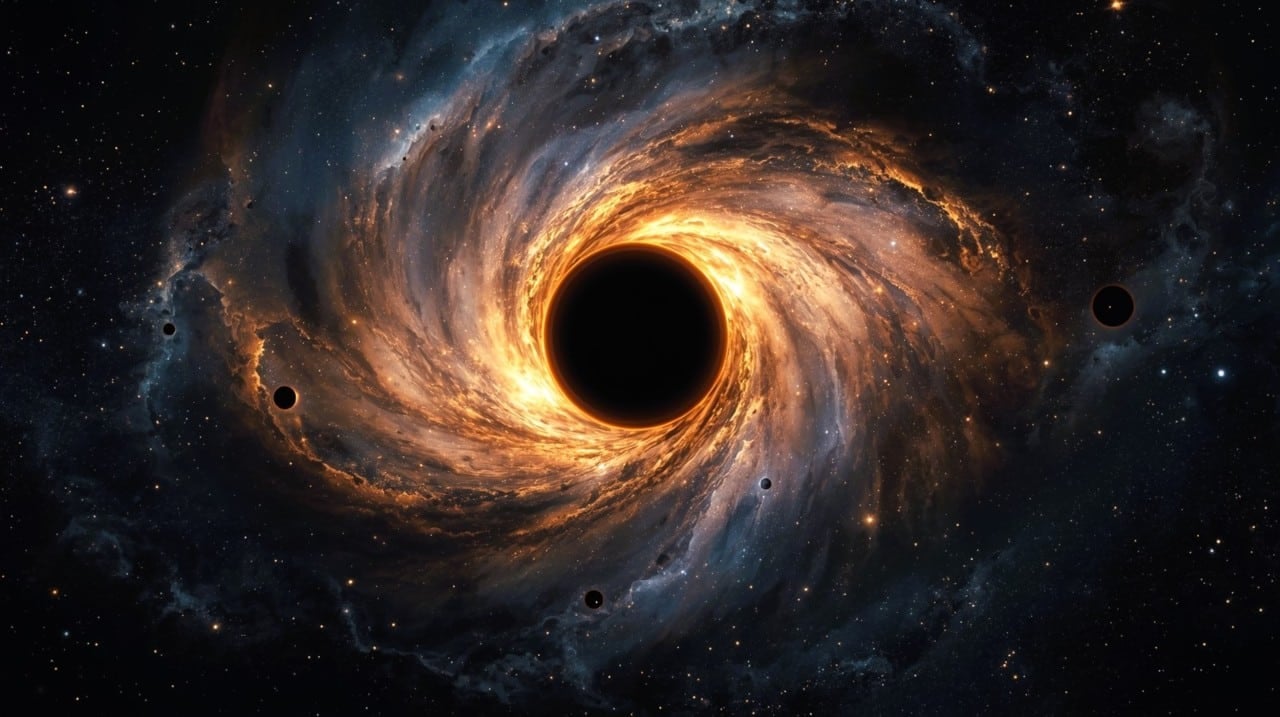
The KM3NeT detector, installed at the bottom of Mar Mediterrâneo, recorded in February 2023 a neutrino with an energy estimated at around 100 PeV. Esse event, named KM3-230213A, exceeds the typical energy of solar neutrinos by billions of times and represents the most energetic ever captured by human instruments.
The detection occurred when the neutrino interacted with water molecules, producing flashes of light detected by underwater sensors. Pesquisas recent studies indicate that the origin may be linked to the explosive evaporation of a primordial black hole with specific characteristics.
This type of particle defies conventional explanations, as there are no known astrophysical sources capable of generating such energy. The event reignites discussions about extreme phenomena in the primordial universe.
Detection details on Mediterrâneo
KM3NeT operates with thousands of optical modules distributed in lines anchored on the seabed. Esses sensors capture the light Cherenkov produced when particles such as neutrinos pass through water at high speeds.
On February 13, 2023, the system identified an intense signal corresponding to a high-energy neutrino. The data reconstruction pointed to a particle with at least 100 PeV, a value that surpasses previous detections at other observatories.
Energy compared to terrestrial accelerators
The energy of the detected neutrino is equivalent to around 100 thousand times that produced in the Large Hadron Collider collisions. Partículas with this power level rarely interacts with ordinary matter, which makes its capture a rare event.
Solar neutrinos, by comparison, have millions of times lower energy. Essa difference highlights the exceptional nature of the signal recorded by KM3NeT.
What are primordial black holes
Primordial black holes would have appeared in the first moments after Big Bang, from dense fluctuations in matter. Diferentemente of those formed by stellar collapse, these objects can have very small masses.
They evaporate over time through Hawking radiation, a theoretical process proposed by Stephen Hawking. Quanto the smaller the mass, the faster the evaporation becomes until a final explosive stage.
- Formation occurs in fractions of a second after the Big Bang
- Masses range from atomic sizes to asteroids
- Evaporation accelerates as mass decreases
- Final phase releases high-energy particles
Quasi-extremal hypothesis
Recent studies propose that the neutrino comes from a quasi-extremal primordial black hole. Esses objects have an additional charge in a dark sector, altering the evaporation process.
The presence of this charge keeps the black hole in an almost maximum state of charge in relation to its mass for a long period. Isso modifies particle emission, concentrating energy in specific high-power events.
Researchers at Universidade and Massachusetts Amherst developed a model that explains the KM3NeT signal. The theory resolves inconsistencies between observations from different detectors.

Differences from simple models
Standard models of primordial black holes predict more uniform particle emissions. Já quasi-extremals suppress neutrinos in certain energy ranges, explaining why IceCube did not record similar events to the same extent.
IceCube, located at Antártida, has been operating for two decades and has detected neutrinos above 1 PeV, but none close to the level of KM3NeT. Essa discrepancy gains explanation with the hypothetical dark charge.
Hawking radiation in action
Hawking radiation arises from the quantum effect near the event horizon. Virtual Partículas become real, gradually reducing the mass of the black hole.
In the final stages, the object heats up rapidly and releases a large amount of energy in the form of elementary particles. Neutrinos are among the most difficult products to detect due to low interaction.
Implications for dark matter
Quasi-extremal primordial black holes could make up some or all of the dark matter observed in the universe. Sua distribution would explain gravitational effects in galaxies without the need for new particles.
Observations of the cosmic microwave background and galactic motions are consistent with this possibility. Detecting more similar events would strengthen the hypothesis.
Other explanations considered
Conventional astrophysical sources include active galaxy nuclei and gamma-ray bursts. However, these origins do not consistently produce neutrinos with such high energy.
Blazars and other extreme objects were analyzed as candidates. Most models fail to explain the absence of correlated signals at other wavelengths.
Unique signal characteristics
Event KM3-230213A showed an upward trajectory, indicating an origin below the Earth’s horizon. Isso eliminates atmospheric sources and reinforces cosmic provenance.
The reconstructed energy varies between estimates, but remains in the range of tens of PeV. Accuracy depends on the calibration of underwater detectors.
- Trajectory compatible with extragalactic origin
- Absence of accompanying muons
- Intensity greater than previous events
- Burst model compatibility
Prospects for new detections
With the expansion of KM3NeT and improvements to IceCube, it is expected to capture more high-energy neutrinos in the coming years. Similar Eventos could confirm or refute the quasi-extremal hypothesis.
Complementary observatories in different locations on the planet increase the chances of triangulation. Redes global detectors are under development for this purpose.
Technological advances in KM3NeT
The Mediterranean detector uses pressure-resistant glass beads with sensitive photomultipliers. The multi-line configuration allows three-dimensional reconstruction of interactions.
The deep sea location reduces cosmic and atmospheric noise. Isso favors the detection of low-energy neutrinos compared to ice observatories.
Contributions to particle physics
If confirmed, the origin in a primordial black hole would reveal new particles beyond Modelo Padrão. The final explosion would emit the entire catalog of possible particles in the universe.
This includes theoretical candidates like gravitons and supersymmetric particles. Observações future studies could identify specific signatures of these emissions.
Distribution of extreme events
The rate at which primordial black holes explode depends on their initial abundance. Modelos predict rare occurrences, but detectable with current instruments.
The relative proximity of an event would explain the strength of the received signal. Distâncias of thousands of astronomical units are compatible with the observations.
Integration with multimessenger observations
Multimessenger astronomy combines neutrinos, gravitational waves and light at different wavelengths. The absence of correlated signals in the case of KM3-230213A favors unconventional origins.
Gamma-ray detectors did not record bursts associated with the event. Isso reinforces the hypothesis of a source with predominantly neutrino emission.
The study of the 2023 neutrino represents a significant advance in the understanding of extreme phenomena. Combining observational data with theoretical models opens new frontiers in astrophysics.