

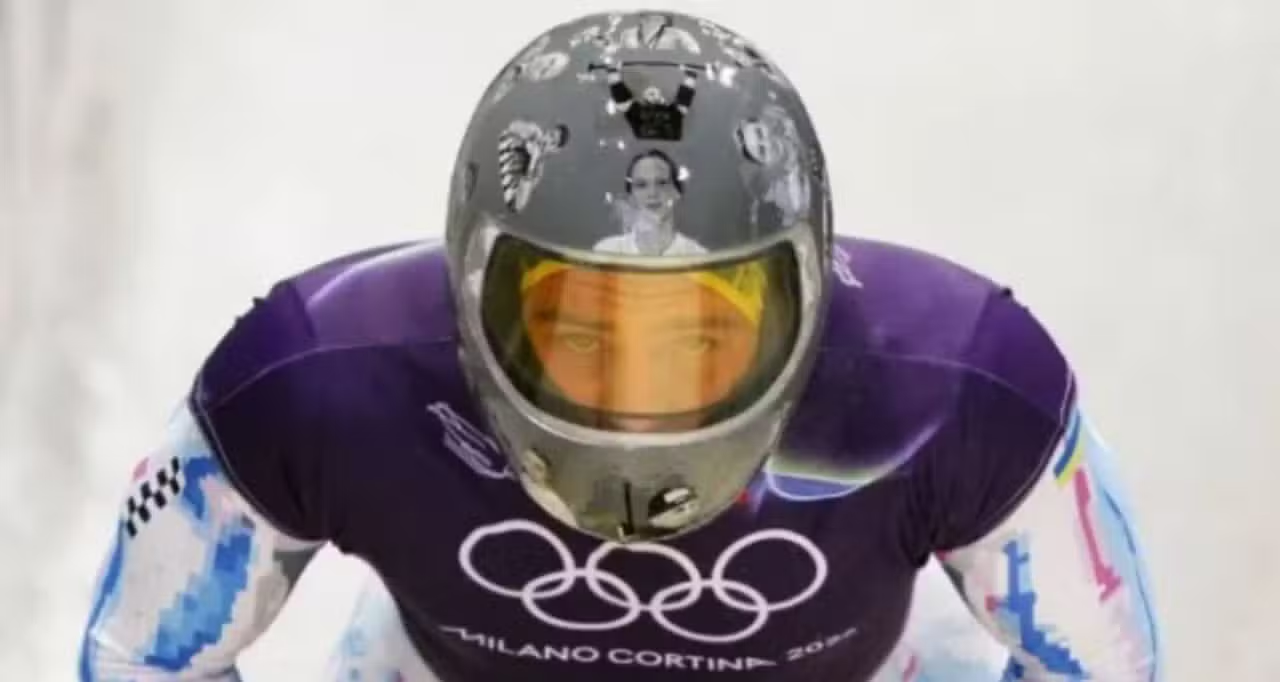
The Ukrainian delegation’s participation in the skeleton events came to an abrupt halt this Thursday during preparations for the official descents in Milão-Cortina. The Comitê Olímpico Internacional (IOC) officially withdrew Vladyslav Heraskevych’s credentials, preventing him from continuing in the global winter event. The drastic measure was taken after the athlete rejected direct orders to replace his personal protective equipment, which contained visual elements considered a violation of the competition’s neutrality rules.
The helmet worn by the athlete was printed with photographs of several compatriot athletes who died as a result of the armed conflict against the Rússia. The organizing entity interpreted the posthumous honor as a political demonstration within the competition area, which goes against the strict guidelines established by Carta Olímpica to keep the games free from geopolitical protests.
Heraskevych had already used the item during training sessions held at the beginning of the week, which caught the attention of inspectors from Federação Internacional of Bobsleigh and Skeleton (IBSF). Mesmo após reuniões com a alta cúpula do comitê, incluindo conversas com a presidente da comissão de atletas, o competidor manteve sua posição de não ocultar as imagens, resultando na sua desclassificação imediata.
Diplomatic impasse and official reactions
The decision to exclude the athlete generated an immediate wave of reactions in both the sporting and diplomatic spheres. The government of Ucrânia, through its highest representatives, condemned the stance of the games organization. The minister of Relações Exteriores, Andrii Sibiga, issued strong statements, arguing that the entity’s attitude tarnishes its own institutional reputation and will be remembered in the future as a shameful moment for world sport.
President Volodymyr Zelensky also expressed public support for Heraskevych’s gesture. The head of state’s endorsement reinforces the view that the Ukrainian presence in international events transcends the search for medals, serving as a platform of visibility for the country’s situation. Para local authorities, the veto of the memorial on the helmet was interpreted as a silencing of the reality experienced by the nation.
In turn, the athlete used his social networks to regret what happened, but reaffirmed his principles. In a post on platform X, Heraskevych declared that disqualification was the price paid for maintaining his dignity. The stance reflects a feeling shared by many athletes in the country, who compete carrying the grief and responsibility of representing the victims of war.
The neutrality rules under debate
The episode reignited discussions about Regra 50 of Carta Olímpica, which prohibits demonstrations of political, religious or racial propaganda in Jogos locations. Historicamente, the IOC defends this rule as essential to preserve the universality of the event and prevent the Olympic village from becoming a stage for external divisions and conflicts. The entity seeks to ensure that the focus remains exclusively on athletic performance and unity between people.
However, critics point out that applying these rules in contexts of humanitarian crisis or war may appear insensitive. The central argument is that honoring colleagues killed in a conflict should not be equated with a traditional political protest. The case of Heraskevych exposes the fine line between athletes’ individual freedom of expression and institutional regulations that seek standardized neutrality.
In previous editions, such as Jogos, Tóquio and The IOC’s insistence on vetoing the helmet demonstrates that the organization does not intend to set precedents that could be used by other nations in different conflicts.
The symbolism of vetoed equipment
The central object of the controversy was not just a security item, but a mobile memorial. The gray helmet was personalized by the Heraskevych team with the specific intention of honoring the memory of the victimized athletes. Cada printed photo represented a career interrupted and a life lost, transforming the descent on the ice rink into an act of silent but visually impactful tribute.
Vladyslav Heraskevych is known on the international circuit not only for his technique but also for his patriotism. Veterano of other Olympic editions, such as PyeongChang 2018 and Pequim 2022, he has always sought to use his visibility to alert the world about conditions in Ucrânia. The choice to take the images to the ice rink was a conscious decision to keep alive the memories of those who were unable to be present.
Skeleton challenges and the context of the war
The modality practiced by Heraskevych, skeleton, is considered one of the most extreme winter sports. Athletes descend face down on a minimalist sled, with their faces just centimeters from the ice, reaching speeds in excess of 130 km/h. The physical and mental demands are immense, demanding absolute focus to control the G-force in the curves and maintain the ideal trajectory.
For Ukrainian athletes, this preparation has been carried out under adverse conditions. Desde the start of the large-scale invasion, many sports infrastructures were destroyed or damaged. Treinamentos were interrupted, and many professionals had to abandon their careers to join the defense fronts or seek refuge in other countries.
The presence of the delegation in Milão-Cortina, therefore, is seen as an act of resistance. Cada descent, jump or run symbolizes the survival of national sport in the face of devastation. The disqualification of one of its main names in skeleton is a heavy blow for the team, which sees the Olympic scene as one of the few opportunities to show resilience on a global scale.