

Engineers at Northwestern Polytechnical University, located in Xi’an, have achieved a significant milestone in aeronautical engineering by developing a robotic system that replicates the flight mechanics of birds and bats with high fidelity. The device, called RoboFalcon 2.0, overcomes historical limitations of previous models by performing takeoffs without external assistance and maintaining stability at low speeds. The innovation lies in the ability to integrate complex wing movements into a continuous cycle, enabling refined aerodynamic control.
The biomimetic technology applied in this project aims to solve persistent challenges in aerial robotics, specifically the dependence on external launchers or the inability to perform slow and precise maneuvers. Testes rigorous tests conducted in laboratories and wind tunnels validated the system’s effectiveness under varying conditions, demonstrating that biological mimicry can offer practical solutions for autonomous navigation.
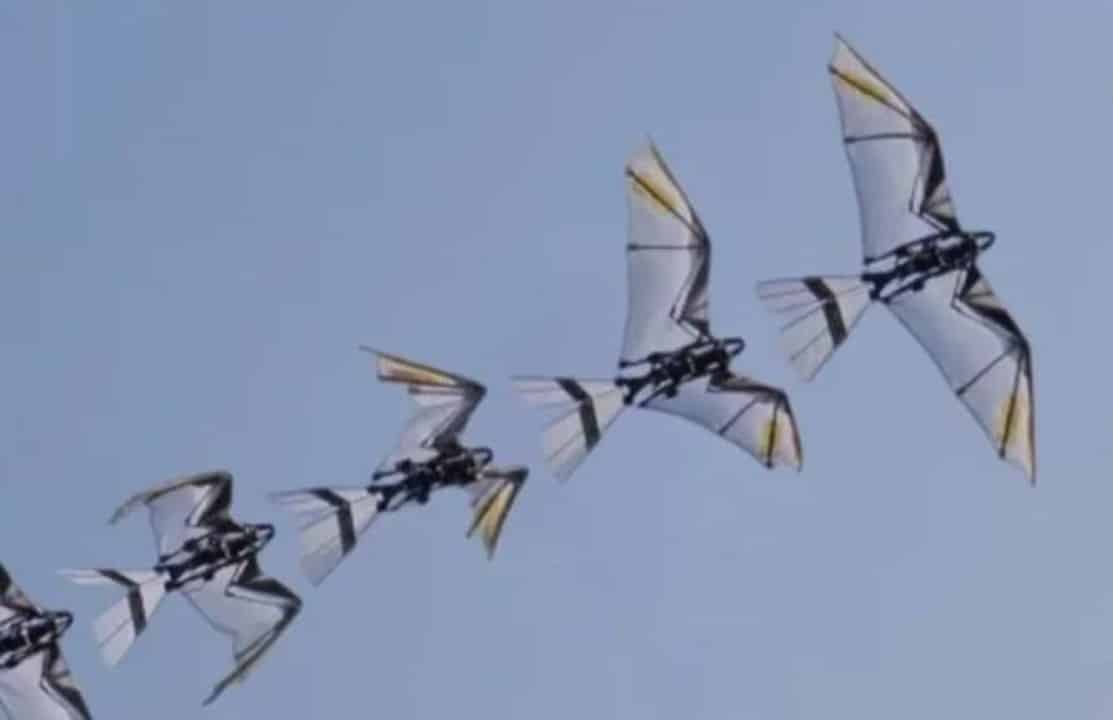
Among the main technical advances observed, the ability to maintain a stable trajectory during tethered flights and the independent adjustment of amplitudes for pitch control stand out. The system also allows an adjustable beat frequency that can reach 7.5 Hz, offering operational versatility.
Device Specifications and Engineering
The RoboFalcon 2.0 features dimensions and weight optimized to simulate the size of an average bird of prey, weighing approximately 800 grams and having a wingspan of 1.2 meters. The central drive structure is powered by a single motor, which connects to a conical rocker type mechanism. Esta mechanical configuration is responsible for the efficient transmission of kinetic energy from the engine to the wings, ensuring the synchronization necessary for flight.
The wings were designed with a strategic division into three distinct segments, all covered by a resistant and light polyester membrane. Esta choice of material ensures the necessary flexibility during beating cycles, mimicking the natural elasticity of the feathers and skin of flying animals.
Advanced decoupling mechanisms have been integrated into the structure, allowing independent variations in bending and sweeping movements. Essa feature creates inclined stroke planes, an aerodynamic technique observed in birds during slow flight, essential for lift without high speed.
FSF cycle dynamics and flight control
The robot’s operation is based on the “flap-sweep-fold” cycle (flap, sweep and fold), which combines three essential biomechanical actions in each movement of the wings. Durante the wing descent phase (downstroke), the anterior ventral movement is responsible for generating most of the lift force necessary to keep the robot in the air. On the other hand, the upstroke is carried out with the wings retracted, an intelligent strategy to minimize aerodynamic resistance and conserve energy.
The sweep of the wings can vary between 5 and 25 degrees, which allows the pitching moment to be modulated in a controlled and precise manner. Amplitudes larger sweeps have been shown to strengthen the leading edge vortex, a fluid-dynamic phenomenon that significantly improves aircraft performance at low speeds. Além In addition, the folding of the wings contributes to stability in the inactive phases of the cycle, providing the ability to perform hovering maneuvers and smooth transitions to directed flight.
Experimental validation and simulations
To prove the theory behind the design, experiments were carried out in an open wind tunnel, evaluating the prototype at speeds ranging from zero to 7 meters per second. The measurements, captured by a six-component load cell, recorded a consistent increase in average lift as the sweep amplitude was broadened.
The device’s net thrust remained stable at different beating frequencies, validating the robustness of the engine and transmission mechanism. Observou It was also noted that the pitching moment became positive at higher speeds, indicating adequate longitudinal control.
The results obtained presented reduced standard deviations, which confirms the repeatability and reliability of the measurements carried out by the research team.
Advanced computational analyses, based on the Navier-Stokes equations, identified strengthening of the leading edge vortex at maximum sweep settings. The simulations revealed that the center of pressure shifted anteriorly, expanding the aerodynamic moment arm and explaining the lift gains in slow flight.
Autonomy and takeoff tests
The autonomous takeoff capability was tested using dynamic simulation models that implemented PID (Proportional-Integral-Derivative) control. Adjustments to the sweep of the wings were essential to maintain pitch stability in near-hover situations, with speeds below 3 meters per second. The system demonstrated control proportional to demands at different scales, although the need for compensation at higher speeds was identified to avoid divergences in trajectory.
In practical tethered flight tests, carried out within a radius of 15 meters, RoboFalcon 2.0 confirmed its ability to take off without external assistance. With the standard center of gravity, the trajectory followed an “S” shaped pattern, reaching a maximum speed of 4 meters per second at a frequency of 7 Hz. Previous Ajustes in the center of gravity allowed even greater acceleration, reaching up to 6 meters per second without presenting pitch instability, with power consumption hovering around 400 watts during the most intense maneuvers.
Technological evolution and institutional context
Unlike the model presented in 2021, which was restricted to cruise flights, version 2.0 incorporates specific reconfigurations for low-speed operations. Enquanto Insect-inspired designs often utilize unique degrees of freedom, RoboFalcon follows patterns observed in vertebrates, offering superior biomechanical complexity. The new prototype addresses historical limitations by coordinating active and inactive phases in an integrated manner, making the approach viable for future practical applications despite energy efficiency challenges.
The research, conducted in the province of Shaanxi, reinforces Northwestern Polytechnical University’s position as a global reference in aerial biomimetic robotics. The responsible team evolved mechanisms from previous prototypes, integrating cutting-edge mechanical and electronic components. The results obtained open promising perspectives for future improvements in the autonomy and flight efficiency of bioinspired drones.



