
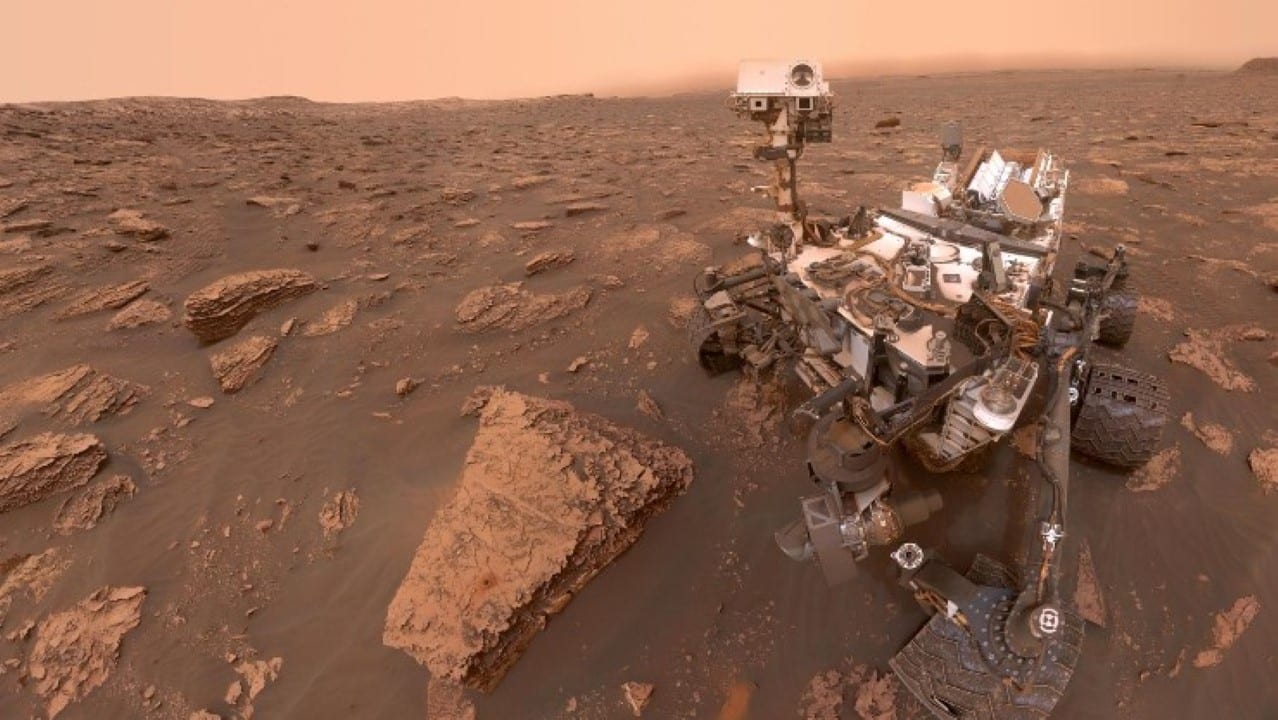
NASA researchers announced that known non-biological processes cannot fully explain the amount of organic compounds found in a rock sample collected by the Curiosity rover in Marte. The analysis, published in February 2026 in the journal Astrobiology, is based on data obtained from Cratera Gale and suggests that ancient biological sources may be a reasonable hypothesis. The identified compounds include decane, undecane and dodecane, the largest organic molecules ever detected on the red planet.
These molecules were initially discovered in March 2025, during examinations in a laboratory on board the rover. Elas may be fragments of fatty acids preserved in ancient mud, common structures in cell membranes in Terra. The team responsible combined laboratory radiation experiments with mathematical modeling to assess degradation over time.
The study estimated the rock’s exposure to cosmic radiation for about 80 million years. The results indicate that the original amount of organic material was greater than what non-biological processes could produce.
- Decane: 10-carbon chain;
- Undecane: 11-carbon chain;
- Dodecane: 12-carbon chain.
These detections represent the largest advance in organic complexity recorded in Marte to date.
Initial discovery on the Curiosity rover
The Curiosity rover collected the sample in a mud formation on Cratera Gale. Essa region is considered an ancient lake environment capable of supporting microbial life billions of years ago.
The compounds were identified using the Sample Analysis at Mars instrument, which heats samples to release volatile molecules. The presence of long carbon chains caught the immediate attention of scientists.
The initial analysis did not allow determining the exact origin of the molecules. Therefore, complementary research evaluated non-biological sources such as meteorite impacts.
Methods used in the investigation
Scientists have carried out experiments simulating Martian conditions with cosmic radiation. Eles applied doses equivalent to millions of years of exposure on the planet’s surface.
Mathematical models helped rewind the rock’s geological time. Essa approach estimated the amount of organics before intense degradation.
The results showed that sources such as meteorites or surface chemical reactions produce insufficient amounts. The observed abundance far exceeds these expected contributions.
Non-biological sources evaluated
Meteorite impacts deliver organic material over geological time. However, calculations indicate very low contributions for long chains like those detected.
Chemical reactions in the atmosphere or on the surface were also considered. Essas pathways generate simple molecules, but do not explain the preservation of complex structures.
Cosmic radiation destroys organics quickly in Marte due to the thin atmosphere. Mesmo therefore, significant quantities survived in the analyzed sample.
Other hypotheses include ancient hydrothermal synthesis. Esses processes occur in hot sources, but still do not fully explain the levels found.
Implications for organic preservation
The preservation of long molecules indicates effective protection in sedimentary rocks. The ancient mud from Cratera Gale acted as a radiation barrier.
Previous studies have already detected smaller organics on the planet. Essa new discovery raises the level of recorded chemical complexity.
The team emphasizes the need for more research into degradation rates. Condições specific to Marte still require better understanding.
Details of the detected molecules
Decane, undecane and dodecane belong to the class of long-chain alkanes. Na Terra, corresponding fatty acids participate in essential biological functions.
Detection occurred at parts per billion levels in the sample. Heating in the laboratory released these preserved fragments.
These structures can derive from larger carboxylic acids. The break during analysis explains the final shape observed.
Context of the mission Curiosity on Marte
The Curiosity rover has been operating since 2012 at Cratera Gale. Sua main goal is to assess the red planet’s past habitability.
The crater has sedimentary layers that record ancient environmental changes. Evidências of abundant liquid water has been confirmed in previous missions.
Onboard instruments enable detailed chemical analysis directly at the surface. Essa capability reduces dependence on samples returned to Terra.
Recent advances in Martian astrobiology
Organic discoveries accumulate evidence of complex chemistry in Marte. Cada finding contributes to the understanding of planetary evolution.
Future missions plan to collect samples for return to Terra. Análises more accurate information will be able to confirm specific origins.
The scientific community remains cautious about biological interpretations. Additional Dados are essential for definitive conclusions.
Current research reinforces the importance of exploring protected environments. Regiões underground may preserve clearer signs of ancient processes.
Next steps in exploration
Teams plan new drillings in strategic locations in the crater. Áreas with greater preservation potential receive priority.
International collaborations expand the scope of analyses. Dados of Curiosity continue to be reprocessed with improved techniques.
Missions like Mars Sample Return aim to bring samples to terrestrial laboratories. Essa initiative promises to resolve outstanding questions about organic origins.
