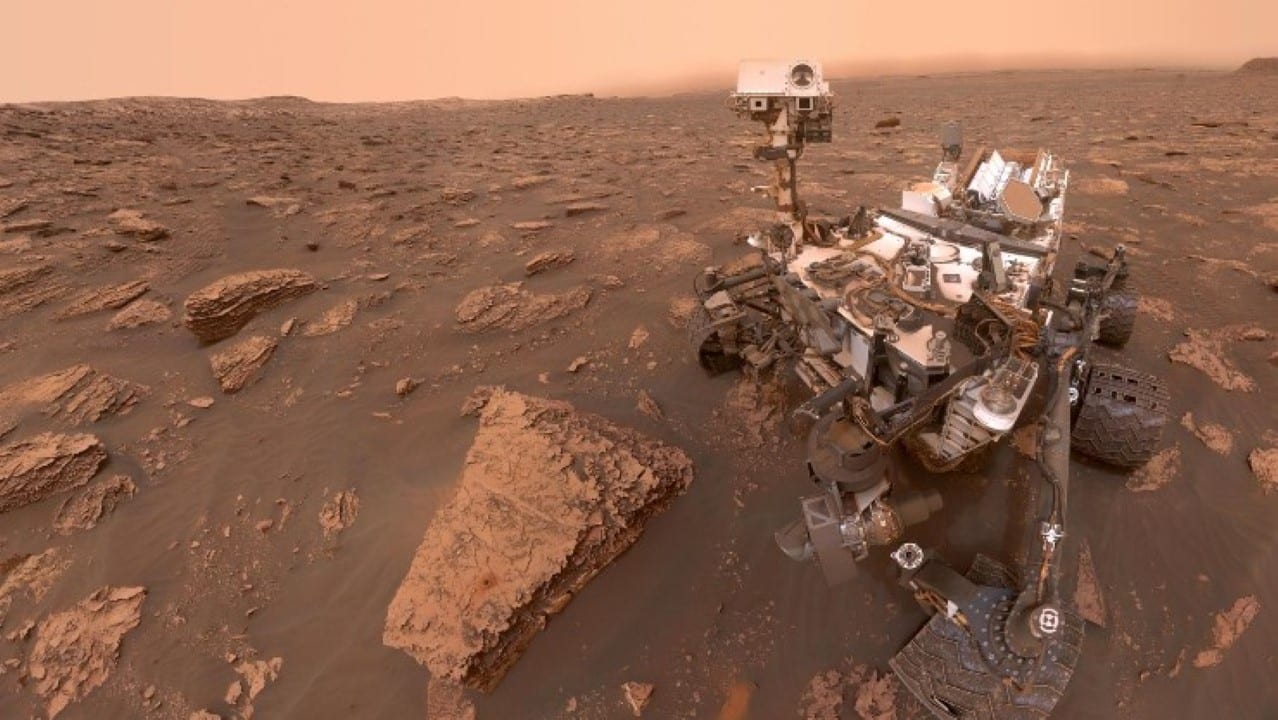
Researchers at Nasa published a study that evaluates the origin of organic compounds detected by the Curiosity rover in a rock sample at Cratera Gale. The analysis concludes that known non-biological sources cannot fully explain the inferred abundance of these molecules. Scientists estimate that the original amount was significantly higher before degradation by cosmic radiation.
The initial discovery occurred in March 2025, when the laboratory aboard Curiosity identified traces of decane, undecane and dodecane in ancient mud. Esses long-chain hydrocarbons represent the largest organic compounds ever found on the Red Planet. Eles may be fragments of fatty acids, common in cell membranes in Terra.
The rover collected the sample in the Cumberland formation, a mud deposit that indicates the presence of an ancient lake in Cratera Gale billions of years ago. Essa region has been a priority target of the mission since 2012 for preserving evidence of habitable environments. Previous Descobertas had already revealed smaller organic molecules at the site.
Discovery of long-chain hydrocarbons
The Sample Analysis at Mars instrument, known as SAM, heats pulverized rock samples and analyzes the gases released. Esse process allowed the compounds to be detected at levels of tens of parts per billion. Scientists emphasize that these values represent only a lower limit due to the rock’s prolonged exposure to the Martian surface.
Cratera Gale housed a persistent lake in ancient periods on the planet. Sedimentos fines accumulated at the bottom preserved organic materials throughout geological time. The Cumberland sample dates back to around 3.5 billion years ago, a time when Marte had wetter conditions.

Study analysis methods
Scientists combined laboratory irradiation experiments with mathematical modeling to simulate the degradation of the compounds. Eles went back approximately 80 million years of exposure to cosmic radiation on the Martian surface. The results indicate that the original concentration reached hundreds or thousands of parts per million.
The team evaluated several possible abiotic sources for these organics. Entre they are delivered by interplanetary dust and carbonaceous meteorite impacts. Outras hypotheses include atmospheric reactions and hydrothermal processes in the crust.
These sources proved to be insufficient to generate the estimated quantity. Meteoritos, for example, deposit organics at low rates and do not penetrate consolidated rocks. Reações as serpentinization also does not align with the mineralogy observed in the sample.
Abiotic sources evaluated
- Delivery by meteorites and interplanetary dust: Quantidades deposited are limited and do not explain internal enrichment in the rock.
- Atmospheric production and deposition: Exige methane-rich conditions that do not match the known geological record.
- Hydrothermal reactions such as Fischer-Tropsch: Inconsistentes with the absence of high-temperature minerals in the mud.
- Surface chemistry: Incapaz of generating long chains at observed levels.
The researchers emphasize that abiotic processes produce organics in modest quantities. The inferred abundance exceeds these known limits. Isso makes it plausible to consider contributions from an ancient biosphere or external hydrothermal vents.
Radiation modeling details
Galactic cosmic radiation destroys organic molecules over millions of years on the surface of Marte. Sem significant atmospheric protection, degradation occurs constantly. Experimentos in the laboratory replicated these conditions with similar rocks.
Computational models integrated data from Curiosity to calculate breakage rates. Eles revealed that the measured levels correspond to remnants of much higher concentrations in the past. The estimate ranges from 120 to 7,700 parts per million originally.
These numbers exceed by orders of magnitude what non-biological sources typically generate. Na Terra, similar organic-rich deposits are associated with biological activity. The parallel reinforces the need for additional research.
Mission context Curiosity
The Curiosity rover has been operating on Cratera Gale since August 2012. Seu’s main objective is to assess the past habitability of Marte. The vehicle has already confirmed the presence of ancient liquid water and favorable chemical conditions.
Discoveries include clays, sulfates and minor organics in previous years. The detection of long chains represents an advance in the identified molecular complexity. SAM continues to analyze samples to refine understandings about preservation.
Nasa plans sample return missions for more precise analysis in terrestrial laboratories. Essas initiatives will be able to determine origins with greater certainty. Até there, studies like this guide interpretations of the available data.
Implications for astrobiology
The presence of long hydrocarbons enriches the debate on prebiotic chemistry in Marte. Esses compounds serve as building blocks for more complex molecules. Sua preservation in ancient mud suggests effective protective mechanisms.
Scientists emphasize that biological hypotheses require extraordinary evidence. The study does not affirm life, but it indicates that abiotic explanations face limitations. Future Pesquisas will focus on degradation rates under actual Martian conditions.
The work involves teams from Goddard Space Flight Center and partner institutions. Publicado in the magazine Astrobiology on February 4, 2026, the article reinforces the importance of robotic exploration. Marte continues to reveal clues about its potentially habitable past.
Next steps in research
Terrestrial laboratories simulate Martian environments to accurately measure organic degradation. Esses experiments include variations in temperature, radiation, and mineral composition. Resultados will refine preservation models in exposed rocks.
Missions like Mars Sample Return will bring samples directly back for advanced analysis. Técnicas terrestrials will detect isotopes and structures that distinguish biological from abiotic origins. Planning advances with international partnerships.
Meanwhile, the Perseverance rover collects samples on Cratera Jezero. Essa region also preserves ancient lake deposits. Comparações between locations will expand the understanding of the distribution of organics on the planet.
The search for signs of past life on Marte combines data from multiple missions. Cada discovery adds layers to accumulated knowledge. The recent study represents a step toward cautious interpretation of complex chemical evidence.
