

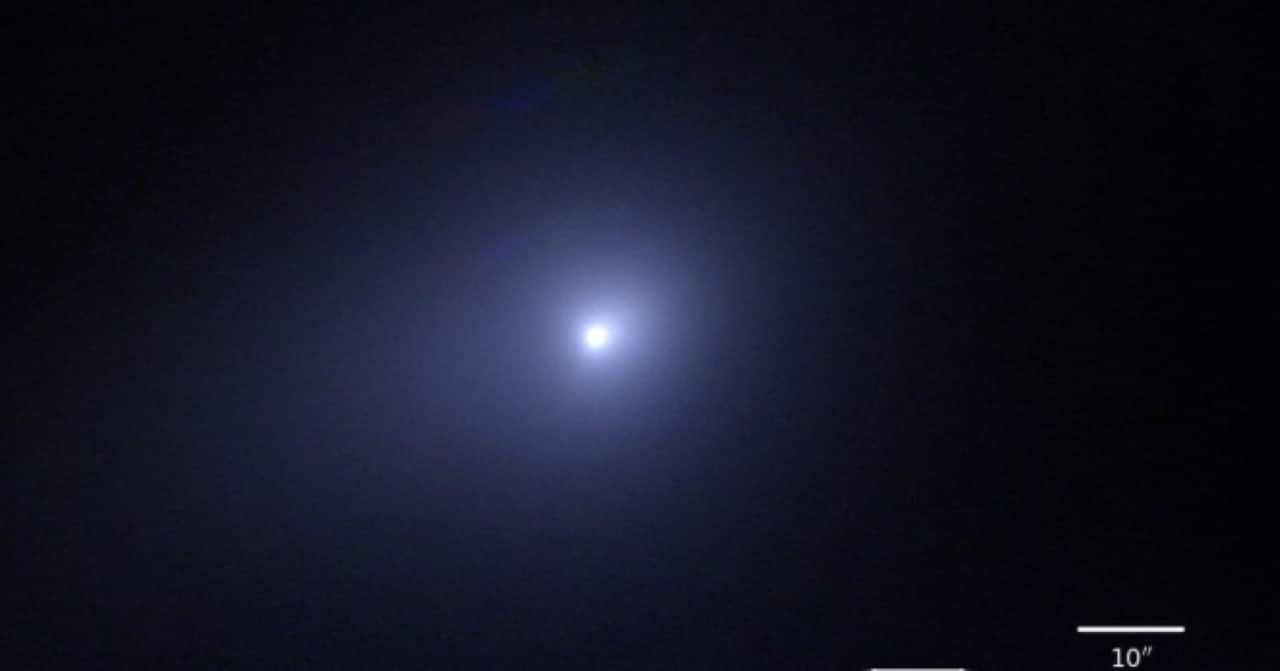
Astronomers have released detailed analyzes of the celestial body 3I/ATLAS, captured by Telescópio Subaru, located at Havaí. The observations, carried out in mid-December 2025, provided high-resolution images that confirm the object’s cometary activity. Este cosmic visitor passed within about 270 million kilometers of Terra, allowing for unprecedented data collection about its physical structure.
The object’s passage through the inner solar system offered a rare opportunity for the global scientific community. Diferente of common asteroids, 3I/ATLAS displayed a well-defined tail of dust and gas, indicating active sublimation processes caused by solar heat. The processed images clearly show the extension of the mane and tail, differentiating it from inert rocky bodies.

Continuous monitoring of this celestial body is fundamental to understanding the formation of distant planetary systems. As it originates outside our solar system, its chemical composition serves as a time capsule, bringing materials from other regions of the galaxy to our cosmic “backyard”.
Experts use this data to refine models about the dynamics of interstellar objects. Visual confirmation of the tail ends debates about the nature of the object, solidifying its classification as an interstellar comet, similar to 2I/Borisov, but with its own characteristics that intrigue researchers.
Identification and context of discovery
Object 3I/ATLAS was initially identified in July 2025 by the ATLAS warning system, operating at Chile. Sua detection marked a historic moment, being only the third interstellar body confirmed to cross our system, following in the footsteps of the mysterious 1I/’Oumuamua and comet 2I/Borisov. Confirmation of its interstellar origin came after precise calculations of its orbit, which proved to be unambiguously hyperbolic.
The activity observed in 3I/ATLAS places it in a distinct category compared to ‘Oumuamua, which did not have a clearly visible tail. The new visitor behaves like a “dirty comet”, releasing volatile materials as it approaches perihelion. Esta feature facilitated visual and spectroscopic tracking by large ground-based observatories.
During its closest approach to Sol, in October 2025, the object maintained a safe distance of 1.36 astronomical units. Agora, in 2026, it follows its outward trajectory, progressively moving away from the inner planets. Analysis of its light curve suggests a rotation period of approximately 15 hours, a crucial piece of data to understand its structural stability.
Spectroscopic analysis and composition
Observations carried out with the FOCAS instrument on Telescópio Subaru allowed a decomposition of the light reflected by the comet. The data revealed the presence of cyanogen and diatomic carbon, chemical signatures common in comets from our own solar system but fascinating when found in a visitor from another star. The reddish color detected suggests the presence of complex organic compounds on its surface, possibly altered by cosmic radiation during its long interstellar journey.
The dynamics of the dust ejected by the comet’s nucleus were precisely measured. The particles are not just floating passively; they are propelled by jets of gas that subtly alter the object’s trajectory, a phenomenon known as non-gravitational acceleration. Scientists were able to quantify the ejection speed of these materials:
- One-micrometer dust particles are ejected at speeds of 22 meters per second.
- Larger particles, over 100 micrometers, move more slowly, at about 2 meters per second.
- The rate of gas and dust production increased consistently between July and August 2025.
These measurements are vital to understanding the density and cohesion of the comet nucleus. The ejection of material confirms that 3I/ATLAS has ice reserves that sublimate, creating the coma visible in the Subaru images. The combination of V, R and I band filters generated a color image that highlights the morphology of the tail, extending in the opposite direction to the Sol.
Future trajectory and scientific legacy
3I/ATLAS’s orbit is open, meaning it will not be trapped by the gravity of Sol. Sua excessive speed relative to the solar system’s escape velocity ensures that it will return to interstellar space. Orbital projections indicate that it will cross the orbit of Marte in early 2026 and reach the distance of the orbit of Júpiter around 2028.
International collaboration was essential to the success of these observations. Além from Subaru, telescopes like the VLT and space observatories like Hubble and James Webb contributed data at different wavelengths. However, Subaru played a central role in capturing wide-field images that contextualized the tail’s extension relative to the stellar background.
Although the object’s brightness is decreasing as it moves away, large telescopes will continue to monitor it in the coming months. Cada new data collected helps build a statistical profile of the population of interstellar objects, allowing astronomers to estimate how many of these invisible bodies cross our system annually without being detected.
The detailed study of 3I/ATLAS leaves a legacy of data that will be analyzed for years. Ele reinforces the theory that planetary formation in other stars involves processes similar to those in our system, ejecting trillions of small icy bodies into the vast space between the stars.