

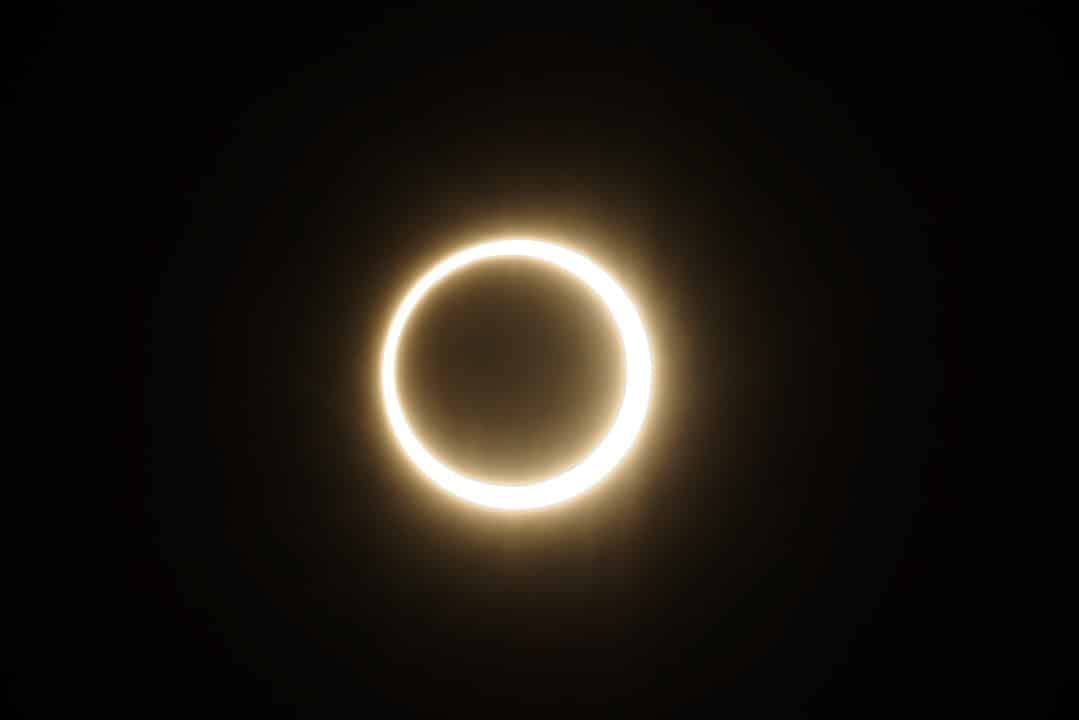
A supposed “global blackout” has been circulating intensely on social media, generating both apprehension and a wave of curiosity regarding an astronomical event scheduled for this Tuesday, February 17th. However, what actually awaits skywatchers is a natural spectacle of rare beauty: the first annular solar eclipse of the year, a phenomenon where Lua aligns itself precisely between Sol and Terra, but being at its furthest point from our planet, it does not completely cover the star, creating an impressive ring of light.
Contrary to the panic suggested by popular denomination, this celestial alignment does not represent any threat to terrestrial infrastructure or the safety of the population, being an event fully understood and predicted by science. The dissemination of accurate information is crucial to differentiating sensationalism from astronomical reality.
This event allows the population to appreciate the true meaning of this phenomenon in an informed way.
The true meaning of the ‘ring of fire’
This phenomenon is affectionately called the “ring of fire” due to the unique visual effect it provides. The silhouette of Lua, smaller than Sol from this perspective, allows a bright halo of the star to remain visible around it. Essa iconic image is the highlight of the annular eclipse, contrasting drastically with the idea of total and dangerous darkness.
The orbital dance behind the celestial spectacle
The occurrence of an annular solar eclipse is the result of a precise combination of celestial factors. The orbit of Lua around Terra is elliptical, which means that there are times when it is closer (perigee) and further away (apogee) from our planet. Quando the Sol-Lua-Earth alignment occurs at lunar apogee, the Moon appears slightly smaller in the sky. Esse reduced apparent size is what prevents total coverage of the solar disk, leaving the characteristic luminous edge. It is a fascinating reminder of the complexity and regularity of celestial movements, accurately predicted by astronomers.
Demystifying panic: no impact on infrastructure
The alarmist designation of a “global blackout” circulated on social media has generated unfounded concerns about possible disruptions to power or communications systems. It is imperative to clarify that the annular solar eclipse is a purely visual phenomenon, without any ability to directly influence electrical grids, telecommunications signals or any other technological infrastructure that supports modern life.
Scientific institutions around the world, including observatories and space agencies, have been monitoring and studying these events for centuries. Predictability and the absence of harmful effects are well-established facts, demonstrating that anxiety surrounding a “blackout” is the result of misinformation and not a real threat.
Global visibility and reality for Brasil
The beauty of the annular solar eclipse this Tuesday, February 17th, will be a privilege for few. The annular band, where the “ring of fire” can be seen in its entirety, crosses geographically distant regions that are difficult to access.
Locations graced with partial or full visibility include remote areas of Antártida, as well as specific portions of África and the vast South American continent. Contudo, even in these regions, observation will require favorable weather conditions.
For astronomy enthusiasts in Brasil, the news is not encouraging. Observatório Nacional, the country’s scientific authority, has already confirmed that the eclipse will not be visible in any part of the national territory, which could frustrate many who expected to witness the event.
This visibility limitation highlights the importance of following eclipse maps published by experts, which precisely delineate the areas where each phase of the phenomenon can be appreciated, ensuring that expectations are aligned with geographic reality.
Safety is a priority when observing the sun
Even though the event is not visible to most, the lesson of solar observation safety remains universal and fundamental. Olhar directly into Sol without adequate protection, even during an eclipse, can cause serious and permanent eye damage, including loss of central vision.
It is essential that any attempt to observe Sol is made with appropriate and certified equipment. Eye protection is the most important measure for anyone looking to appreciate the grandeur of these celestial spectacles.
Below are some crucial recommendations for safely observing solar eclipses:
- Always use specific and certified eclipse glasses, which block harmful radiation.
- Never use ordinary sunglasses, x-rays, exposed photographic films or telescopes/binoculars without appropriate solar filter.
- Indirect projection techniques, such as a homemade camera obscura or projecting the image through binoculars onto a white surface, are safe alternatives.
- Monitor children during observation to ensure they follow all safety guidelines.
An overview of upcoming astronomical events
Although this February 17th eclipse cannot be admired by everyone, the astronomical calendar reserves other opportunities for contemplation. The next big highlight for Brazilian observers is scheduled for February 6, 2027.
On that date, a new annular solar eclipse can finally be seen in some parts of the country, renewing the hopes of enthusiasts.
In addition to eclipses, the year 2026 also promises other celestial spectacles, such as meteor showers and planetary conjunctions.
The ancient fascination with celestial phenomena
Since time immemorial, eclipses have captured the human imagination, weaving mythical narratives and driving the search for knowledge. Civilizações Ancient women in different cultures often interpreted these events as divine omens or moments of supernatural intervention, recording them in texts and monuments, which highlights the deep mark they left on the worldview of the time.
Science against misinformation
In a scenario of information proliferation, the role of science and serious journalism becomes even more vital to combat misinformation surrounding natural phenomena such as eclipses. The ability to discern fact from fiction not only prevents unnecessary panic, but also adds value to the knowledge accumulated over centuries of observation and study. Transparency in data disclosure and constant updating by trusted institutions are essential pillars for the public to understand and appreciate the complexity of the universe in a safe and informed way.