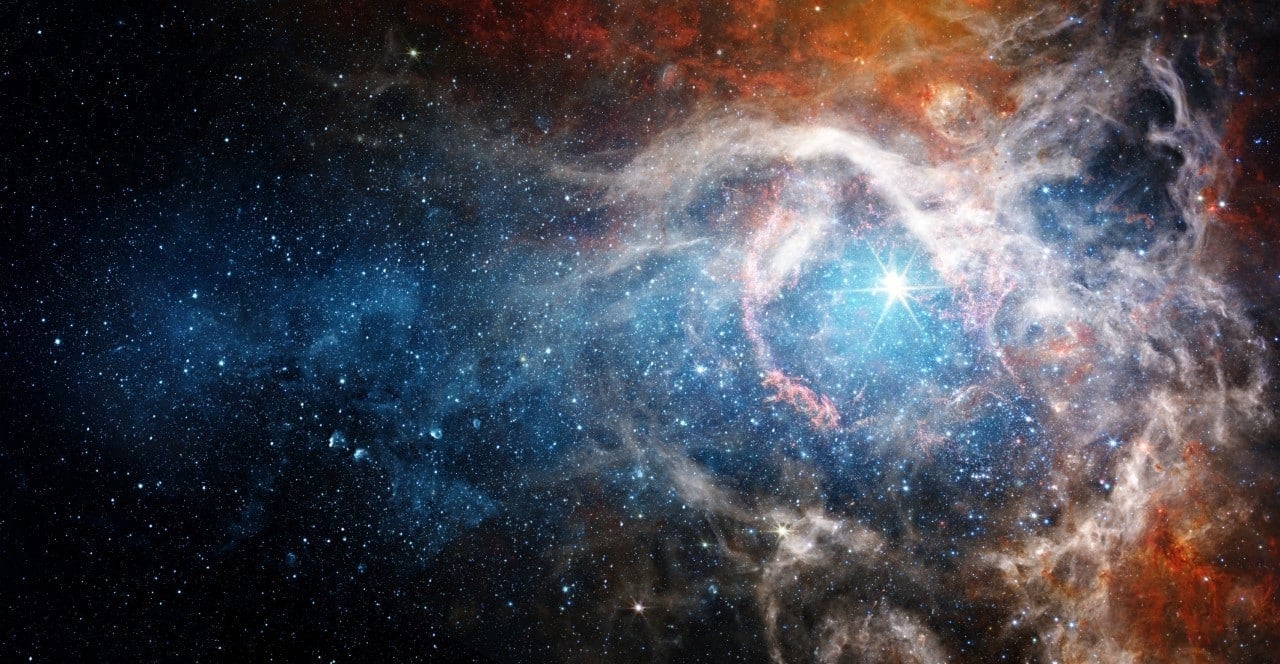
Astronomical exploration has reached a new level of precision with the integration of data captured by state-of-the-art terrestrial and space observatories. Advanced Equipamentos, led by James Webb Space Telescope (JWST) and Hubble, can now record everything from the atmospheric complexity of neighboring planets to the remaining light from the beginnings of cosmic formation. Essa technological capability allows scientists to visualize the organization of matter on multiple scales, revealing a universal architecture that connects Terra’s immediate environment to the boundaries of observable space.
The conventional limit of outer space, established just over 100 kilometers from the surface, marks the beginning of a vast frontier of observation. From Estação Espacial Internacional, it is possible to monitor local phenomena and planetary conjunctions, such as the alignments between Vênus and Júpiter, free from optical distortions caused by the Earth’s atmosphere. Essas Initial images show our planet’s air shell as a semitransparent film, serving as a prelude to the vast distances that extend beyond low orbit.
Significant advances in instrumentation now allow the detailed study of the solar corona, especially during total eclipses, and the detailed analysis of the gas giants that orbit Sol. JWST, operating primarily in the infrared spectrum, has delivered calibrated portraits of Júpiter, Saturno, Urano, and Netuno to the scientific community. Esses records not only capture the aesthetic beauty of these worlds, but highlight with unprecedented clarity the dynamics of their rings, the violence of their storms and the composition of their moons, providing crucial data for understanding planetary formation.
Solar System and Neighborhood Perspectives
The solar system, our immediate cosmic address, is home to a diversity of celestial bodies that orbit the central star, ranging from rocky planets to distant comets. Modern logarithmic representations of astronomical distances illustrate the vastness that separates the inner planets from the Oort cloud and trans-Neptunian objects. Essa local scale is fundamental to understanding the position of Terra in relation to its neighbors and the gravitational protection exerted by the large bodies in the system.
The most recent observations have revealed that the atmospheric complexity of gas giants is much greater than imagined in past decades. Subtle Variações in ring systems and the chemical composition of cloud tops indicate active dynamical processes. Além Furthermore, the planetary census suggests an immense variety of sizes, with bodies ranging from dimensions greater than those of Júpiter to small worlds less than a thousand kilometers in diameter, each with unique geological histories.
Stellar structures in Via Láctea
Our galaxy, Via Láctea, functions as a vast astrophysics laboratory, containing hundreds of billions of stars organized in majestic spiral arms. Regiões of active star formation, known as stellar nurseries, are priority targets for telescopes. Iconic Áreas nebulae, such as the Ômega, Águia, and Sharpless 2-54, feature dense clouds of gas and dust where new stars are continually being forged, illuminating the interstellar medium with intense radiation.
Both observatories situated on high mountains and orbiting telescopes capture panoramic views that reveal thousands of stars, many invisible to the human eye. The concentration of objects increases dramatically towards the galactic center, where the density of matter is greatest. Embora most stars remain hidden due to distance or reduced brightness, mapping these central regions helps to understand the chemical and dynamic evolution of our cosmic island.
The Grupo Local and distant clusters
Beyond the limits of Via Láctea, the universe is organized into hierarchical structures, starting with Grupo Local. The Este group brings together more than a hundred galaxies, being gravitationally dominated by our galaxy and Andrômeda. Andrômeda, which surpasses Via Láctea in physical extent, is accompanied by other important structures, such as the Triângulo galaxy and the Grande Nuvem of Magalhães. Esta last stands out in the night sky of the southern hemisphere as the outer galactic object with the greatest angular extent, located 165 thousand light years away.
Moving to larger scales, we find the Virgo cluster, located about 55 million light years away. Esta region represents the greatest concentration of mass in our broad cosmic neighborhood, containing approximately one thousand large galaxies. Muitas of these are giant ellipticals, “retired” in terms of star formation, but rich in evolutionary history. Cadeias of galaxies, like that of Markarian, align within this cluster, demonstrating the influence of gravity on large-scale organization.
- Gas giants: Infrared reveals atmospheric details and complex ring systems in Júpiter and Saturno.
- Active nebulae: Nuvens of dust and gas in Via Láctea act as continuous factories of new stars.
- Virgo cluster: Concentração massive elliptical galaxies 55 million light years away.
- Relativistic jets: The quasar Porphyrion emits jets of plasma that cross 23 million light years.
- Cosmic web: Dark matter forms the invisible infrastructure that connects the observable universe.
High energy phenomena and black holes
At the hearts of many massive galaxies, supermassive black holes play a crucial role in the evolution of the cosmos. Quando active, these objects devour matter and expel jets of plasma at speeds close to that of light. A striking example is the quasar Porphyrion, whose jets extend 23 million light years. Essa colossal structure is hundreds of times the diameter of Via Láctea, demonstrating how a compact object can influence the intergalactic medium on macroscopic scales.
Direct observation of these phenomena was revolutionized by Event Horizon Telescope, which captured an image of the black hole in Messier 87. The data confirmed the existence of a persistent photon ring and validated general relativity’s predictions about the event horizon. Esses jets and radio emissions are the largest continuous structures known in the current universe, shaping the environment around them and preventing or encouraging the formation of stars in neighboring galaxies.
The cosmic web and the ends of the universe
The large-scale structure of the universe resembles a cosmic web, composed of filaments, walls and large voids. Recent Mapas generated by JWST traced the distribution of dark matter with greater precision than Hubble, revealing the invisible skeleton that supports baryonic matter. Essa network connects clusters of galaxies over time, although the accelerating expansion of the universe, driven by dark energy, tends to separate superclusters and filaments that are not gravitationally bound.
In the voids of this web, solitary galaxies like MCG+01-02-015 exist in splendid isolation, separated from any neighbors by more than a hundred million light-years. Essas field galaxies preserve ancient features and maintain moderate star formation, as they have undergone few interactions or mergers over billions of years. Elas serve as time capsules, offering glimpses of how galaxies evolve without the disruptive influence of dense environments.
At the extreme limit of observation, light travels for eons before reaching our sensors. The galaxy MoM-z14, confirmed as the most distant object known, lies at a moving distance of approximately 33.8 billion light years. Sua light was emitted when the universe was just 282 million years old. More remote Ainda is the afterglow of Big Bang, the cosmic microwave background, which draws the map of the infant universe 46 billion light years away, refined by missions like Planck.
