

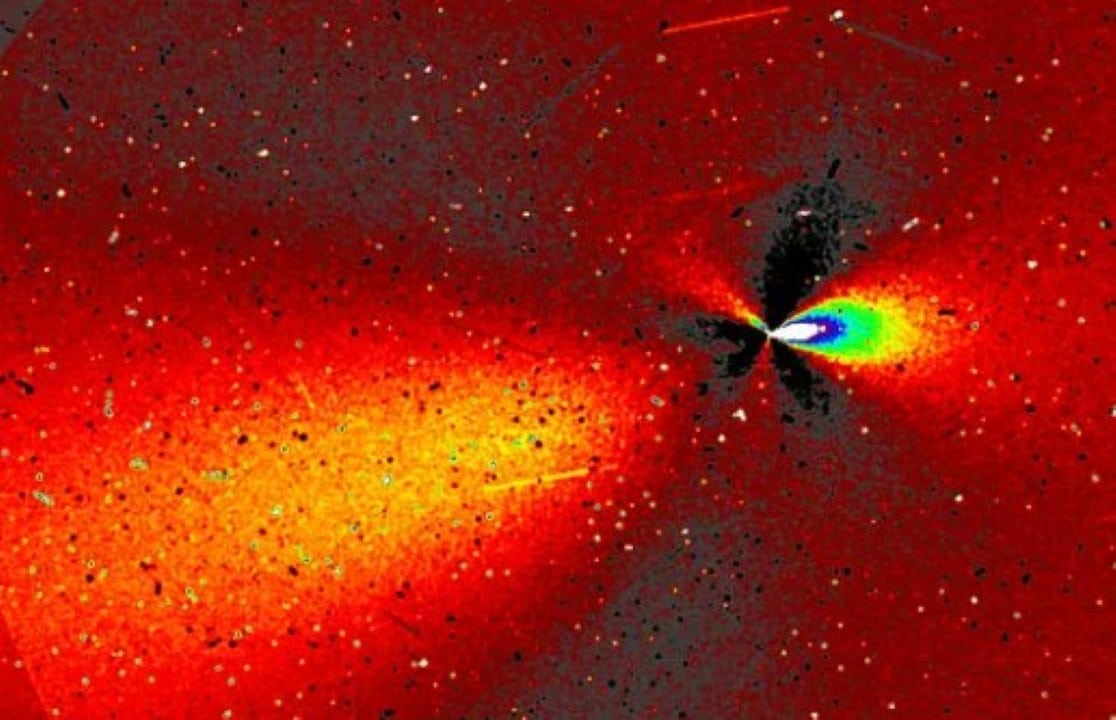
The global scientific community turns its attention to an enigma that defies the conventional laws of astrophysics observed to date. The interstellar object identified as 3I/ATLAS has become the center of intense debate due to features that do not perfectly align with known natural comet models. The focal point of this investigation lies in an “anti-tail” jet projecting toward Sol, a phenomenon that, depending on the composition and extent of gases present, could rewrite what we know about visitors from other star systems.
Researchers are focused on determining the exact distance that the gases expelled by the object can travel before being dissipated. The central hypothesis suggests that, if the gaseous presence is confirmed beyond a specific barrier away from the nucleus, the classification of 3I/ATLAS as a natural celestial body could be discarded. Esse scenario would open space for more audacious theories, including the possibility of the object possessing some type of technological propulsion, which would radically change human understanding of life and technology in the universe.

The complexity of the analysis lies in differentiating the behavior of ejected materials. Enquanto cosmic dust follows predictable patterns under the influence of solar radiation, the gas interacts differently with the space environment. Essa discrepancy is the key to unraveling the true nature of the object, requiring absolute precision in the data collected by the most advanced observatories on the planet and in space.
Detailed study of 3I/ATLAS emissions is not just a matter of astronomical classification, but a fundamental test of current detection tools. Confirmation of anomalies in the structure of the tail and anti-tail jet requires a review of calculations on mass density and interaction with the solar wind. Cada new data obtained works like a piece in a puzzle that could reveal the first concrete evidence of non-human technology crossing our solar system.
Distinct dynamics between dust and gas
To understand the uniqueness of 3I/ATLAS, it is essential to distinguish how different materials react to the forces of space. The dust particles ejected by the object are driven mainly by solar radiation pressure. Esse mechanism allows dust to reach considerable speeds and spread over hundreds of thousands of kilometers, creating the visible tails we traditionally associate with comets. Previous Observações have documented this behavior, which aligns with Newtonian physics applied to celestial bodies.
In contrast, the ejected gas faces a much more robust obstacle: the solar wind. Este continuous flow of charged particles, emanated by Sol, acts as a physical barrier that exerts pressure against the expansion of the gas. In a natural comet scenario, this force should drastically limit the dispersion of gaseous molecules, preventing them from following the dust over long distances in the Sol direction. The interaction between the object’s gas flow and the solar wind is therefore the critical parameter for validating current theories.
The physical limit of 5 thousand kilometers
Recent astrophysical calculations have established a crucial theoretical limit for the 3I/ATLAS investigation. If the object is, in fact, a natural comet governed by the laws of ice sublimation, the gas present in its anti-tail jet should not exceed the mark of 5 thousand kilometers away from the nucleus. Esse number is not random; it results from the balance of forces between the propulsion pressure of the expelled gas and the resistance imposed by the solar wind, whose density maintains consistency in the observed region.
Several technical factors support this limit estimate:
- The object’s mass loss rate is estimated to be about 500 kg/s after it passes through perihelion.
- The gas exit velocity is limited to approximately 0.2 km/s, consistent with the sublimation of carbon dioxide (CO2) at 200 Kelvin.
- The mass density of the gas decreases inversely with the square of the distance, making it vulnerable to dispersal by the solar wind.
- The radius of 5 thousand kilometers coincides with the bright halo, or coma, observed in the images captured by the Hubble telescope.
If future observations detect gas beyond this 5,000-kilometer boundary, the natural comet theory will suffer a severe blow. The physics of the solar system dictate that the solar wind should “sweep” any gas away from the Sol, directing it toward the main tail. The persistence of gas in an extended anti-tail jet would be a physical anomaly unexplained by passive sublimation models, suggesting that an additional force is pushing this material against the solar flow.
Technological propulsion hypotheses
The possibility that 3I/ATLAS is not a natural body gains strength as artificial propulsion mechanisms are considered. If the gas is detected at distances much greater than the limit of 5,000 kilometers, scientists will have to consider that the object may be using an active thrust system. Essa theory proposes that material ejection is not a passive byproduct of solar heat, but a controlled exhaust for maneuvering or acceleration.
Theoretical models have already established clear markers to identify the type of technology that could be in use, based on the exhaust velocity and range of the gas. If the object is using conventional chemical propellants, with exhaust velocities around 5 km/s, the gas trails could be detected up to 25 thousand kilometers from the nucleus. Essa distance is five times greater than the natural limit allowed for a comet, representing a statistical deviation impossible to ignore.
On the other hand, the hypothesis of an even more advanced technology, such as ion thrusters, would drastically expand these limits. With ejection speeds approaching 90 km/s, typical of high-efficiency ion engines, the gas could be projected to distances of up to 100,000 kilometers in the direction of the anti-tail jet. Detection of material at this distance would be the strongest evidence yet of an artificial origin, requiring immediate validation through spectroscopic analysis to identify molecular signatures that do not occur naturally under these conditions.
Verification methodology and observatories
To confirm or disprove these extraordinary hypotheses, modern astronomy depends on high-precision observation techniques. The primary method involves tracking specific molecular tracers, such as carbon monoxide (CO) and carbon dioxide (CO2), along the axis of the anti-tail jet. By measuring the spatial profile of these gases and comparing it with the sunlight reflected by the dust, scientists can map the true extent of the gaseous cloud and see if it violates the critical limit of 5,000 kilometers.
The global observation infrastructure is being mobilized for this task. On the ground, large telescopes such as the Keck, the VLT (Very Large Telescope) and the ALMA (Atacama Large Millimeter/submillimeter The high resolution of these instruments makes it possible to distinguish between the diffuse glow of the coma and the linear structure of a directed jet.
Simultaneously, space observatories play a vital role in eliminating interference from the Earth’s atmosphere. The James Webb space telescope and the upcoming SPHEREx offer detection capabilities at infrared wavelengths that are ideal for identifying thermal and molecular signatures of gases in a vacuum. The combination of ground and space data will provide definitive proof of the nature of 3I/ATLAS, whether reaffirming our knowledge of comets or ushering in a new era in the search for extraterrestrial intelligence.