

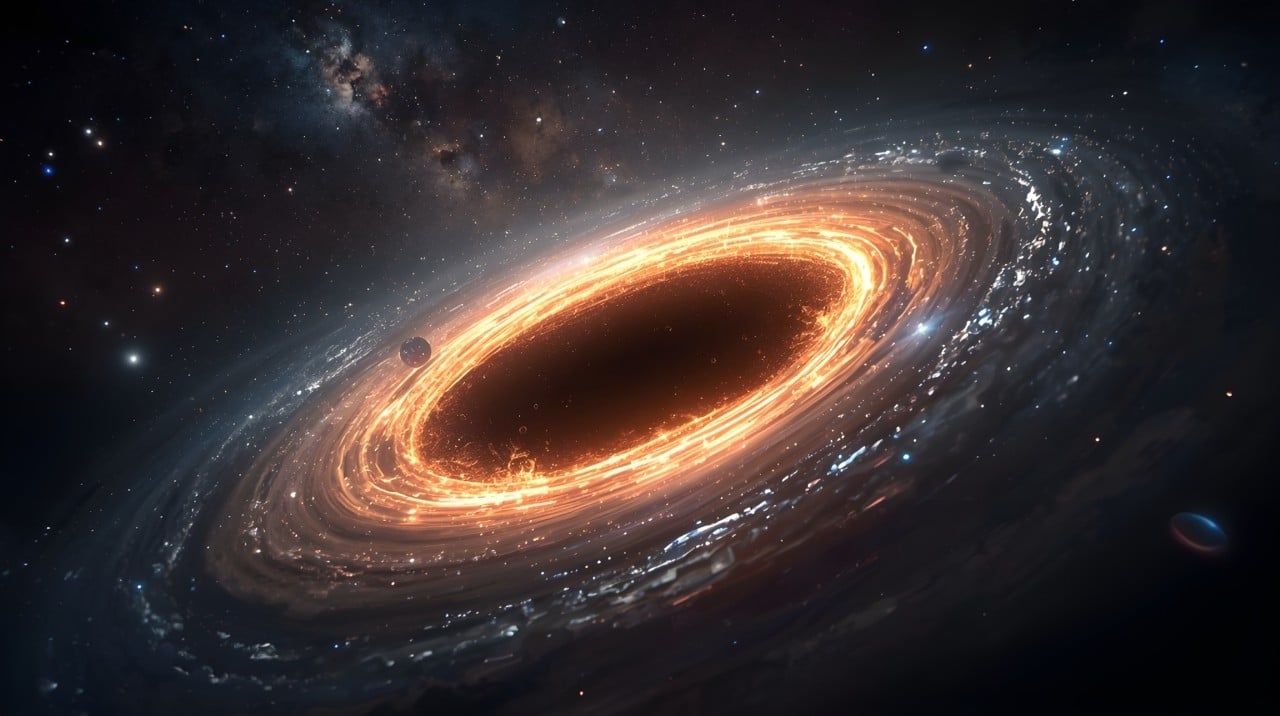
A recent astronomical discovery challenges traditional understanding about the death of massive stars in the cosmic neighborhood of Terra. Observações details indicate that a yellow supergiant, located in the Andrômeda galaxy, ended its life cycle by transforming directly into a black hole, bypassing the explosive supernova phase. The phenomenon, captured by high-precision instruments, reveals a silent and rare gravitational collapse process 2.5 million light years away.
Astronomers monitored the object identified as M31-2014-DS1, which progressively disappeared between 2014 and 2022. Diferente of the cataclysmic events that usually illuminate entire galaxies, this star had its luminosity drastically reduced, leaving only a fraction of its original brightness. The joint data analysis indicates that gravity overcame the internal pressure forces, directly collapsing the stellar core.

Advanced Instrumentos, such as Telescópio Espacial James Webb (JWST) and Observatório Chandra, were fundamental in unraveling the nature of this event in 2024. The absence of X-ray emissions and the detection of specific infrared signatures confirmed that there was not the typical explosion expected for a star of this magnitude.
Chemical traces and structure of the remnant
Observations carried out in the mid-infrared spectrum revealed a reddish-colored source in the exact position where the star used to shine. Spectroscopic analysis detected the presence of cold dust and complex molecules such as sulfur dioxide and water, indicating that part of the star’s outer envelope was gently ejected before or during the final collapse.
The remaining material formed a peculiar structure around the newborn black hole. Dados technicians point out specific characteristics of this circumstellar environment:
- Presence of molecular gas expanding at speeds close to 100 km/s in the internal region.
- Formation of a dust shell with dimensions comparable to the size of our Sistema Solar.
- Reduction in source luminosity to approximately 7% of the parent star’s brightness.
- Detection of absorption of molecules such as CO and CO2 in ejected material.
The star’s original mass, estimated to be between 12 and 13 times the mass of Sol, suffered a significant reduction during the process. The resulting compact object retains about five solar masses, while the rest of the material has been expelled or remains in an energy-efficient accretion disk, which explains the lack of intense radiation.
Implications for stellar evolution
Este event, classified as a “failed supernova”, provides crucial evidence for theoretical models that predict that not all massive stars end in visible explosions. The physics involved suggest that, in certain mass ranges, gravity prevents the reversal of the internal shock that would cause the explosion, forcing matter to fall directly onto the nucleus.
Confirmation of this mechanism in the Andrômeda galaxy validates hypotheses about the silent formation of black holes. Estimativas Scientific research suggests that up to 30% of massive star collapses could occur this way, which would significantly alter the census of compact objects in the universe.
High energy monitoring and absence
The validation of the phenomenon also depended on what was not seen. Observatório Chandra X-rays scanned the region for high-energy emissions common in black holes that voraciously devour matter. The non-detection of any source of X-rays reinforces the theory that the accretion of material by the new black hole is minimal and occurs discreetly.
Continuous monitoring of the region will allow scientists to follow the evolution of the light curve and the dispersion of dust. The relative proximity of Andrômeda provides an ideal natural laboratory for studying these long-lasting “fallback” events, helping to refine understanding of how stellar remnants populate the galaxies of Grupo Local.