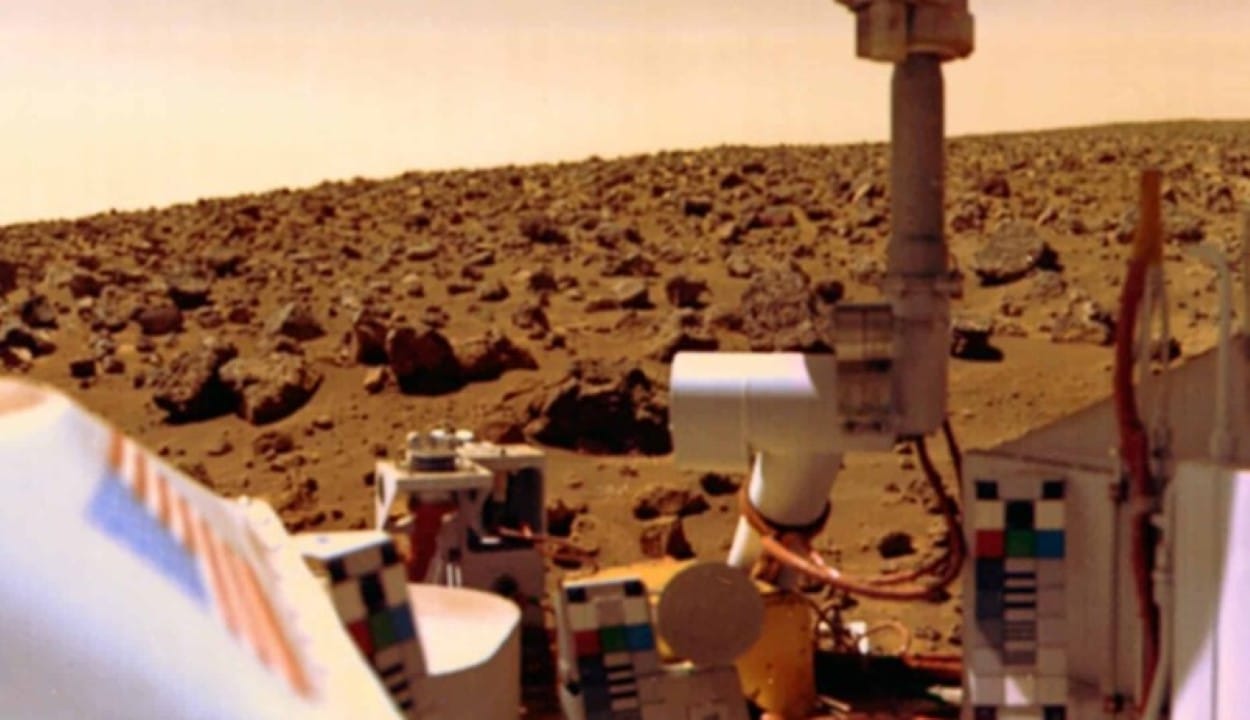
The search for definitive answers about the existence of microorganisms in Planeta Vermelho may have had premature and unrecognized success exactly 50 years ago. Novas interpretations of chemical data suggest that the instruments on the probes sent to the Martian soil detected organic matter, but the analysis protocols ended up incinerating the samples before confirmation. The scenario points to a technical mistake caused by the lack of knowledge of the exact composition of the soil at the time.
The central element of this scientific turnaround is perchlorate, a salt that is highly oxidizing and flammable when subjected to high temperatures. In the 1970s, the space agency was unaware of the prevalence of this compound on the surface of its planetary neighbor.
ANNIVERSARY OF THIS HISTORIC PHOTO!!
On May 18, 1979, the lander of the Viking 2 mission, which, together with its twin Viking 1, was sent by@NASAto search for life on Marte captured this image of water ice on the surface of Utopia Planitia.pic.twitter.com/LXY5JMzr2h
—Sacani (Space Today) – AKA Gordão Foguetes (@SpaceToday1)May 19, 2024
By carrying out standard soil heating tests to release analyzable gases, the equipment would have inadvertently created a chemical furnace, destroying any biological traces that might exist.
The decisive role of perchlorate in analyzes
Understanding Martian chemistry changed dramatically after the Phoenix mission in 2008, which identified perchlorate in abundance in the regolith. Esse data was the missing piece to reevaluate the results obtained by probes Viking 1 and 2. The gas chromatograph-mass spectrometer (GC-MS) used at the time heated the samples to high temperatures, aiming to vaporize organic compounds for identification.
- Martian soil contained perchlorate, unknown to scientists in 1976.
- Heating the samples activated the oxidizing property of the salt.
- The resulting chemical reaction incinerated any organic matter present.
- The instruments only detected carbon dioxide and residual chlorides.
The presence of chloromethane and dichloromethane in the original results was, for decades, attributed to terrestrial contamination brought by the ships themselves. However, modern laboratory experiments, simulating the conditions of Marte with the presence of perchlorate, reproduced exactly the same gases. Isso indicates that the organic molecules were native to the planet and were degraded by the search method itself.
Biological models and persistence of positive signals
The debate gains new contours with the introduction of the BARSOOM model, proposed by the chemist Steve Benner. The theory suggests the existence of autotrophic bacteria capable of breathing stored oxygen, adapted to the arid and oxidizing conditions of the current surface. Segundo this hypothesis, organisms would have mechanisms to survive in protected niches, being compatible with data that were previously considered inconclusive or negative.
This view aligns with the historical advocacy of Gil Levin, principal investigator of one of Viking’s biological experiments, the Liberação test of Marcador. Levin maintained until the end of his life that the positive metabolism results detected in 1976 were genuine. The perchlorate explanation resolves the contradiction between the positive sign of metabolism and the supposed absence of organic bodies, validating the possibility that life was detected and then destroyed by the neighboring instrument.
Impact on modern missions and sample collection
Lessons learned from past misinterpretations have fundamentally shaped the architecture of current missions, like that of the Perseverance rover. The contemporary strategy has abandoned in situ destructive thermal analysis as the primary method for detecting life. Instead, the focus has shifted to collecting and airtight storage of promising rocks and sediments.
The objective now is to return these samples to Terra, where laboratories equipped with superior technology and free from the energy limitations of a space probe will be able to perform cold analyses. Esse method will preserve complex molecular structures that would be lost in aggressive field testing, ensuring that if biosignatures exist, they will not be mistaken for abiotic chemical reactions.
