A rare annular solar eclipse, popularly known as the “ring of fire”, captivated the attention of astronomers and astronomy enthusiasts on February 16, 2026. The phenomenon occurs when Lua is positioned directly between Terra and Sol, but its orbital distance prevents full coverage of the solar disk, resulting in a bright rim of sunlight visible around the dark lunar silhouette. Este celestial spectacle, which marks the first eclipse of the year, was enjoyed by a very restricted portion of the global population.
The visibility of the “ring of fire” was privileged in a narrow band of Antártida, offering a unique panorama for scientists and the few observers present on the icy continent. Além of annular totality, a partial eclipse could be seen in other parts of Antártida, as well as in extensions of África and América of Sul.
Annular solar eclipses are events that occur every one or two years, but their full observation is often limited to geographically isolated areas. Para many, the only way to witness this phenomenon is through live broadcasts.
The “ring of fire” mechanism
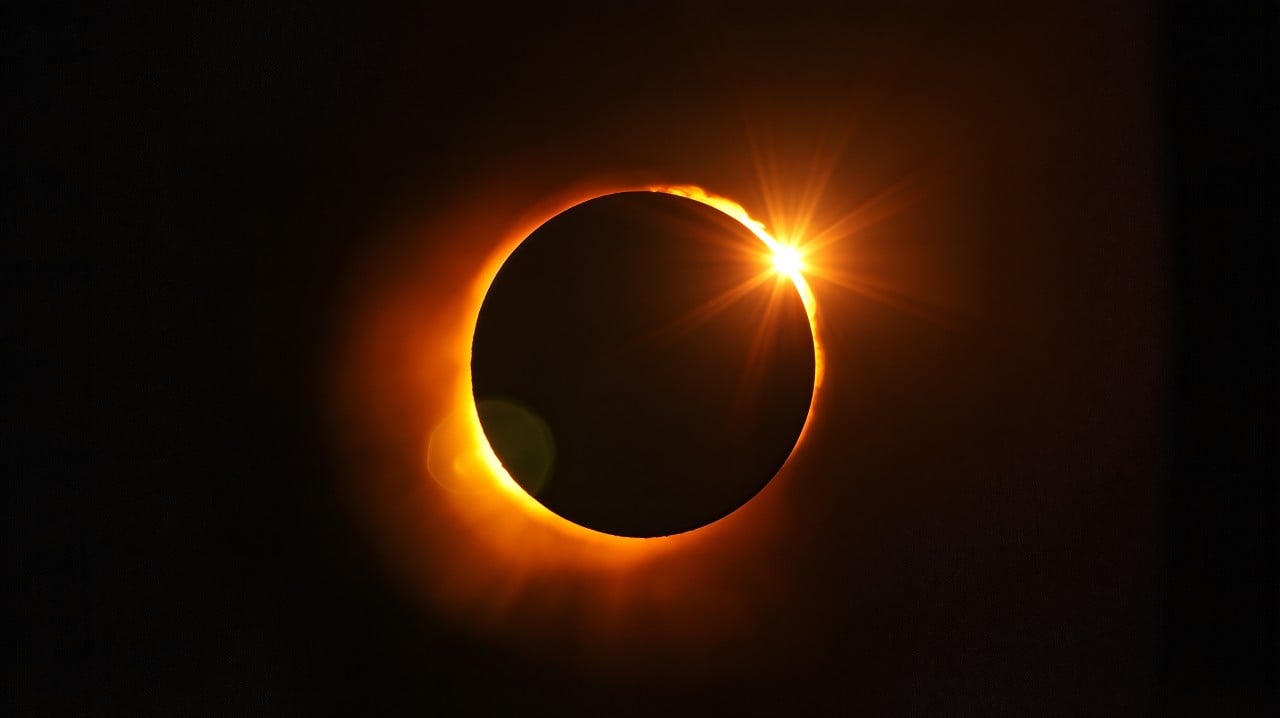
The annular solar eclipse is characterized by a peculiar alignment between the Lua, the Terra and the Sol. Diferente of a total eclipse, Lua cannot completely cover the solar disk, as it is at a more distant point in its orbit, creating a luminous halo that resembles a “ring of fire”.
When Lua completely covers Sol, there is a total eclipse. Já a partial solar eclipse occurs when Lua passes between Sol and Terra, but the three celestial bodies are not perfectly aligned, and only a portion of Sol is obscured, as experts explain.
Restricted visibility at Antártida
The best opportunity to observe the “ring of fire” in its entirety was concentrated in a restricted range over Antártida. Além from the epicenter, the event provided a partial eclipse in other areas of the ice continent and in portions of África and América of Sul, with direct observation being a privilege for few. The rarity of witnessing an eclipse like this is due to the geometry, which requires the observer to be exactly in the narrow band of annularity to have the complete view. The annular eclipse was most impressive at Estação Concordia, at Antártida, starting at 6:48 pm local time and reaching its peak at 7:47 pm local time.
Upcoming annular eclipses and seasons
Astronomers point out that annular solar eclipses happen every two years. Contudo, the rarity lies in the location of the visibility range, which often passes through uninhabited or difficult-to-access regions, limiting the experience to a privileged few. The next annular eclipse is scheduled for February 6, 2027, with visibility in large areas of América, Sul and África.
Eclipses often occur in pairs, and occasionally in trios, in periods that astronomers call “eclipse seasons.” A solar eclipse is invariably preceded or followed by a lunar eclipse at an interval of approximately two weeks. The February 16, 2026 phenomenon was the first eclipse of the season, being followed by a total lunar eclipse scheduled for March 3.
Guidelines for safe observation
During an annular or partial solar eclipse, it is crucial to take strict safety measures to protect your vision. Especialistas reiterate that it is never safe to look directly at Sol without certified eye protection, as intense solar radiation can cause permanent damage to the retina. Óculos of common sun shades, even those with a darker shade, are insufficient and do not offer the necessary barrier against harmful sun rays.
The difference between partial and annular eclipses in relation to total eclipses lies in the fact that there is no time when Lua completely covers the bright face of Sol. Consequentemente, adequate eye protection is always essential at any stage of these phenomena to avoid eye injuries.
Building a pinhole projector
Para For those who do not have certified eclipse glasses, making a simple hole projector is a viable and safe alternative. To create it, simply make a small hole in a piece of cardboard, using it to observe the event indirectly.
With your back to Sol, hold the cardboard so that sunlight shines through the hole. Isso will project an image of Sol onto a flat surface behind the cardboard.
This way, it is possible to observe the shape of the “ring of fire” projected right there, enjoying the phenomenon indirectly and completely safely.
2026 astronomical calendar: alignments and moons
The year 2026 appears to be exceptionally rich in astronomical phenomena, in addition to the recent annular eclipse. Ainda in February, on the 28th, the night sky will provide a rare spectacle: a parade of six aligned planets.
Mercury, Vênus, Saturno and Júpiter can be seen with the naked eye, depending on weather conditions and the absence of light pollution. Já To observe Urano and Netuno, the aid of binoculars or a telescope will be necessary for a detailed view.
On March 3, a total lunar eclipse, known as “Lua of Sangue” due to the reddish color that the Moon acquires, will be visible in large parts of Ásia, Austrália, Este represents the last such event visible in América from Norte until 2028.
In addition, the year holds a series of meteor showers, with peaks of activity distributed throughout the months, offering additional luminous spectacles for astronomy enthusiasts in different regions of the globe.
The meteor showers that will light up 2026
The meteor shower calendar for 2026 is full of fascinating events for skywatchers. The first to reach the peak will be the Líridas, between April 21st and 22nd, followed by the Eta Aquáridas, from the 5th to the 6th of May, which promise a light show. In July, two rains will share the skies: Aquáridas, Delta, Sul and Alfa Capricornídeos, both peaking between the 30th and 31st, providing a double observation opportunity.
August will bring the renowned Perseidas, with its peak between the 12th and 13th, always one of the most anticipated events of the year. Outubro will be marked by the Orionídeos, with the peak between the 21st and 22nd, while November will feature a sequence of Taurídeos from the Sul (4 to 5), Taurídeos from the Norte (11 to 12) and the
To close the year, December reserves the Geminídeos, between the 13th and 14th, known for their intensity, and finally the Ursídeos, on the 21st and 22nd, closing the cycle of celestial spectacles with a flourish. Cada one of these showers offers a unique observation experience, encouraging the search for dark, clear skies.
Understanding the visual experience
When witnessing an annular solar eclipse, the observer will initially notice Lua moving slowly in front of Sol, characterizing a partial eclipse. Conforme coverage increases to around 80%, shadows on the ground start to become sharper and lose their fuzzy edges, ambient light decreases and shadows start to appear curved, giving the impression that “something is biting Sol”. At the maximum point, called annularity, the Lua is directly in front of the Sol, leaving an impressive ring of light.
