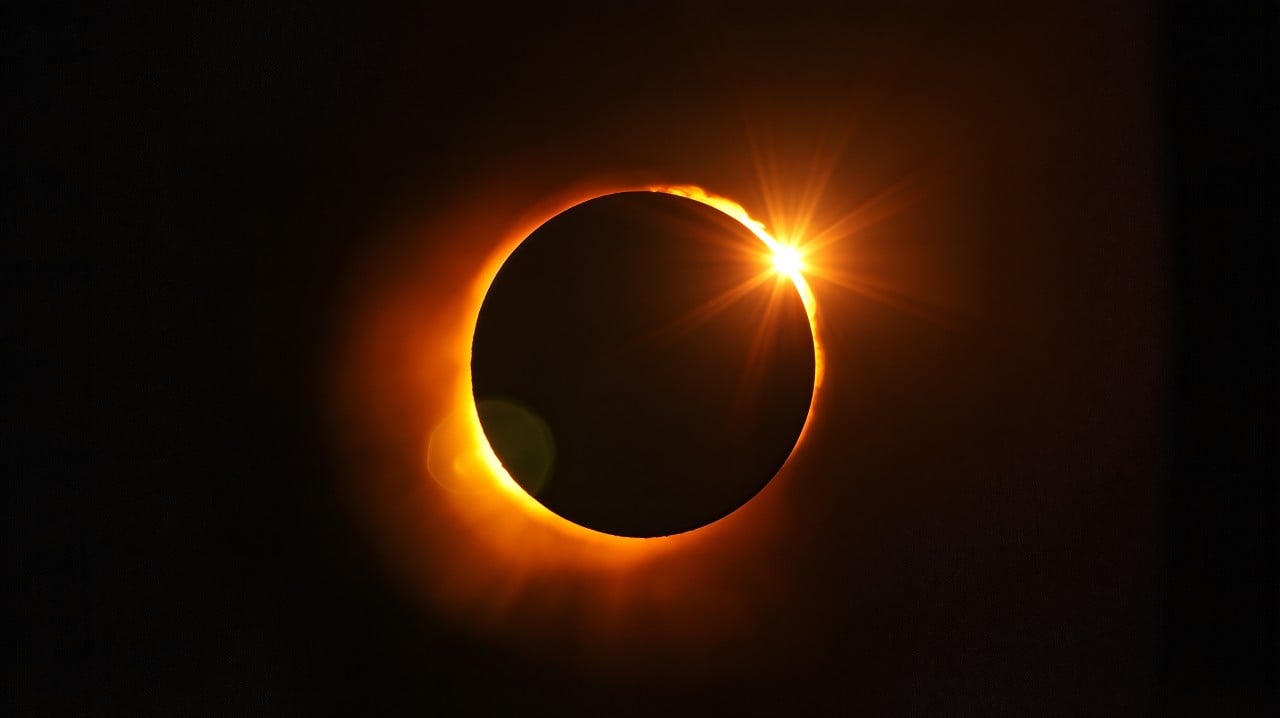
The sky in the extreme south of the planet features a unique orbital alignment this Tuesday, February 17th. Lua is positioned directly between Terra and Sol, but due to the specific distance in its orbit, it cannot completely cover the star’s disk, resulting in the visually striking phenomenon known as the ring of fire. The lunar silhouette, surrounded by a luminous solar rim, marks the first major astronomical event of this annual cycle and attracts the attention of scientists and observers in remote regions.
This phenomenon occurs because the natural satellite reaches a point in its elliptical trajectory called apogee, the moment at which it is furthest from the Earth’s surface. Essa additional distance makes the apparent diameter of Lua insufficient to block all sunlight, differentiating the event from a total eclipse, where day momentarily turns into night. The precise celestial mechanics of this alignment create a bright frame around the lunar sphere, visible only in a narrow geographic range.

The event’s maximum visibility is concentrated almost exclusively on the Antarctic continent, where the central shadow, or antumbra, touches the Earth’s surface. Estações of research and scientific bases located in this privileged area have the ideal conditions to record the complete annulment, which has an estimated duration of up to two minutes and twenty seconds at its point of greatest centrality. The geographic isolation of the region makes in-person observation restricted to researchers and specialized expeditions operating in the location.
Although the ring of fire is exclusive to Antártida, partial visibility extends to other areas of the Southern Hemisphere. Habitantes of southern regions of África and América of Sul, including parts of Chile and However, Brazilian territory is not included in the visibility zone of this specific event, remaining outside the twilight area projected by the alignment.
Timeline and stages of the phenomenon
The evolution of the eclipse follows strict timing based on Tempo Universal Coordenado (UTC), serving as a reference for astronomers across the globe. The beginning of the partial phase, when the edge of Lua begins to touch the solar disk, occurs in the morning, marking the beginning of the orbital transit. Este first contact is imperceptible to the naked eye without suitable equipment, but it signals alignment in progress.
The culmination of the event, the moment in which the annularity is completely formed on the Antártida, occurs in the early afternoon according to universal time. It is at this moment that the spatial geometry is completed, forming the perfect luminous circle. Após the peak, Lua continues its orbital movement, breaking the ring and returning to the partial eclipse phase until the shadow completely leaves the Earth’s surface hours later.
Observers following the phenomenon remotely or in bias areas should be aware of the specific times in their local zones. The precision of astronomical calculations makes it possible to predict every second of the transit, facilitating the planning of photographic records and the collection of scientific data at polar bases.
Safety protocols for observation
Direct observation of Sol requires strict safety precautions to avoid permanent ophthalmological damage. The ultraviolet and infrared radiation emitted by the star can burn the retina in seconds, even when part of the solar disk is covered by Lua. Especialistas reiterate that common sunglasses, x-ray plates or old photographic film do not offer the necessary protection against harmful rays.
The only safe method for direct viewing involves the use of solar filters certified to the international standard ISO 12312-2. Estes equipment blocks more than 99.9% of intense sunlight, allowing comfortable and risk-free observation. Telescópios, binoculars and cameras also require specific solar filters attached to their objective lenses; Looking through unprotected optical instruments magnifies the intensity of light and accelerates eye damage.
Indirect projection methods represent a safe and affordable alternative for those who do not have certified filters. The camera obscura technique, which projects the image of Sol through a small hole on a flat surface, allows you to follow the progress of the eclipse without looking at the sky. Esta approach is often used in educational activities to demonstrate the mechanics of the event without exposing participants to risks.
Sequence of astronomical events in the year
This Tuesday’s annular eclipse inaugurates a series of four major phenomena predicted for the 2026 astronomical calendar. The distribution of events alternates solar and lunar occultations, offering observation opportunities on different continents throughout the months. The next highlight will be a total lunar eclipse scheduled for early March, which will be visible throughout most of the Américas.
In the second semester, attention will turn to August 12th, the date of a total solar eclipse. Diferente of the Antarctic event, this phenomenon will cross inhabited regions of the northern hemisphere, including Espanha, Islândia and Groenlândia. The entirety of this future event promises to attract significant astronomical tourism to Europa, given the easy access to zones of full shadow.
The year ends astronomically with a partial lunar eclipse at the end of August, visible again at Europa, África and Américas. Esta sequence of alignments reinforces the cyclical and predictable nature of the solar system, allowing scientists and enthusiasts to prepare in advance for each opportunity for study and contemplation.
Scientific relevance and monitoring
For the scientific community, each solar eclipse offers a valuable chance to study Sol’s outer atmosphere, known as the solar corona, and refine calculations about the lunar orbit. The stations on Antártida, despite extreme weather conditions, are equipped with sensitive instruments to capture variations in radiation and temperature during annularity. Esses data helps to better understand the interactions between the solar wind and the Earth’s magnetosphere.
The event also serves to validate long-term mathematical models, such as the Saros cycles, which predict the repetition of eclipses with similar characteristics every 18 years. This week’s eclipse belongs to Saros 131, a family of eclipses that share similar orbital geometry. Continuous monitoring of these cycles is essential for the precision of space navigation and for understanding the orbital evolution of the Terra-Moon system.
Thanks to satellite communication technology, the phenomenon in remote Antártida can be followed globally. Diversos observatórios e canais de divulgação científica realizam transmissões ao vivo, democratizando o acesso a um espetáculo que, fisicamente, está restrito a uma das regiões mais inóspitas do planeta. The digital connection allows Ring of Fire to be enjoyed in real time, regardless of the viewer’s geographic location.
